Pearson Edexcel · GCSE · History
Course version: 1HI0 · Version from Sept 2016
The historic environment - 2 Knowledge, selection and use of sources for…
Full specification wording
Option 12: The historic environment - 2 Knowledge, selection and use of sources for historical enquiries: Recognition of the strengths and weaknesses of different types of source for specific enquiries.
Evaluating historical evidence requires a nuanced recognition of the strengths and weaknesses inherent in different types of sources, always judged against a specific enquiry.
Checked against the Pearson Edexcel 1HI0 specification (opens in a new tab) on .
- Point 3 of 5
- 2 key terms
Study notes
From the checked teaching notes for this specification point.
The idea
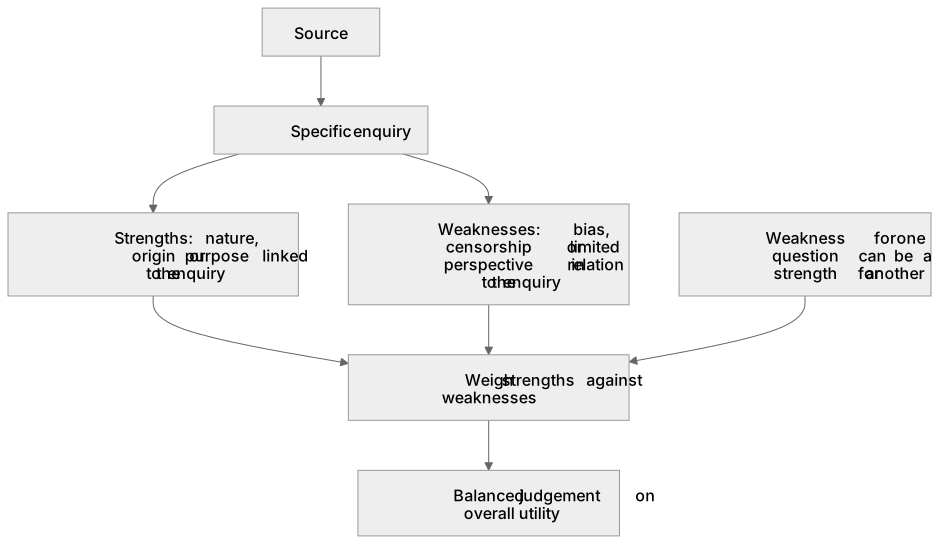
Evaluating historical evidence requires a nuanced recognition of the strengths and weaknesses inherent in different types of sources, always judged against a specific enquiry. A source is never universally 'reliable' or 'unreliable'; its utility depends entirely on the question being asked. For example, a heavily censored newspaper has weaknesses for an enquiry into the factual details of a military defeat, as facts will be obscured. However, that same newspaper possesses significant strengths for an enquiry into government propaganda and morale-management techniques.
What earns the marks
- Assess the strengths of a source by linking its nature, origin, or purpose directly to the specific enquiry.
- Identify the weaknesses of a source, such as bias, censorship, or limited perspective, in relation to the enquiry.
- Explain how a source's weakness for one historical question might be a strength for another.
- Synthesise the strengths and weaknesses to reach a balanced judgement on the source's overall utility.
Common mistakes and how to put them right
Stating a source is 'biased and therefore useless'.
Put it right: Explain how bias can actually be a strength if the enquiry is about attitudes or propaganda.
Evaluating the source in isolation.
Put it right: Evaluate the strengths and weaknesses in the context of the specific enquiry question provided.
Relying on generic statements like 'photographs cannot lie'.
Put it right: Acknowledge that photographs can be staged, cropped, or selectively framed.
Exam tips
- Always use the wording of the specific enquiry in your answer to ensure your evaluation remains focused.
- Look for the 'purpose' of the source in its provenance; this is often the key to unlocking both its strengths and weaknesses.
- Avoid generic evaluations; ensure your points about strengths and weaknesses are specific to the content and context of the source provided.
Try the lesson
The start of the Option 12: The historic environment - 2 Knowledge, selection and use of sources for historical enquiries: Recognition of the strengths and weaknesses of different types of source for specific enquiries. lesson, made from checked teaching notes for this specification point.
Have a go first
What is a common strength of using a personal diary as a historical source for a specific enquiry?
Listen
Evaluating historical evidence requires a nuanced recognition of the strengths and weaknesses inherent in different types of sources, always judged against a specific enquiry. A source is never universally 'reliable' or 'unreliable'; its utility depends entirely on the question being asked. For example, a heavily censored newspaper has weaknesses for an enquiry into the factual details of a military defeat, as facts will be obscured. However, that same newspaper possesses significant strengths for an enquiry into government propaganda and morale-management techniques. A strong answer earns marks for these points. Assess the strengths of a source by linking its nature, origin, or purpose directly to the specific enquiry. Identify the weaknesses of a source, such as bias, censorship, or limited perspective, in relation to the enquiry. Explain how a source's weakness for one historical question might be a strength for another. Synthesise the strengths and weaknesses to reach a balanced judgement on the source's overall utility. A common slip: Stating a source is 'biased and therefore useless'. Instead, explain how bias can actually be a strength if the enquiry is about attitudes or propaganda. Exam tip: Always use the wording of the specific enquiry in your answer to ensure your evaluation remains focused.
See it
Key words
Say what each word means before you turn the card.
Source utility
Try answering aloud or in your head before turning the card.
Provenance
Try answering aloud or in your head before turning the card.
See every definition
- Source utility
- The overall value of a source to the historian, determined by weighing its strengths and weaknesses against the specific enquiry.
- Provenance
- The nature, origin and purpose of a source, weighed against the specific focus of the investigation to determine its overall value.
Label the diagram
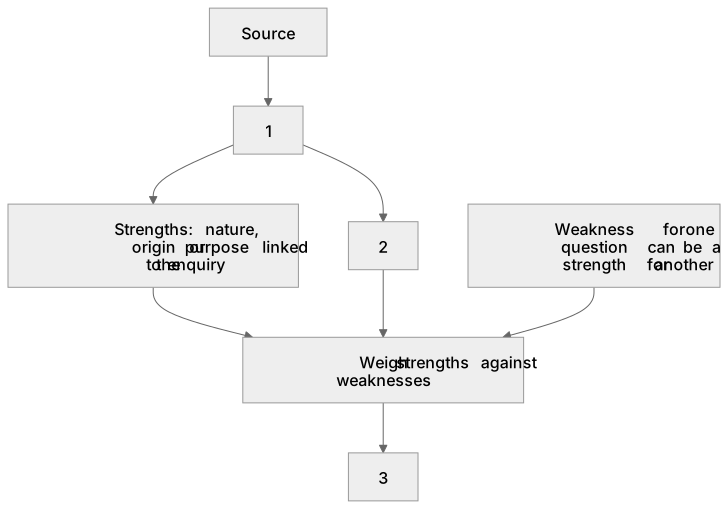
Some boxes have lost their names. Pick the right name for each number.
1Box 1
2Box 2
3Box 3
There is more to this lesson
The full lesson goes on to check your understanding and help you earn the marks. Create a free account to carry on, with your progress saved.
A week of Premium from your first lesson · Then the free plan continues · No card, no charge
Test your understanding of Option 12: The historic environment - 2 Knowledge, selection and use of sources for historical enquiries: Recognition of the strengths and weaknesses of different types of source for specific enquiries.
Active recall beats re-reading. Take an instant quiz now to test what you’ve learned and lock it into long-term memory.
A week of Premium from your first lesson · Then the free plan continues · No card, no charge