Pearson Edexcel · GCSE · History
Course version: 1HI0 · Version from Sept 2016
The historic environment - 2 Knowledge, selection and use of sources for…
Full specification wording
Option 12: The historic environment - 2 Knowledge, selection and use of sources for historical enquiries: Knowledge of local sources relevant to the period and issue, e.g. personal accounts and photographs, local newspapers, local council records.
To investigate a historic environment, historians rely on local sources to understand the lived experiences of a community.
Checked against the Pearson Edexcel 1HI0 specification (opens in a new tab) on .
- Point 1 of 5
- 2 key terms
Study notes
From the checked teaching notes for this specification point.
The idea
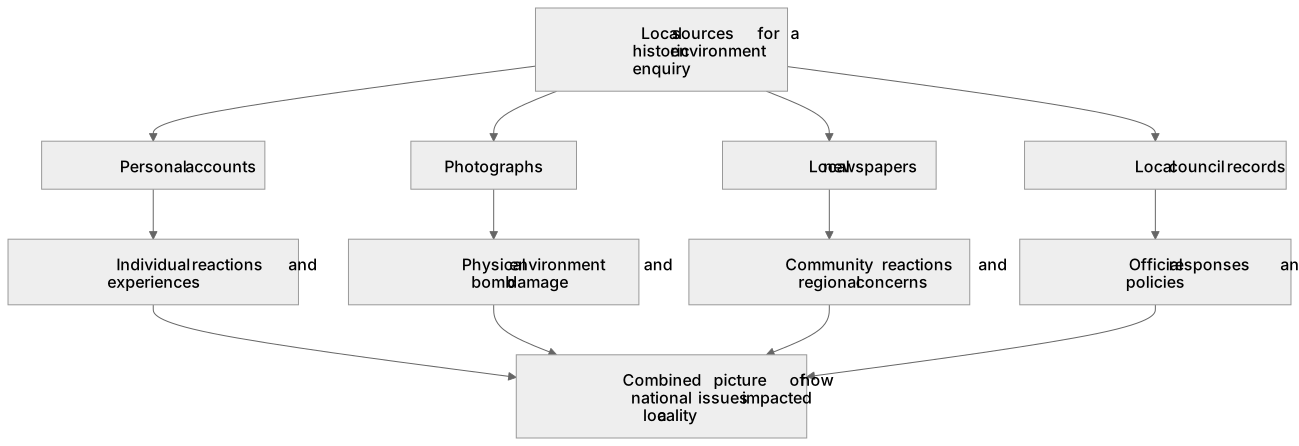
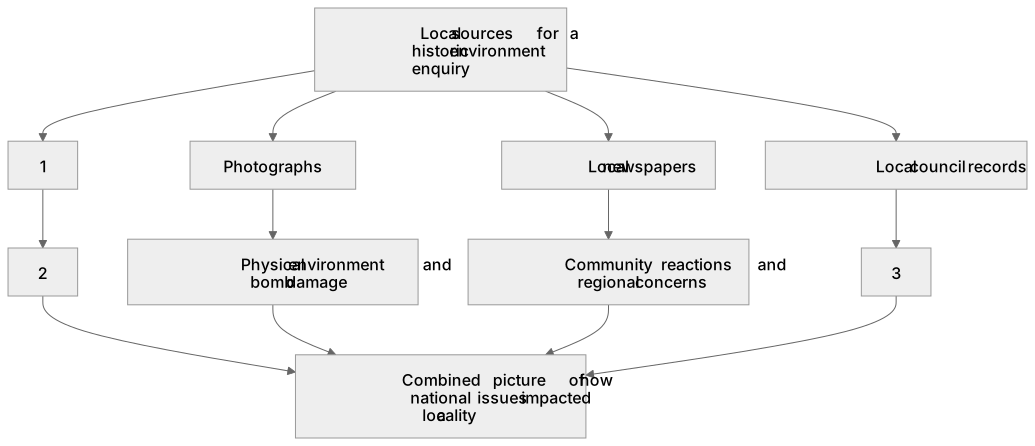
To investigate a historic environment, historians rely on local sources to understand the lived experiences of a community. Personal accounts, such as diaries, provide intimate insights into individual reactions to events, though they may be highly subjective. Photographs offer visual evidence of the physical environment or bomb damage, capturing a specific moment in time. Local newspapers are invaluable for gauging community reactions, regional concerns, and local propaganda. Meanwhile, local council records reveal official responses, such as housing policies, air raid precautions, or infrastructure planning. By combining these sources, historians can reconstruct a detailed picture of how national issues impacted a specific locality.
What earns the marks
- Identify specific types of local sources relevant to the historical enquiry.
- Explain how personal accounts and photographs provide evidence of individual experiences and physical conditions.
- Analyse local newspapers to understand community attitudes and regional reporting of events.
- Use local council records to determine official local government actions and policies.
Common mistakes and how to put them right
Treating local newspapers as entirely objective.
Put it right: Recognise that local press often reflects specific community biases or wartime censorship.
Dismissing personal accounts due to subjectivity.
Put it right: Value personal accounts precisely for their subjective insight into individual attitudes and experiences.
Confusing local council records with national government policy.
Put it right: Distinguish between local implementation (council records) and national directives.
Exam tips
- Always link the specific type of local source to the exact enquiry question being asked.
- When evaluating a photograph, consider what might have been deliberately excluded from the frame.
- Use local council records to provide concrete evidence of how national events affected everyday infrastructure.
Try the lesson
The start of the Option 12: The historic environment - 2 Knowledge, selection and use of sources for historical enquiries: Knowledge of local sources relevant to the period and issue, e.g. personal accounts and photographs, local newspapers, local council records. lesson, made from checked teaching notes for this specification point.
Have a go first
Which of the following is an example of a local source that could be used to investigate living conditions in a specific town?
Listen
To investigate a historic environment, historians rely on local sources to understand the lived experiences of a community. Personal accounts, such as diaries, provide intimate insights into individual reactions to events, though they may be highly subjective. Photographs offer visual evidence of the physical environment or bomb damage, capturing a specific moment in time. Local newspapers are invaluable for gauging community reactions, regional concerns, and local propaganda. Meanwhile, local council records reveal official responses, such as housing policies, air raid precautions, or infrastructure planning. By combining these sources, historians can reconstruct a detailed picture of how national issues impacted a specific locality. A strong answer earns marks for these points. Identify specific types of local sources relevant to the historical enquiry. Explain how personal accounts and photographs provide evidence of individual experiences and physical conditions. Analyse local newspapers to understand community attitudes and regional reporting of events. Use local council records to determine official local government actions and policies. A common slip: Treating local newspapers as entirely objective. Instead, recognise that local press often reflects specific community biases or wartime censorship. Exam tip: Always link the specific type of local source to the exact enquiry question being asked.
See it
Key words
Say what each word means before you turn the card.
Source evaluation
Try answering aloud or in your head before turning the card.
Community experience
Try answering aloud or in your head before turning the card.
See every definition
- Source evaluation
- Judging the utility of sources for a historical enquiry, recognising that personal accounts may be highly subjective and that photographs capture a specific moment in time.
- Community experience
- The lived experiences of a community, understood through local sources such as personal accounts, photographs and local newspapers.
Label the diagram
Some boxes have lost their names. Pick the right name for each number.
1Box 1
2Box 2
3Box 3
There is more to this lesson
The full lesson goes on to check your understanding and help you earn the marks. Create a free account to carry on, with your progress saved.
A week of Premium from your first lesson · Then the free plan continues · No card, no charge
Test your understanding of Option 12: The historic environment - 2 Knowledge, selection and use of sources for historical enquiries: Knowledge of local sources relevant to the period and issue, e.g. personal accounts and photographs, local newspapers, local council records.
Active recall beats re-reading. Take an instant quiz now to test what you’ve learned and lock it into long-term memory.
A week of Premium from your first lesson · Then the free plan continues · No card, no charge