Pearson Edexcel · GCSE · History
Course version: 1HI0 · Version from Sept 2016
The historic environment - 2 Knowledge, selection and use of sources for…
Full specification wording
Option 12: The historic environment - 2 Knowledge, selection and use of sources for historical enquiries: Knowledge of national sources relevant to the period and issue, e.g. government records, newspapers, Mass Observation reports, newsreels, memoirs.
National sources provide the broader context for historical enquiries, revealing country-wide policies and public moods.
Checked against the Pearson Edexcel 1HI0 specification (opens in a new tab) on .
- Point 2 of 5
Study notes
From the checked teaching notes for this specification point.
The idea
National sources provide the broader context for historical enquiries, revealing country-wide policies and public moods. Government records offer authoritative evidence of official planning and state intervention. National newspapers shape and reflect widespread public opinion, while newsreels provide curated visual broadcasts often used for morale or propaganda. Mass Observation reports are uniquely valuable, capturing the everyday habits and uncensored thoughts of ordinary citizens across the country through volunteer diaries. Finally, memoirs offer retrospective national overviews from key figures, though they are often written with the benefit of hindsight and a desire to shape the author's legacy.
What earns the marks
- Identify how government records provide evidence of national policy and official statistics.
- Explain the role of national newspapers and newsreels in shaping public morale and disseminating information.
- Assess the unique value of Mass Observation reports in capturing the authentic, everyday attitudes of the general public.
- Evaluate memoirs for their retrospective insights while accounting for the author's hindsight and personal agenda.
Common mistakes and how to put them right
Assuming government records are always completely accurate.
Put it right: Recognise that official records can be incomplete or designed to justify policy.
Treating newsreels as unfiltered reality.
Put it right: Identify newsreels as highly edited media often designed for propaganda or morale-boosting.
Confusing memoirs with diaries.
Put it right: Note that memoirs are written retrospectively with hindsight, whereas diaries are contemporary accounts.
Exam tips
- Contrast official government records with Mass Observation reports to compare state policy against public reality.
- When discussing newsreels, explicitly mention their intended audience and purpose, such as cinema-goers seeking wartime updates.
- Use the specific provenance of a memoir to evaluate its utility, considering when it was published and why.
Try the lesson
The start of the Option 12: The historic environment - 2 Knowledge, selection and use of sources for historical enquiries: Knowledge of national sources relevant to the period and issue, e.g. government records, newspapers, Mass Observation reports, newsreels, memoirs. lesson, made from checked teaching notes for this specification point.
Have a go first
Which of the following is an example of a national source that could be used to investigate public morale during a major conflict?
Listen
National sources provide the broader context for historical enquiries, revealing country-wide policies and public moods. Government records offer authoritative evidence of official planning and state intervention. National newspapers shape and reflect widespread public opinion, while newsreels provide curated visual broadcasts often used for morale or propaganda. Mass Observation reports are uniquely valuable, capturing the everyday habits and uncensored thoughts of ordinary citizens across the country through volunteer diaries. Finally, memoirs offer retrospective national overviews from key figures, though they are often written with the benefit of hindsight and a desire to shape the author's legacy. A strong answer earns marks for these points. Identify how government records provide evidence of national policy and official statistics. Explain the role of national newspapers and newsreels in shaping public morale and disseminating information. Assess the unique value of Mass Observation reports in capturing the authentic, everyday attitudes of the general public. Evaluate memoirs for their retrospective insights while accounting for the author's hindsight and personal agenda. A common slip: Assuming government records are always completely accurate. Instead, recognise that official records can be incomplete or designed to justify policy. Exam tip: Contrast official government records with Mass Observation reports to compare state policy against public reality.
See it

Label the diagram
Some boxes have lost their names. Pick the right name for each number.
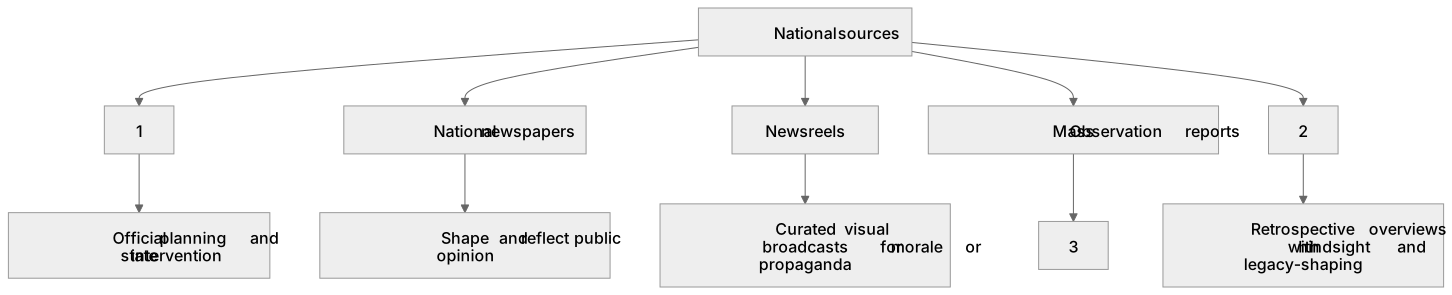
1Box 1
2Box 2
3Box 3
There is more to this lesson
The full lesson goes on to check your understanding and help you earn the marks. Create a free account to carry on, with your progress saved.
A week of Premium from your first lesson · Then the free plan continues · No card, no charge
Test your understanding of Option 12: The historic environment - 2 Knowledge, selection and use of sources for historical enquiries: Knowledge of national sources relevant to the period and issue, e.g. government records, newspapers, Mass Observation reports, newsreels, memoirs.
Active recall beats re-reading. Take an instant quiz now to test what you’ve learned and lock it into long-term memory.
A week of Premium from your first lesson · Then the free plan continues · No card, no charge