Pearson Edexcel · GCSE · History
Course version: 1HI0 · Version from Sept 2016
C1500–c1700: Migration in early modern England - 1 The context for…
Full specification wording
Option 13: c1500–c1700: Migration in early modern England - 1 The context for migration: Change and continuity in reasons for migration and patterns of settlement, including migrants from Europe and Africa.
Between 1500 and 1700, reasons for migration to England showed both change and continuity.
Checked against the Pearson Edexcel 1HI0 specification (opens in a new tab) on .
- Point 1 of 2
Study notes
From the checked teaching notes for this specification point.
The idea
Between 1500 and 1700, reasons for migration to England showed both change and continuity. Economic opportunity remained a continuous pull factor, attracting skilled European artisans like Dutch weavers. However, religious persecution emerged as a significant new push factor, driving Protestant Huguenots from France to seek asylum. Patterns of settlement evolved; while London remained a primary destination, migrants increasingly settled in regional hubs like Norwich and Canterbury. The period also saw the arrival of Africans, often via trade routes or as servants to wealthy households, establishing small but notable black communities in port cities and London, reflecting England's growing global connections.
What earns the marks
- Identify economic migration as a continuous factor, drawing skilled workers from Europe to English towns.
- Explain the emergence of religious persecution as a changing reason for migration, particularly for European Protestants.
- Describe the settlement patterns of migrants, noting the concentration in London and specific regional centres like Norwich.
- Discuss the presence and settlement of African migrants in early modern England, linking this to expanding global trade networks.
Common mistakes and how to put them right
Stating that all migrants came for religious reasons.
Put it right by emphasising that economic motives remained a constant driver.
Assuming African migrants only arrived as enslaved people.
Put it right by noting that many were free individuals working as sailors, musicians, or servants.
Believing migrants settled evenly across England.
Put it right by highlighting their concentration in London, port cities, and specific textile towns.
Exam tips
- Clearly distinguish between push factors and pull factors when explaining reasons for migration.
- Use the Huguenots as a prime example of religious refugees changing the demographic landscape.
- Mention specific locations like Canterbury or Norwich to demonstrate knowledge of regional settlement patterns.
Try the lesson
The start of the Option 13: c1500–c1700: Migration in early modern England - 1 The context for migration: Change and continuity in reasons for migration and patterns of settlement, including migrants from Europe and Africa. lesson, made from checked teaching notes for this specification point.
Have a go first
Which of the following was a major reason for the migration of French Huguenots to England during the early modern period?
Listen
Between 1500 and 1700, reasons for migration to England showed both change and continuity. Economic opportunity remained a continuous pull factor, attracting skilled European artisans like Dutch weavers. However, religious persecution emerged as a significant new push factor, driving Protestant Huguenots from France to seek asylum. Patterns of settlement evolved; while London remained a primary destination, migrants increasingly settled in regional hubs like Norwich and Canterbury. The period also saw the arrival of Africans, often via trade routes or as servants to wealthy households, establishing small but notable black communities in port cities and London, reflecting England's growing global connections. A strong answer earns marks for these points. Identify economic migration as a continuous factor, drawing skilled workers from Europe to English towns. Explain the emergence of religious persecution as a changing reason for migration, particularly for European Protestants. Describe the settlement patterns of migrants, noting the concentration in London and specific regional centres like Norwich. Discuss the presence and settlement of African migrants in early modern England, linking this to expanding global trade networks. A common slip: Stating that all migrants came for religious reasons. Instead, emphasising that economic motives remained a constant driver. Exam tip: Clearly distinguish between push factors and pull factors when explaining reasons for migration.
See it
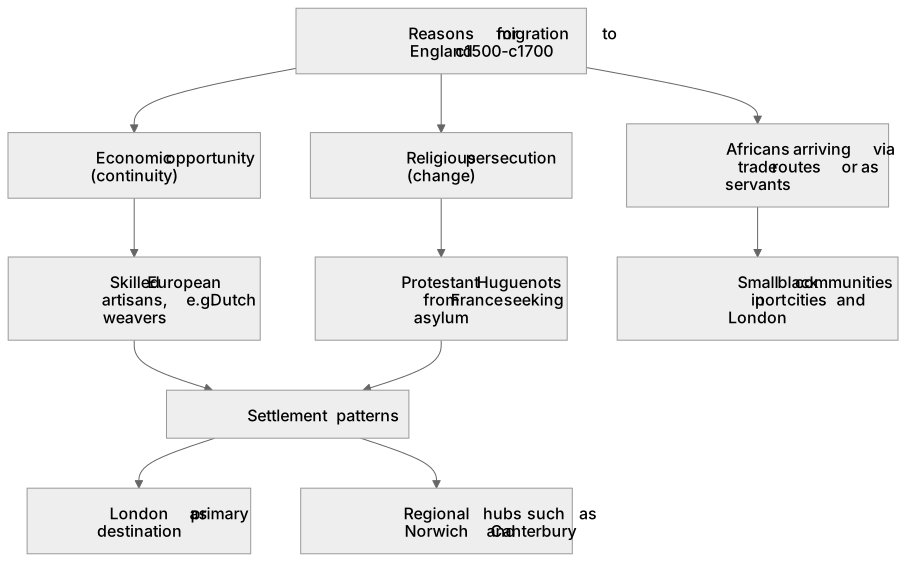
Label the diagram
Some boxes have lost their names. Pick the right name for each number.
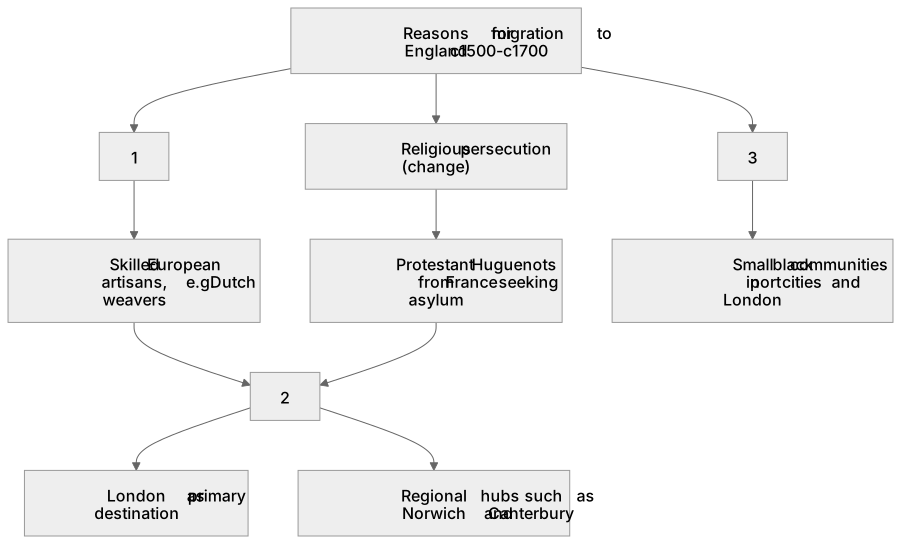
1Box 1
2Box 2
3Box 3
There is more to this lesson
The full lesson goes on to check your understanding and help you earn the marks. Create a free account to carry on, with your progress saved.
A week of Premium from your first lesson · Then the free plan continues · No card, no charge
Test your understanding of Option 13: c1500–c1700: Migration in early modern England - 1 The context for migration: Change and continuity in reasons for migration and patterns of settlement, including migrants from Europe and Africa.
Active recall beats re-reading. Take an instant quiz now to test what you’ve learned and lock it into long-term memory.
A week of Premium from your first lesson · Then the free plan continues · No card, no charge