Pearson Edexcel · GCSE · History
Course version: 1HI0 · Version from Sept 2016
C1500–c1700: Migration in early modern England - 1 The context for…
Full specification wording
Option 13: c1500–c1700: Migration in early modern England - 1 The context for migration: The changing context of English society: changing social structures; economic growth, including the cloth industry and global trading companies; privateering and trade; the emergence of England as a predominantly Protestant nation.
Early modern England experienced profound societal shifts that created a new context for migration.
Checked against the Pearson Edexcel 1HI0 specification (opens in a new tab) on .
- Point 2 of 2
- 4 key terms
Study notes
From the checked teaching notes for this specification point.
The idea
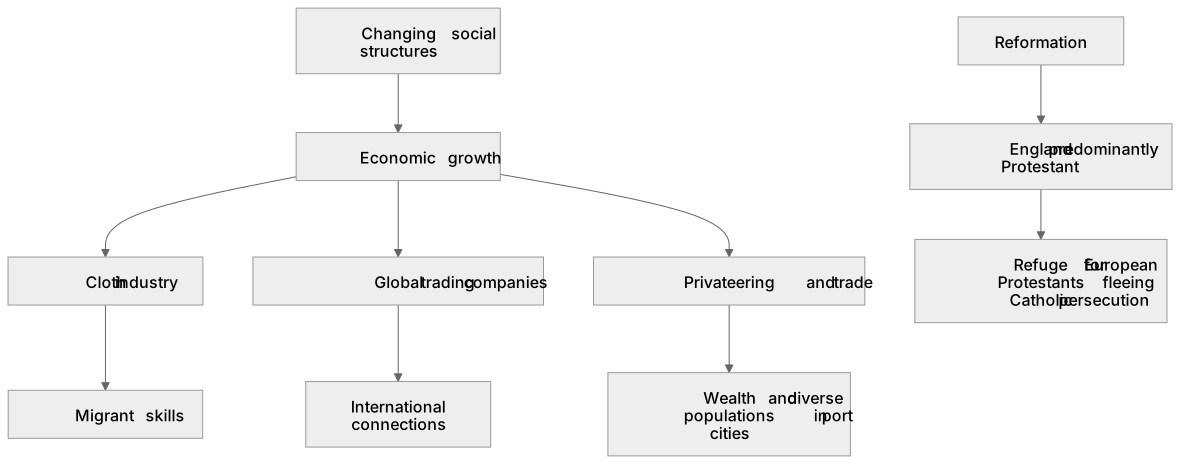
Early modern England experienced profound societal shifts that created a new context for migration. Social structures evolved as a growing "middling sort" of merchants and professionals challenged traditional hierarchies. Economic growth was driven by the booming cloth industry, which relied on migrant skills, and the establishment of global trading companies like the East India Company, expanding international connections. Privateering and overseas trade brought wealth and diverse populations to port cities. Concurrently, the Reformation transformed England into a predominantly Protestant nation, making it a sanctuary for European Protestants fleeing Catholic persecution, while altering domestic religious and political dynamics.
What earns the marks
- Explain how the rise of the merchant class and the "middling sort" altered traditional English social structures.
- Describe the role of the cloth industry and global trading companies in driving economic growth and attracting migrants.
- Analyse how privateering and expanding international trade routes connected England to the wider world and brought new populations.
- Evaluate the impact of England's transition to a Protestant nation on its foreign policy and its role as a refuge for persecuted Protestants.
Common mistakes and how to put them right
Confusing privateering with standard piracy.
Put it right by explaining that privateers had government permission to attack enemy ships.
Overlooking the domestic economic drivers.
Put it right by ensuring the cloth industry is discussed alongside global trading companies.
Assuming the transition to Protestantism was immediate and universally accepted.
Put it right by acknowledging it was a complex process that shaped migration policies over time.
Exam tips
- Link the emergence of global trading companies directly to the arrival of new migrant groups, such as Lascars or African sailors.
- Use the cloth industry as a specific example of how economic growth relied on the integration of skilled European migrants.
- Explain how England's Protestant identity acted as a powerful pull factor for groups like the Huguenots.
Try the lesson
The start of the Option 13: c1500–c1700: Migration in early modern England - 1 The context for migration: The changing context of English society: changing social structures; economic growth, including the cloth industry and global trading companies; privateering and trade; the emergence of England as a predominantly Protestant nation. lesson, made from checked teaching notes for this specification point.
Have a go first
Which industry experienced significant growth in England between c1500 and c1700, attracting many skilled migrants?
Listen
Early modern England experienced profound societal shifts that created a new context for migration. Social structures evolved as a growing "middling sort" of merchants and professionals challenged traditional hierarchies. Economic growth was driven by the booming cloth industry, which relied on migrant skills, and the establishment of global trading companies like the East India Company, expanding international connections. Privateering and overseas trade brought wealth and diverse populations to port cities. Concurrently, the Reformation transformed England into a predominantly Protestant nation, making it a sanctuary for European Protestants fleeing Catholic persecution, while altering domestic religious and political dynamics. A strong answer earns marks for these points. Explain how the rise of the merchant class and the "middling sort" altered traditional English social structures. Describe the role of the cloth industry and global trading companies in driving economic growth and attracting migrants. Analyse how privateering and expanding international trade routes connected England to the wider world and brought new populations. Evaluate the impact of England's transition to a Protestant nation on its foreign policy and its role as a refuge for persecuted Protestants. A common slip: Confusing privateering with standard piracy. Instead, explaining that privateers had government permission to attack enemy ships. Exam tip: Link the emergence of global trading companies directly to the arrival of new migrant groups, such as Lascars or African sailors.
See it
Key words
Say what each word means before you turn the card.
Economic transformation
Try answering aloud or in your head before turning the card.
Religious change
Try answering aloud or in your head before turning the card.
Social mobility
Try answering aloud or in your head before turning the card.
Global expansion
Try answering aloud or in your head before turning the card.
See every definition
- Economic transformation
- Economic growth was driven by the booming cloth industry, which relied on migrant skills, and the establishment of global trading companies, expanding international connections.
- Religious change
- The Reformation transformed England into a predominantly Protestant nation, making it a sanctuary for European Protestants fleeing Catholic persecution.
- Social mobility
- Social structures evolved as a growing "middling sort" of merchants and professionals challenged traditional hierarchies.
- Global expansion
- Privateering and overseas trade brought wealth and diverse populations to port cities, connecting England to the wider world.
Label the diagram
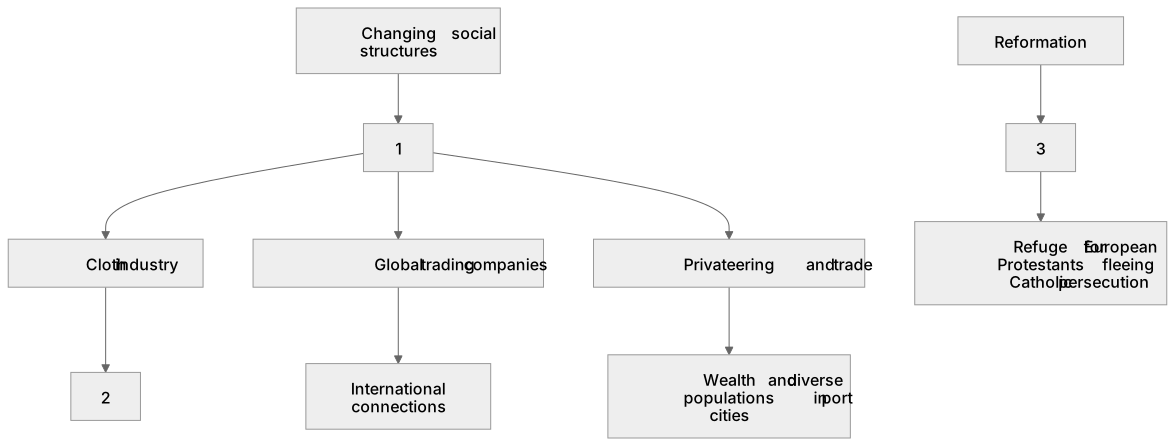
Some boxes have lost their names. Pick the right name for each number.
1Box 1
2Box 2
3Box 3
There is more to this lesson
The full lesson goes on to check your understanding and help you earn the marks. Create a free account to carry on, with your progress saved.
A week of Premium from your first lesson · Then the free plan continues · No card, no charge
Test your understanding of Option 13: c1500–c1700: Migration in early modern England - 1 The context for migration: The changing context of English society: changing social structures; economic growth, including the cloth industry and global trading companies; privateering and trade; the emergence of England as a predominantly Protestant nation.
Active recall beats re-reading. Take an instant quiz now to test what you’ve learned and lock it into long-term memory.
A week of Premium from your first lesson · Then the free plan continues · No card, no charge