Pearson Edexcel · GCSE · History
Course version: 1HI0 · Version from Sept 2016
C1500–c1700: Migration in early modern England - 2 The experience and…
Full specification wording
Option 13: c1500–c1700: Migration in early modern England - 2 The experience and impact of migrants: The experience of migrants in England: their relations with the authorities and the existing population.
The experience of migrants in early modern England was defined by complex interactions with both authorities and the existing population.
Checked against the Pearson Edexcel 1HI0 specification (opens in a new tab) on .
- Point 1 of 2
- 4 key terms
Study notes
From the checked teaching notes for this specification point.
The idea
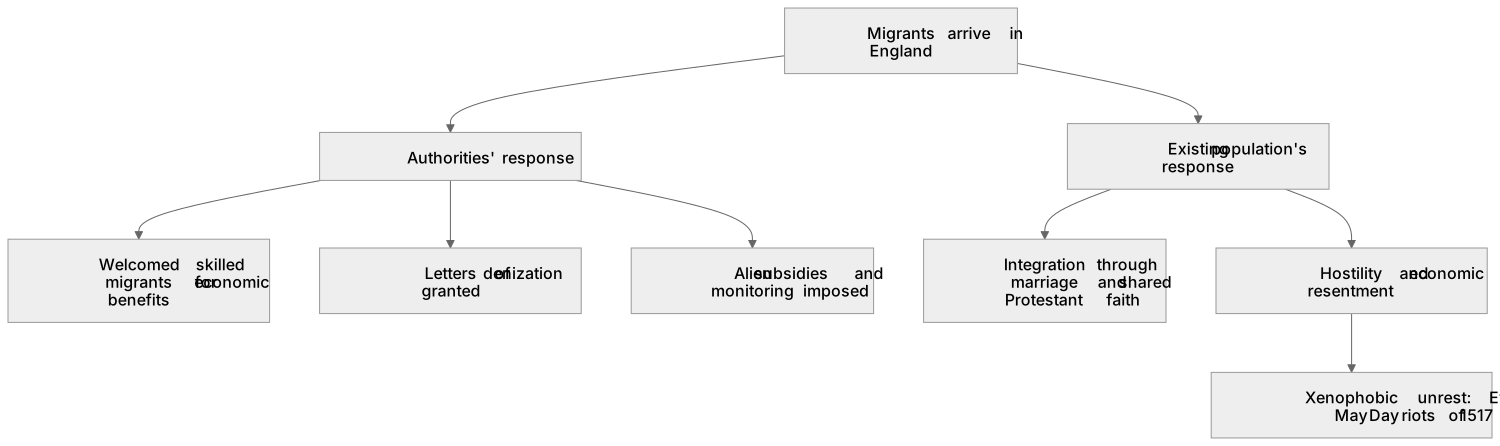
The experience of migrants in early modern England was defined by complex interactions with both authorities and the existing population. Authorities often welcomed skilled migrants, such as Flemish weavers, for their economic benefits, granting them letters of denization to legally reside and work. However, the state also imposed restrictions, such as alien subsidies and monitoring. Relations with the existing population were mixed; while some migrants integrated successfully through marriage and shared Protestant faith, others faced hostility. Economic resentment frequently sparked xenophobic unrest, such as the Evil May Day riots of 1517, where Londoners attacked foreign merchants accused of taking local jobs and driving up prices.
What earns the marks
- Describe the legal mechanisms used by authorities to manage migrants, such as letters of denization and alien subsidies.
- Explain why authorities often supported skilled migrants due to the economic advantages they brought to the realm.
- Analyse the causes of tension between migrants and the existing population, focusing on economic competition and xenophobia.
- Provide specific examples of conflict, such as the Evil May Day riots, to illustrate the challenges faced by migrants.
Common mistakes and how to put them right
Assuming all migrants faced constant persecution.
Put it right by highlighting that many integrated successfully and were protected by the authorities.
Confusing the attitudes of the authorities with those of the general public.
Put it right by noting that the Crown often protected migrants while local workers resented them.
Believing that religious similarity guaranteed a warm welcome.
Put it right by explaining that even Protestant migrants faced economic resentment from English workers.
Exam tips
- Use the Evil May Day riots as a key case study to demonstrate economic tensions between Londoners and foreign merchants.
- Mention letters of denization to show precise knowledge of how migrants navigated legal status with the authorities.
- Contrast the official government policy with the grassroots reaction to provide a balanced evaluation.
Try the lesson
The start of the Option 13: c1500–c1700: Migration in early modern England - 2 The experience and impact of migrants: The experience of migrants in England: their relations with the authorities and the existing population. lesson, made from checked teaching notes for this specification point.
Have a go first
How did the English authorities generally respond to the arrival of skilled Protestant migrants, such as the Walloons, in the 16th century?
Listen
The experience of migrants in early modern England was defined by complex interactions with both authorities and the existing population. Authorities often welcomed skilled migrants, such as Flemish weavers, for their economic benefits, granting them letters of denization to legally reside and work. However, the state also imposed restrictions, such as alien subsidies and monitoring. Relations with the existing population were mixed; while some migrants integrated successfully through marriage and shared Protestant faith, others faced hostility. Economic resentment frequently sparked xenophobic unrest, such as the Evil May Day riots of 1517, where Londoners attacked foreign merchants accused of taking local jobs and driving up prices. A strong answer earns marks for these points. Describe the legal mechanisms used by authorities to manage migrants, such as letters of denization and alien subsidies. Explain why authorities often supported skilled migrants due to the economic advantages they brought to the realm. Analyse the causes of tension between migrants and the existing population, focusing on economic competition and xenophobia. Provide specific examples of conflict, such as the Evil May Day riots, to illustrate the challenges faced by migrants. A common slip: Assuming all migrants faced constant persecution. Instead, highlighting that many integrated successfully and were protected by the authorities. Exam tip: Use the Evil May Day riots as a key case study to demonstrate economic tensions between Londoners and foreign merchants.
See it
Key words
Say what each word means before you turn the card.
Letters of denization
Try answering aloud or in your head before turning the card.
Alien subsidies
Try answering aloud or in your head before turning the card.
Economic resentment
Try answering aloud or in your head before turning the card.
Evil May Day riots
Try answering aloud or in your head before turning the card.
See every definition
- Letters of denization
- Grants from authorities allowing skilled migrants, such as Flemish weavers, to legally reside and work.
- Alien subsidies
- Restrictions imposed by the state on migrants, alongside monitoring.
- Economic resentment
- Hostility that frequently sparked xenophobic unrest, such as the Evil May Day riots of 1517.
- Evil May Day riots
- Unrest in 1517 where Londoners attacked foreign merchants accused of taking local jobs and driving up prices.
Label the diagram
Some boxes have lost their names. Pick the right name for each number.
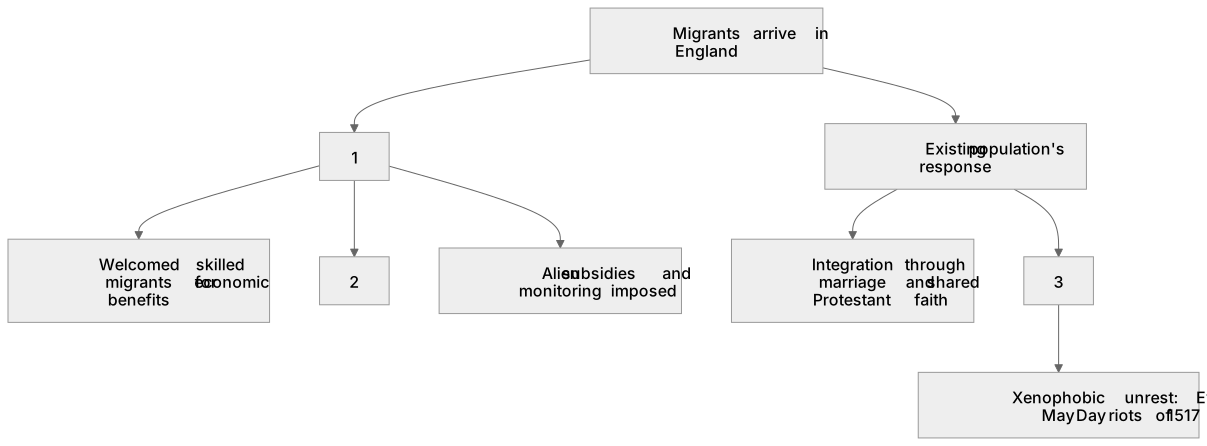
1Box 1
2Box 2
3Box 3
There is more to this lesson
The full lesson goes on to check your understanding and help you earn the marks. Create a free account to carry on, with your progress saved.
A week of Premium from your first lesson · Then the free plan continues · No card, no charge
Test your understanding of Option 13: c1500–c1700: Migration in early modern England - 2 The experience and impact of migrants: The experience of migrants in England: their relations with the authorities and the existing population.
Active recall beats re-reading. Take an instant quiz now to test what you’ve learned and lock it into long-term memory.
A week of Premium from your first lesson · Then the free plan continues · No card, no charge