Pearson Edexcel · GCSE · History
Course version: 1HI0 · Version from Sept 2016
C1500–c1700: Migration in early modern England - 2 The experience and…
Full specification wording
Option 13: c1500–c1700: Migration in early modern England - 2 The experience and impact of migrants: The impact of migrants in England, including culture, trade, industry and agriculture.
Migrants in early modern England profoundly shaped the nation's culture, trade, industry, and agriculture.
Checked against the Pearson Edexcel 1HI0 specification (opens in a new tab) on .
- Point 2 of 2
- 3 key terms
Study notes
From the checked teaching notes for this specification point.
The idea
Migrants in early modern England profoundly shaped the nation's culture, trade, industry, and agriculture. Culturally, they introduced new architectural styles, religious practices, and consumer goods. In trade, migrant networks connected England to broader European markets, boosting exports. Industrially, skilled artisans, such as Flemish weavers, revolutionised textile production by introducing the 'New Draperies', which were lighter and more fashionable. In agriculture, migrants brought advanced techniques like market gardening and land drainage, significantly increasing crop yields and transforming the landscape, particularly in East Anglia. These contributions collectively modernised the English economy.
What earns the marks
- Identify specific cultural impacts, such as the introduction of new religious practices or architectural styles by migrants.
- Explain how migrant networks expanded English trade routes and increased the export of manufactured goods.
- Describe the industrial impact of migrants, particularly the introduction of the 'New Draperies' by Flemish weavers.
- Detail agricultural innovations brought by migrants, such as market gardening and fen drainage techniques.
- Evaluate the overall economic transformation of England resulting from migrant skills and labour.
Common mistakes and how to put them right
Stating that migrants only impacted the textile industry.
Put it right: Ensure you also discuss their significant contributions to agriculture, trade, and culture.
Claiming that all migrants were unskilled labourers.
Put it right: Highlight that many migrants were highly skilled artisans and professionals who introduced new technologies.
Ignoring the cultural impact of migrants.
Put it right: Include examples of how migrants influenced English culture, such as through religion, food, and architecture.
Exam tips
- Use specific examples, like the Flemish weavers or Dutch engineers, to illustrate the industrial and agricultural impacts of migrants.
- When discussing trade, mention how migrant connections helped England integrate into wider European and global markets.
- Link the different areas of impact together; for example, how agricultural improvements supported industrial growth and trade.
Try the lesson
The start of the Option 13: c1500–c1700: Migration in early modern England - 2 The experience and impact of migrants: The impact of migrants in England, including culture, trade, industry and agriculture. lesson, made from checked teaching notes for this specification point.
Have a go first
Which of the following describes a major impact of Flemish and Walloon migrants on English industry during the sixteenth and seventeenth centuries?
Listen
Migrants in early modern England profoundly shaped the nation's culture, trade, industry, and agriculture. Culturally, they introduced new architectural styles, religious practices, and consumer goods. In trade, migrant networks connected England to broader European markets, boosting exports. Industrially, skilled artisans, such as Flemish weavers, revolutionised textile production by introducing the 'New Draperies', which were lighter and more fashionable. In agriculture, migrants brought advanced techniques like market gardening and land drainage, significantly increasing crop yields and transforming the landscape, particularly in East Anglia. These contributions collectively modernised the English economy. A strong answer earns marks for these points. Identify specific cultural impacts, such as the introduction of new religious practices or architectural styles by migrants. Explain how migrant networks expanded English trade routes and increased the export of manufactured goods. Describe the industrial impact of migrants, particularly the introduction of the 'New Draperies' by Flemish weavers. Detail agricultural innovations brought by migrants, such as market gardening and fen drainage techniques. A common slip: Stating that migrants only impacted the textile industry. Instead, ensure you also discuss their significant contributions to agriculture, trade, and culture. Exam tip: Use specific examples, like the Flemish weavers or Dutch engineers, to illustrate the industrial and agricultural impacts of migrants.
See it
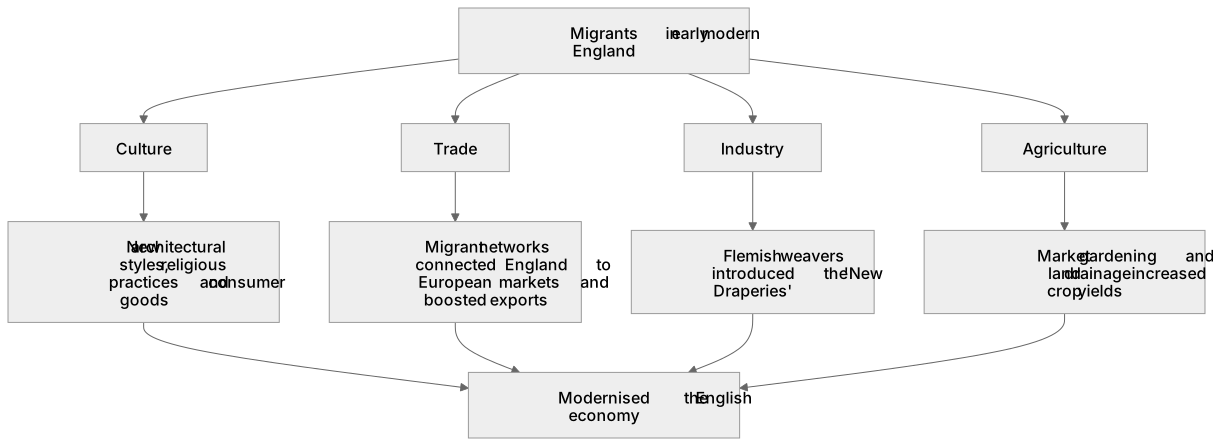
Key words
Say what each word means before you turn the card.
Economic transformation
Try answering aloud or in your head before turning the card.
New Draperies
Try answering aloud or in your head before turning the card.
Market gardening
Try answering aloud or in your head before turning the card.
See every definition
- Economic transformation
- The modernising of the English economy collectively brought about by the contributions of migrants.
- New Draperies
- Lighter and more fashionable textiles introduced by Flemish weavers, revolutionising textile production.
- Market gardening
- An advanced agricultural technique brought by migrants that significantly increased crop yields.
Label the diagram
Some boxes have lost their names. Pick the right name for each number.
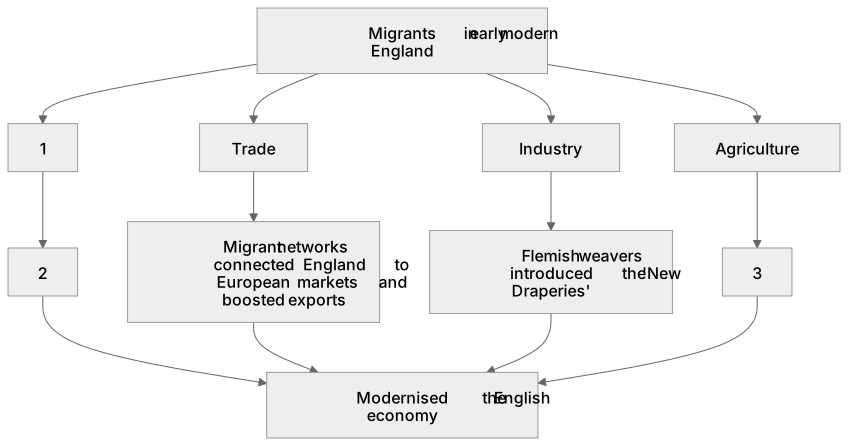
1Box 1
2Box 2
3Box 3
There is more to this lesson
The full lesson goes on to check your understanding and help you earn the marks. Create a free account to carry on, with your progress saved.
A week of Premium from your first lesson · Then the free plan continues · No card, no charge
Test your understanding of Option 13: c1500–c1700: Migration in early modern England - 2 The experience and impact of migrants: The impact of migrants in England, including culture, trade, industry and agriculture.
Active recall beats re-reading. Take an instant quiz now to test what you’ve learned and lock it into long-term memory.
A week of Premium from your first lesson · Then the free plan continues · No card, no charge