Pearson Edexcel · GCSE · History
Course version: 1HI0 · Version from Sept 2016
C1700–c1900: Migration in eighteenth- and nineteenth-century Britain - 2…
Full specification wording
Option 13: c1700–c1900: Migration in eighteenth- and nineteenth-century Britain - 2 The experience and impact of migrants: The impact of migrants in Britain, including culture, trade and industry, politics and the urban environment.
Migrants profoundly shaped Britain between 1700 and 1900 across culture, trade, politics, and the urban environment.
Checked against the Pearson Edexcel 1HI0 specification (opens in a new tab) on .
- Point 2 of 2
Study notes
From the checked teaching notes for this specification point.
The idea
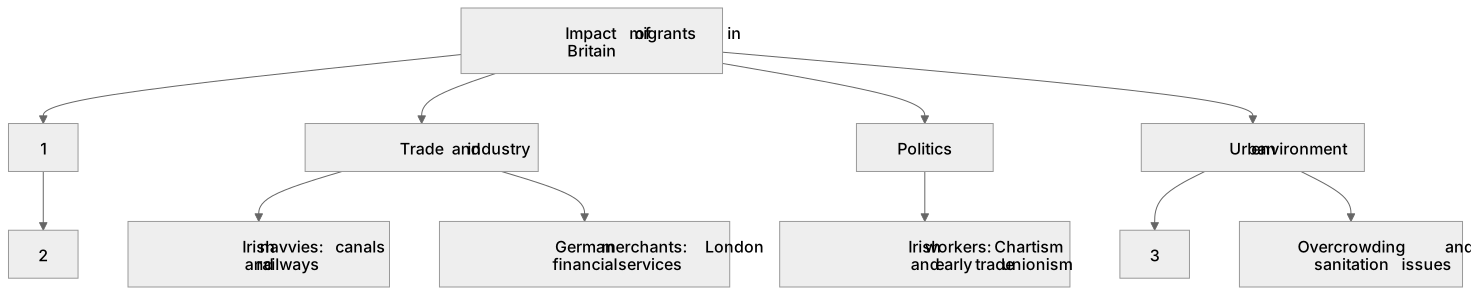
Migrants profoundly shaped Britain between 1700 and 1900 across culture, trade, politics, and the urban environment. Culturally, groups like the Italians introduced new culinary traditions, establishing popular cafes. In trade and industry, migrants were vital; Irish labourers built extensive canal and railway networks, while German merchants expanded London's financial services. Politically, migrants influenced radical movements, with Irish workers heavily involved in Chartism and early trade unionism. The urban environment was transformed as migrant settlement created distinct neighbourhoods, such as Jewish communities in the East End, which stimulated local economies but also highlighted pressing issues of overcrowding and sanitation.
What earns the marks
- Detail specific cultural contributions, such as Italian food businesses or Jewish tailoring.
- Explain the economic impact of migrants on trade and industry, highlighting Irish navvies in infrastructure development.
- Assess the political influence of migrants, including their participation in working-class movements like Chartism.
- Describe changes to the urban environment, focusing on the development of distinct migrant enclaves and the resulting pressures on housing.
Common mistakes and how to put them right
Focusing only on negative impacts like overcrowding.
Put it right by balancing this with positive contributions to industry and culture.
Providing vague statements about 'doing jobs'.
Put it right by specifying the industries, such as Irish migrants building railways or Huguenots in silk weaving.
Overlooking political impacts; correct by including migrant involvement in radical politics or trade unionism.
Exam tips
- Ensure you explicitly address all four areas (culture, trade/industry, politics, urban environment) if a question asks about overall impact.
- Use the term 'navvies' when discussing Irish contributions to the transport infrastructure to demonstrate specific historical knowledge.
- Link changes in the urban environment to both cultural enrichment and public health challenges to provide a nuanced analysis.
Try the lesson
The start of the Option 13: c1700–c1900: Migration in eighteenth- and nineteenth-century Britain - 2 The experience and impact of migrants: The impact of migrants in Britain, including culture, trade and industry, politics and the urban environment. lesson, made from checked teaching notes for this specification point.
Have a go first
What significant contribution did German migrants often make to British trade and industry during the nineteenth century?
Listen
Migrants profoundly shaped Britain between 1700 and 1900 across culture, trade, politics, and the urban environment. Culturally, groups like the Italians introduced new culinary traditions, establishing popular cafes. In trade and industry, migrants were vital; Irish labourers built extensive canal and railway networks, while German merchants expanded London's financial services. Politically, migrants influenced radical movements, with Irish workers heavily involved in Chartism and early trade unionism. The urban environment was transformed as migrant settlement created distinct neighbourhoods, such as Jewish communities in the East End, which stimulated local economies but also highlighted pressing issues of overcrowding and sanitation. A strong answer earns marks for these points. Detail specific cultural contributions, such as Italian food businesses or Jewish tailoring. Explain the economic impact of migrants on trade and industry, highlighting Irish navvies in infrastructure development. Assess the political influence of migrants, including their participation in working-class movements like Chartism. Describe changes to the urban environment, focusing on the development of distinct migrant enclaves and the resulting pressures on housing. A common slip: Focusing only on negative impacts like overcrowding. Instead, balancing this with positive contributions to industry and culture. Exam tip: Ensure you explicitly address all four areas (culture, trade/industry, politics, urban environment) if a question asks about overall impact.
See it

Label the diagram
Some boxes have lost their names. Pick the right name for each number.
1Box 1
2Box 2
3Box 3
There is more to this lesson
The full lesson goes on to check your understanding and help you earn the marks. Create a free account to carry on, with your progress saved.
A week of Premium from your first lesson · Then the free plan continues · No card, no charge
Test your understanding of Option 13: c1700–c1900: Migration in eighteenth- and nineteenth-century Britain - 2 The experience and impact of migrants: The impact of migrants in Britain, including culture, trade and industry, politics and the urban environment.
Active recall beats re-reading. Take an instant quiz now to test what you’ve learned and lock it into long-term memory.
A week of Premium from your first lesson · Then the free plan continues · No card, no charge