Pearson Edexcel · GCSE · History
Course version: 1HI0 · Version from Sept 2016
The historic environment - 2 Knowledge, selection and use of sources for…
Full specification wording
Option 13: The historic environment - 2 Knowledge, selection and use of sources for historical enquiries: Framing of questions relevant to the pursuit of a specific enquiry.
Framing historical questions is a crucial skill for investigating the historic environment of Notting Hill, c1948–c1970.
Checked against the Pearson Edexcel 1HI0 specification (opens in a new tab) on .
- Point 4 of 5
- 4 key terms
Study notes
From the checked teaching notes for this specification point.
The idea
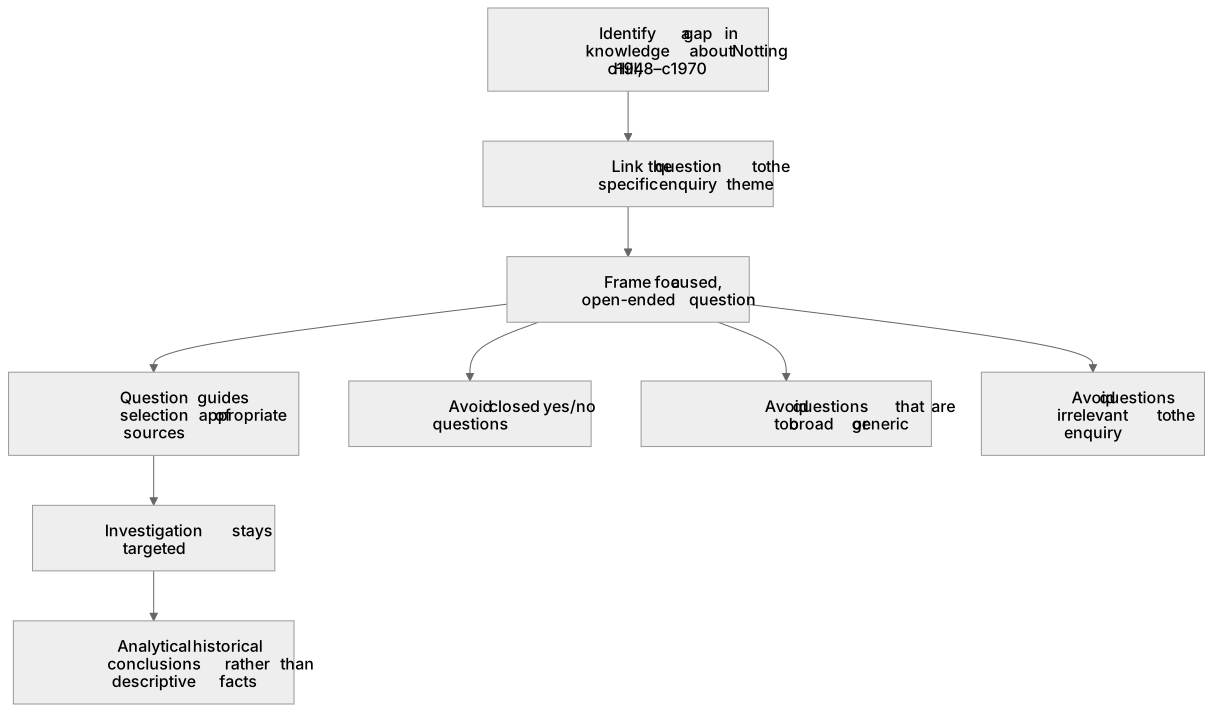
Framing historical questions is a crucial skill for investigating the historic environment of Notting Hill, c1948–c1970. For example, if investigating housing, a relevant question is 'How did Peter Rachman's actions affect the living conditions of Caribbean migrants in Notting Hill during the 1950s?' rather than a generic 'Who lived in Notting Hill?'. Good questions are focused, open-ended, and guide the selection of appropriate sources. They must explicitly link to the specific enquiry's theme, ensuring the investigation remains targeted and yields analytical historical conclusions rather than mere descriptive facts.
What earns the marks
- Identifies a specific historical detail or gap in knowledge relevant to the overarching enquiry into Notting Hill.
- Formulates a clear, focused question that directs further historical investigation.
- Ensures the question is open-ended to allow for analytical reasoning rather than a simple yes/no answer.
- Links the framed question explicitly to the context of the specific historic environment being studied.
Common mistakes and how to put them right
Asking closed questions that only require a yes/no answer.
Put it right: Use 'how' or 'why' to prompt deeper analysis of Notting Hill's history.
Framing questions that are too broad or generic.
Put it right: Narrow the focus to a specific time period, event, or feature of the site, such as the 1958 race riots.
Asking questions that are irrelevant to the specific enquiry.
Put it right: Ensure the question directly targets the stated theme of the investigation.
Exam tips
- Always link your proposed question directly back to the specific enquiry focus provided in the exam prompt.
- Use question stems like 'How far...', 'In what ways...', or 'Why did...' to demonstrate higher-level historical thinking.
- Briefly explain why your framed question is important for advancing the specific historical investigation.
Try the lesson
The start of the Option 13: The historic environment - 2 Knowledge, selection and use of sources for historical enquiries: Framing of questions relevant to the pursuit of a specific enquiry. lesson, made from checked teaching notes for this specification point.
Have a go first
A student is beginning a historical enquiry into the experiences of Caribbean migrants in Notting Hill in the 1950s. Which of the following is the most appropriately framed question to guide this specific research?
Listen
Framing historical questions is a crucial skill for investigating the historic environment of Notting Hill, c1948–c1970. For example, if investigating housing, a relevant question is 'How did Peter Rachman's actions affect the living conditions of Caribbean migrants in Notting Hill during the 1950s?' rather than a generic 'Who lived in Notting Hill? Good questions are focused, open-ended, and guide the selection of appropriate sources. They must explicitly link to the specific enquiry's theme, ensuring the investigation remains targeted and yields analytical historical conclusions rather than mere descriptive facts. A strong answer earns marks for these points. Identifies a specific historical detail or gap in knowledge relevant to the overarching enquiry into Notting Hill. Formulates a clear, focused question that directs further historical investigation. Ensures the question is open-ended to allow for analytical reasoning rather than a simple yes/no answer. Links the framed question explicitly to the context of the specific historic environment being studied. A common slip: Asking closed questions that only require a yes/no answer. Instead, Use 'how' or 'why' to prompt deeper analysis of Notting Hill's history. Exam tip: Always link your proposed question directly back to the specific enquiry focus provided in the exam prompt.
See it
Key words
Say what each word means before you turn the card.
Historical enquiry
Try answering aloud or in your head before turning the card.
Open-ended question
Try answering aloud or in your head before turning the card.
Focused question
Try answering aloud or in your head before turning the card.
Historic environment
Try answering aloud or in your head before turning the card.
See every definition
- Historical enquiry
- The pursuit of a specific investigation into the historic environment, guided by questions that directly address gaps in knowledge.
- Open-ended question
- A question framed to allow for analytical reasoning rather than a simple yes or no answer.
- Focused question
- A question that is narrow and explicitly linked to the specific enquiry's theme, keeping the investigation targeted.
- Historic environment
- The site being studied, in this case Notting Hill, c1948–c1970, which framed questions must explicitly link to.
Label the diagram
Some boxes have lost their names. Pick the right name for each number.
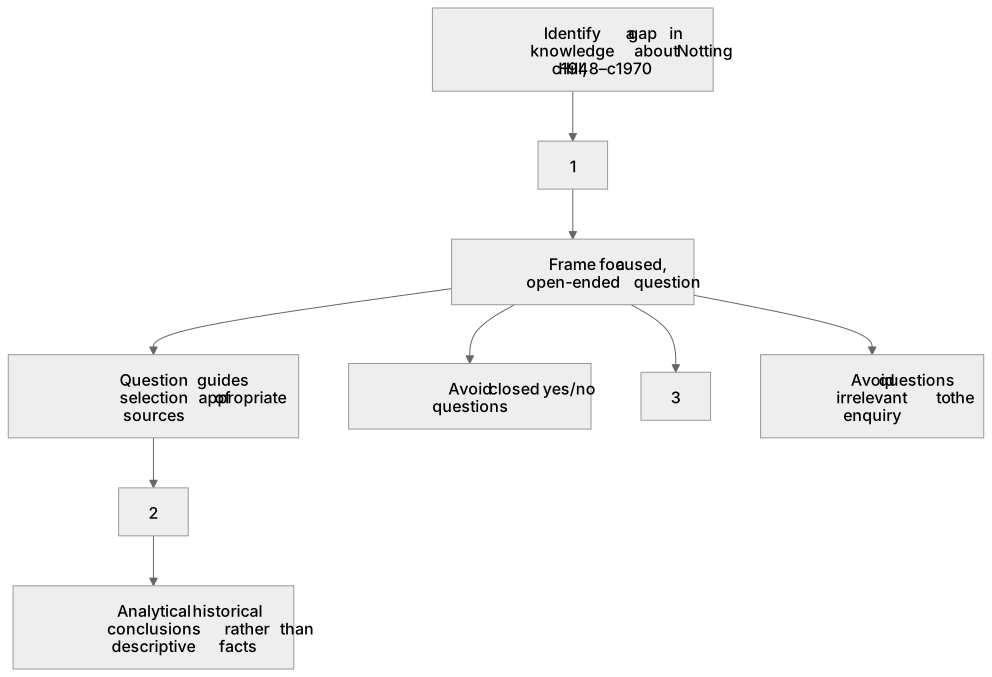
1Box 1
2Box 2
3Box 3
There is more to this lesson
The full lesson goes on to check your understanding and help you earn the marks. Create a free account to carry on, with your progress saved.
A week of Premium from your first lesson · Then the free plan continues · No card, no charge
Test your understanding of Option 13: The historic environment - 2 Knowledge, selection and use of sources for historical enquiries: Framing of questions relevant to the pursuit of a specific enquiry.
Active recall beats re-reading. Take an instant quiz now to test what you’ve learned and lock it into long-term memory.
A week of Premium from your first lesson · Then the free plan continues · No card, no charge