Pearson Edexcel · GCSE · History
Course version: 1HI0 · Version from Sept 2016
The historic environment - 2 Knowledge, selection and use of sources for…
Full specification wording
Option 13: The historic environment - 2 Knowledge, selection and use of sources for historical enquiries: Selection of appropriate sources for specific investigations.
Selecting appropriate sources is vital for conducting specific historical investigations into the historic environment of Notting Hill, c1948–c1970.
Checked against the Pearson Edexcel 1HI0 specification (opens in a new tab) on .
- Point 5 of 5
- 3 key terms
Study notes
From the checked teaching notes for this specification point.
The idea
Selecting appropriate sources is vital for conducting specific historical investigations into the historic environment of Notting Hill, c1948–c1970. For instance, if investigating the 1958 race riots, police reports or local newspaper articles are highly appropriate for revealing immediate events, whereas a general history of London is less relevant. The selection process requires matching the source's nature, origin, and purpose to the specific investigation's aims.
What earns the marks
- Identifies a specific type of source (e.g., police records, local newspapers, housing reports) relevant to the investigation.
- Explains how the content of the selected source directly addresses the specific historical enquiry.
- Evaluates the nature, origin, and purpose of the source to justify its appropriateness for the task.
- Contrasts the utility of different sources to demonstrate why the selected source is the most appropriate choice.
Common mistakes and how to put them right
Selecting a source without explaining its relevance.
Put it right: Explicitly link the source's content to the specific investigation into Notting Hill.
Error: Choosing generic sources (e.g., 'a history book') instead of specific types of primary or contemporary evidence (e.g., 'Bruce Kenrick's housing reports').
Confusing a source's general reliability with its specific utility.
Put it right: A biased source can still be highly appropriate for investigating attitudes or propaganda.
Exam tips
- Name specific types of sources (e.g., police records, photographs of the Kelso Cochrane funeral) rather than just saying 'written sources' or 'pictures'.
- Clearly state why the source you have selected would yield information relevant to the specific enquiry focus.
- Consider the limitations of your selected source to show a balanced understanding of historical evidence gathering.
Try the lesson
The start of the Option 13: The historic environment - 2 Knowledge, selection and use of sources for historical enquiries: Selection of appropriate sources for specific investigations. lesson, made from checked teaching notes for this specification point.
Have a go first
Which source would be most appropriate for an investigation into the daily duties of a police constable in Whitechapel in 1888?
Listen
Selecting appropriate sources is vital for conducting specific historical investigations into the historic environment of Notting Hill, c1948–c1970. For instance, if investigating the 1958 race riots, police reports or local newspaper articles are highly appropriate for revealing immediate events, whereas a general history of London is less relevant. The selection process requires matching the source's nature, origin, and purpose to the specific investigation's aims. A strong answer earns marks for these points. Identifies a specific type of source (e.g., police records, local newspapers, housing reports) relevant to the investigation. Explains how the content of the selected source directly addresses the specific historical enquiry. Evaluates the nature, origin, and purpose of the source to justify its appropriateness for the task. Contrasts the utility of different sources to demonstrate why the selected source is the most appropriate choice. A common slip: Selecting a source without explaining its relevance. Instead, explicitly link the source's content to the specific investigation into Notting Hill. Exam tip: Name specific types of sources (e.g., police records, photographs of the Kelso Cochrane funeral) rather than just saying 'written sources' or 'pictures'.
See it
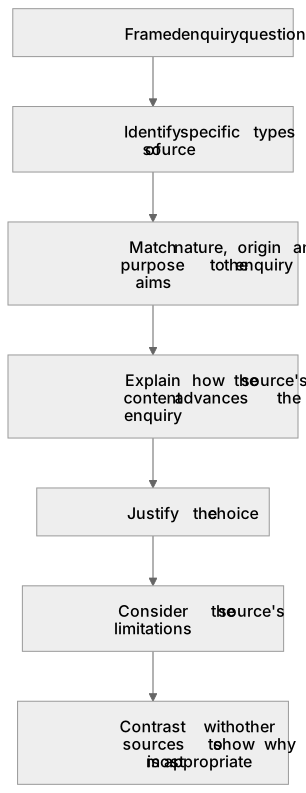
Put it in order
Put these steps in the order they happen.
- 1. Contrast with other sources to show why it is most appropriate
- 2. Consider the source's limitations
- 3. Match nature, origin and purpose to the enquiry aims
- 4. Justify the choice
- 5. Framed enquiry question
- 6. Identify specific types of source
- 7. Explain how the source's content advances the enquiry
Key words
Say what each word means before you turn the card.
Source utility
Try answering aloud or in your head before turning the card.
Historical evidence
Try answering aloud or in your head before turning the card.
The historic environment
Try answering aloud or in your head before turning the card.
See every definition
- Source utility
- How appropriate a source is for a specific investigation, judged by matching its nature, origin and purpose to the aims of that enquiry.
- Historical evidence
- The content or perspective of a chosen source that directly advances the targeted historical enquiry.
- The historic environment
- The subject of specific historical investigations, here the historic environment of Notting Hill, c1948–c1970.
Label the diagram
Some boxes have lost their names. Pick the right name for each number.
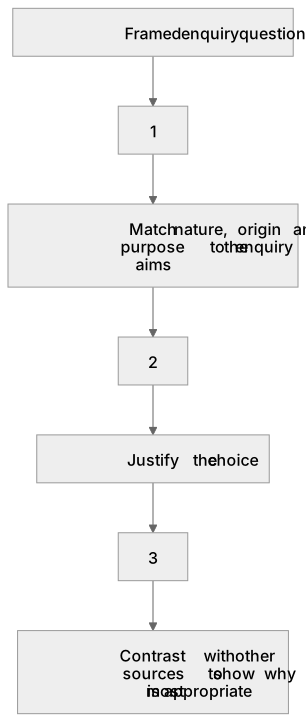
1Box 1
2Box 2
3Box 3
There is more to this lesson
The full lesson goes on to check your understanding and help you earn the marks. Create a free account to carry on, with your progress saved.
A week of Premium from your first lesson · Then the free plan continues · No card, no charge
Test your understanding of Option 13: The historic environment - 2 Knowledge, selection and use of sources for historical enquiries: Selection of appropriate sources for specific investigations.
Active recall beats re-reading. Take an instant quiz now to test what you’ve learned and lock it into long-term memory.
A week of Premium from your first lesson · Then the free plan continues · No card, no charge