Pearson Edexcel · GCSE · History
Course version: 1HI0 · Version from Sept 2016
Key topic 1: The revolutions of 1917 - 1 The growth of opposition to the…
Full specification wording
Option 30: Key topic 1: The revolutions of 1917 - 1 The growth of opposition to the tsar in early 1917: Growing discontent among peasants and town workers.
In early 1917, opposition to Tsar Nicholas II surged due to deep grievances among peasants and town workers.
Checked against the Pearson Edexcel 1HI0 specification (opens in a new tab) on .
- Point 1 of 2
- 3 key terms
Study notes
From the checked teaching notes for this specification point.
The idea
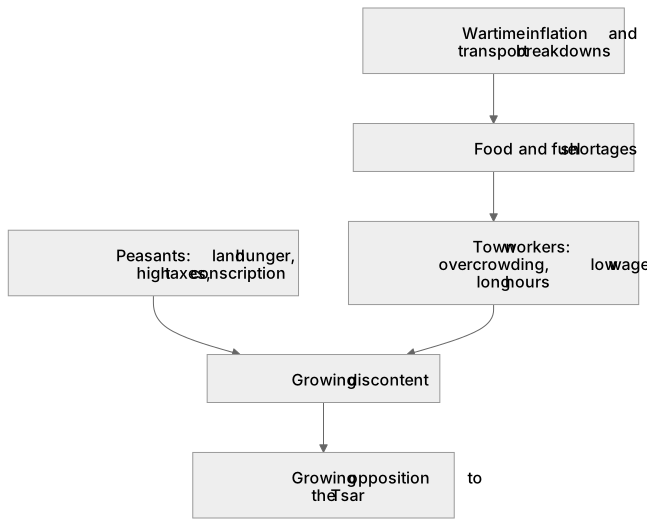
In early 1917, opposition to Tsar Nicholas II surged due to deep grievances among peasants and town workers. Peasants suffered from severe land hunger, high taxes, and wartime conscription, which stripped villages of their agricultural workforce. Meanwhile, town workers faced appalling living conditions and overcrowding in rapidly industrialising cities like Petrograd. Their discontent was exacerbated by low wages, long hours, and severe food shortages caused by wartime inflation and transport breakdowns. This dual crisis in the countryside and urban centres created a volatile environment, uniting both groups in their desperation and anger towards the Tsarist regime, laying the groundwork for the impending revolution.
What earns the marks
- Identify specific peasant grievances, such as land shortages and the impact of conscription on farming.
- Describe the poor living and working conditions of town workers, including overcrowding and long hours.
- Explain how wartime inflation and transport failures led to severe food and fuel shortages in cities.
- Link the growing discontent of both groups directly to the increasing opposition to the Tsar's government.
Common mistakes and how to put them right
Stating that peasants and workers had the exact same grievances.
Put it right: Distinguish between peasant land hunger and worker living/working conditions.
Claiming that discontent only began in 1917.
Put it right: Explain that these were long-term issues severely worsened by the First World War.
Ignoring the role of inflation.
Put it right: Explicitly mention how wages failed to keep up with the rising cost of basic goods like bread.
Exam tips
- Use specific examples, such as the population boom in Petrograd, to illustrate urban overcrowding.
- When explaining causes of opposition, link long-term social issues with short-term wartime triggers.
- Ensure you address both peasants and town workers if a question asks about social discontent.
Try the lesson
The start of the Option 30: Key topic 1: The revolutions of 1917 - 1 The growth of opposition to the tsar in early 1917: Growing discontent among peasants and town workers. lesson, made from checked teaching notes for this specification point.
Have a go first
What was a primary cause of discontent among town workers in Russia by early 1917?
Listen
In early 1917, opposition to Tsar Nicholas II surged due to deep grievances among peasants and town workers. Peasants suffered from severe land hunger, high taxes, and wartime conscription, which stripped villages of their agricultural workforce. Meanwhile, town workers faced appalling living conditions and overcrowding in rapidly industrialising cities like Petrograd. Their discontent was exacerbated by low wages, long hours, and severe food shortages caused by wartime inflation and transport breakdowns. This dual crisis in the countryside and urban centres created a volatile environment, uniting both groups in their desperation and anger towards the Tsarist regime, laying the groundwork for the impending revolution. A strong answer earns marks for these points. Identify specific peasant grievances, such as land shortages and the impact of conscription on farming. Describe the poor living and working conditions of town workers, including overcrowding and long hours. Explain how wartime inflation and transport failures led to severe food and fuel shortages in cities. Link the growing discontent of both groups directly to the increasing opposition to the Tsar's government. A common slip: Stating that peasants and workers had the exact same grievances. Instead, distinguish between peasant land hunger and worker living/working conditions. Exam tip: Use specific examples, such as the population boom in Petrograd, to illustrate urban overcrowding.
See it
Key words
Say what each word means before you turn the card.
Economic hardship
Try answering aloud or in your head before turning the card.
Urbanisation
Try answering aloud or in your head before turning the card.
Opposition to autocracy
Try answering aloud or in your head before turning the card.
See every definition
- Economic hardship
- Low wages, long hours and severe food shortages caused by wartime inflation and transport breakdowns worsened the discontent of town workers.
- Urbanisation
- Rapid industrialisation drew town workers into overcrowded cities like Petrograd, where living conditions were appalling.
- Opposition to autocracy
- Desperation and anger towards the Tsarist regime united peasants and town workers, laying the groundwork for the impending revolution.
Label the diagram
Some boxes have lost their names. Pick the right name for each number.
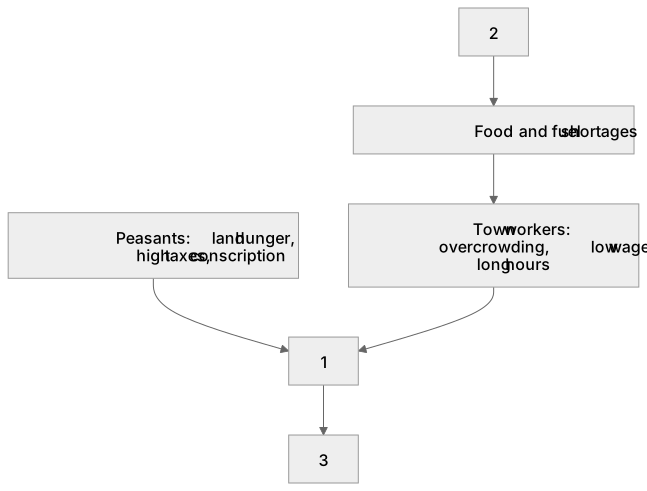
1Box 1
2Box 2
3Box 3
There is more to this lesson
The full lesson goes on to check your understanding and help you earn the marks. Create a free account to carry on, with your progress saved.
A week of Premium from your first lesson · Then the free plan continues · No card, no charge
Test your understanding of Option 30: Key topic 1: The revolutions of 1917 - 1 The growth of opposition to the tsar in early 1917: Growing discontent among peasants and town workers.
Active recall beats re-reading. Take an instant quiz now to test what you’ve learned and lock it into long-term memory.
A week of Premium from your first lesson · Then the free plan continues · No card, no charge