Pearson Edexcel · GCSE · History
Course version: 1HI0 · Version from Sept 2016
Key topic 2: The Bolsheviks in power, 1917–24 - 1 Early consolidation of…
Full specification wording
Option 30: Key topic 2: The Bolsheviks in power, 1917–24 - 1 Early consolidation of power, 1917–18: The reasons for, main terms, and significance of, the Treaty of Brest-Litovsk. Different reactions in Russia to the Treaty.
The Treaty of Brest-Litovsk (March 1918) formally ended Russia's involvement in the First World War.
Checked against the Pearson Edexcel 1HI0 specification (opens in a new tab) on .
- Point 3 of 3
Study notes
From the checked teaching notes for this specification point.
The idea
The Treaty of Brest-Litovsk (March 1918) formally ended Russia's involvement in the First World War. Lenin pushed for peace because the Russian army was disintegrating and the Bolsheviks needed breathing space to consolidate power. The main terms were exceptionally harsh: Russia lost vast territories including Ukraine and the Baltic states, equating to a third of its population and agricultural land, and half its industry. The significance of the treaty was profound. It saved the Bolshevik regime from German conquest but provoked furious reactions in Russia. Patriotic Russians were outraged by the humiliating losses, swelling the ranks of the White armies. Even Left Socialist Revolutionaries resigned from the government in protest, leaving the Bolsheviks to rule alone.
What earns the marks
- Identify Lenin's practical and ideological reasons for signing the Treaty of Brest-Litovsk.
- Detail the main territorial, demographic, and economic losses imposed on Russia by the treaty's terms.
- Explain the significance of the treaty in allowing the Bolsheviks to survive the immediate threat of German invasion.
- Analyse the different reactions within Russia, including the outrage of conservatives, the boost to the White armies, and the split with the Left Socialist Revolutionaries.
Common mistakes and how to put them right
Stating that the Treaty of Brest-Litovsk was signed with the Allies.
Put it right: Specify that the treaty was signed between Soviet Russia and the Central Powers, primarily Germany.
Underestimating the severity of the treaty's terms.
Put it right: Provide specific examples of the losses, such as the loss of Ukraine (a vital agricultural region) and a significant portion of Russia's coal and iron resources.
Assuming all Bolsheviks supported the treaty.
Put it right: Mention that there was fierce debate within the party, with figures like Trotsky initially advocating for a 'neither peace nor war' approach before Lenin forced the decision.
Exam tips
- Memorise key statistics regarding the losses (e.g., population, land, industry) to provide strong supporting evidence in your answers.
- Use the reactions to the treaty as a major cause for the escalation of the Russian Civil War.
- Contrast Lenin's pragmatic need for peace with the ideological and patriotic outrage it caused among other Russian groups.
Try the lesson
The start of the Option 30: Key topic 2: The Bolsheviks in power, 1917–24 - 1 Early consolidation of power, 1917–18: The reasons for, main terms, and significance of, the Treaty of Brest-Litovsk. Different reactions in Russia to the Treaty. lesson, made from checked teaching notes for this specification point.
Have a go first
What was one of the main terms of the Treaty of Brest-Litovsk (March 1918)?
Listen
The Treaty of Brest-Litovsk (March 1918) formally ended Russia's involvement in the First World War. Lenin pushed for peace because the Russian army was disintegrating and the Bolsheviks needed breathing space to consolidate power. The main terms were exceptionally harsh: Russia lost vast territories including Ukraine and the Baltic states, equating to a third of its population and agricultural land, and half its industry. The significance of the treaty was profound. It saved the Bolshevik regime from German conquest but provoked furious reactions in Russia. Patriotic Russians were outraged by the humiliating losses, swelling the ranks of the White armies. Even Left Socialist Revolutionaries resigned from the government in protest, leaving the Bolsheviks to rule alone. A strong answer earns marks for these points. Identify Lenin's practical and ideological reasons for signing the Treaty of Brest-Litovsk. Detail the main territorial, demographic, and economic losses imposed on Russia by the treaty's terms. Explain the significance of the treaty in allowing the Bolsheviks to survive the immediate threat of German invasion. Analyse the different reactions within Russia, including the outrage of conservatives, the boost to the White armies, and the split with the Left Socialist Revolutionaries. A common slip: Stating that the Treaty of Brest-Litovsk was signed with the Allies. Instead, Specify that the treaty was signed between Soviet Russia and the Central Powers, primarily Germany. Exam tip: Memorise key statistics regarding the losses (e.g., population, land, industry) to provide strong supporting evidence in your answers.
See it
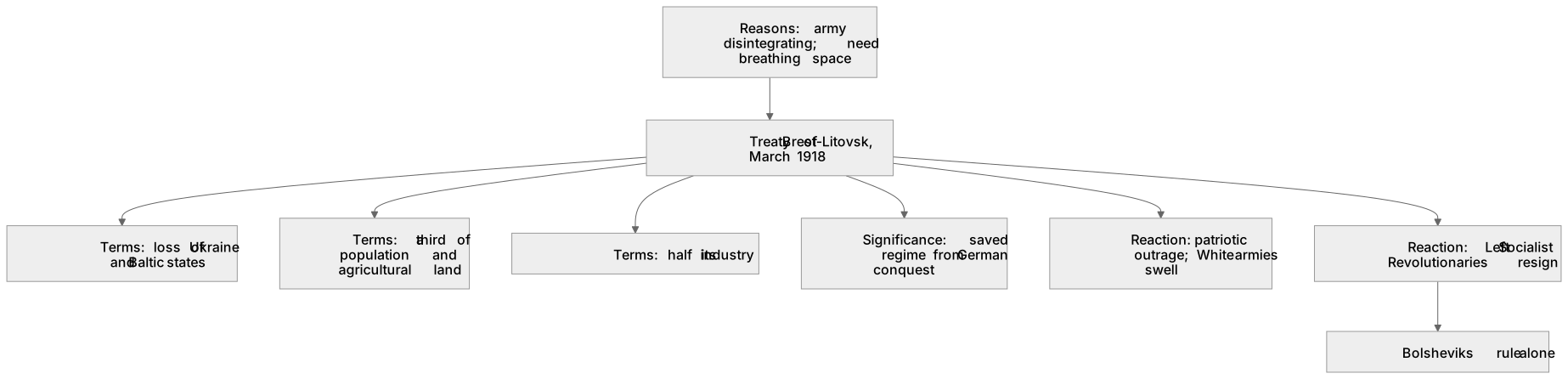
Label the diagram
Some boxes have lost their names. Pick the right name for each number.
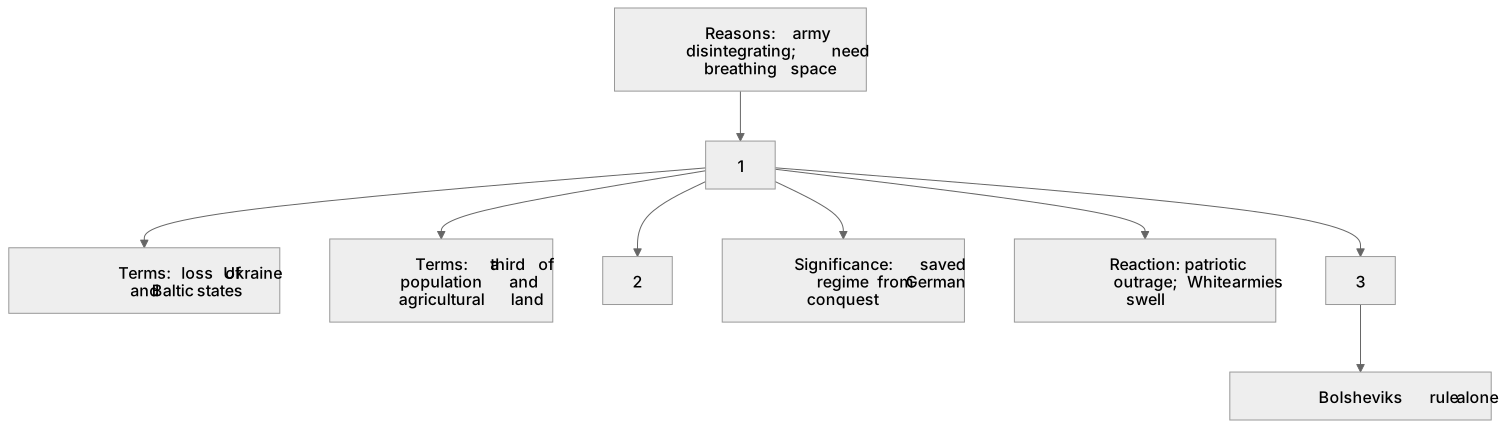
1Box 1
2Box 2
3Box 3
There is more to this lesson
The full lesson goes on to check your understanding and help you earn the marks. Create a free account to carry on, with your progress saved.
A week of Premium from your first lesson · Then the free plan continues · No card, no charge
Test your understanding of Option 30: Key topic 2: The Bolsheviks in power, 1917–24 - 1 Early consolidation of power, 1917–18: The reasons for, main terms, and significance of, the Treaty of Brest-Litovsk. Different reactions in Russia to the Treaty.
Active recall beats re-reading. Take an instant quiz now to test what you’ve learned and lock it into long-term memory.
A week of Premium from your first lesson · Then the free plan continues · No card, no charge