Pearson Edexcel · GCSE · History
Course version: 1HI0 · Version from Sept 2016
Key topic 2: The Bolsheviks in power, 1917–24 - 1 Early consolidation of…
Full specification wording
Option 30: Key topic 2: The Bolsheviks in power, 1917–24 - 1 Early consolidation of power, 1917–18: The removal of opposition, including the Constituent Assembly and the execution of Tsar Nicholas II and his family.
To secure their fragile grip on power, the Bolsheviks systematically removed political and royal opposition.
Checked against the Pearson Edexcel 1HI0 specification (opens in a new tab) on .
- Point 2 of 3
- 3 key terms
Study notes
From the checked teaching notes for this specification point.
The idea
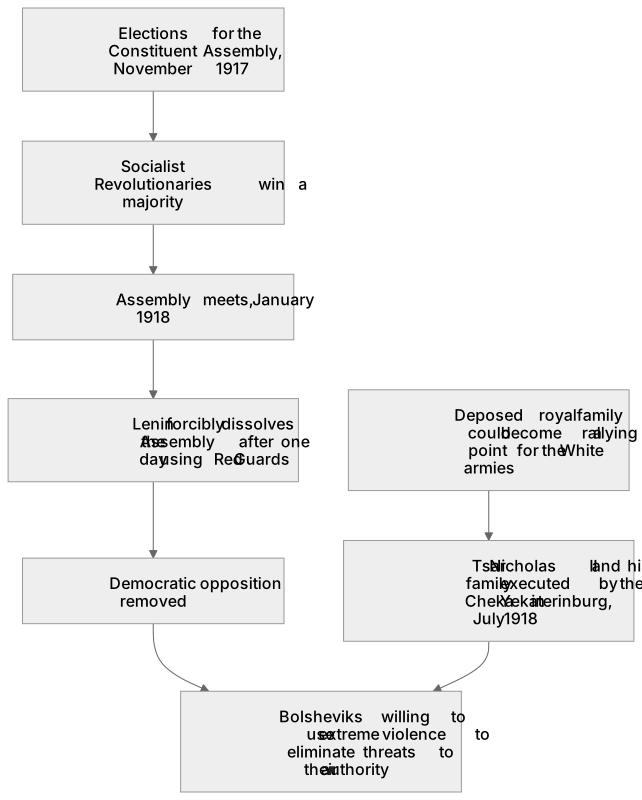
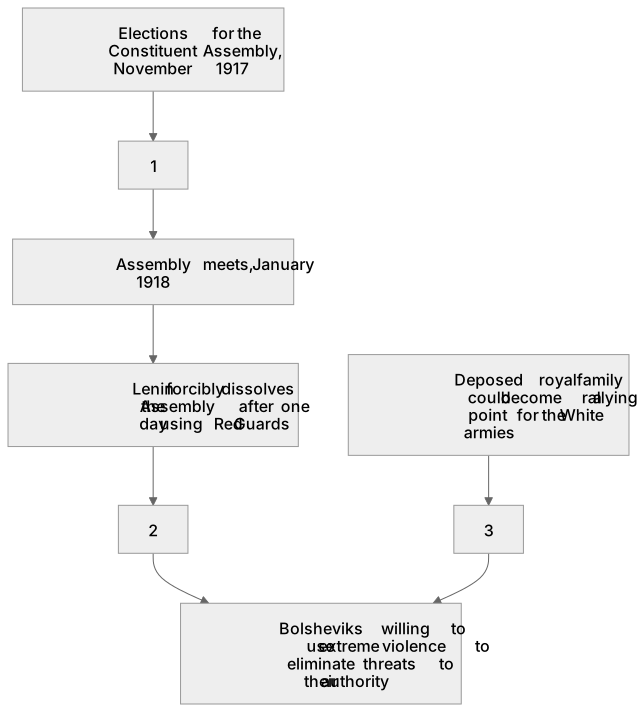
To secure their fragile grip on power, the Bolsheviks systematically removed political and royal opposition. Elections for the Constituent Assembly in November 1917 resulted in a majority for the Socialist Revolutionaries. When the Assembly met in January 1918, Lenin forcibly dissolved it after one day using Red Guards, claiming it did not represent the workers. This removal of democratic opposition sparked outrage. Furthermore, to prevent the deposed royal family from becoming a rallying point for the anti-Bolshevik White armies, Tsar Nicholas II and his family were executed by the Cheka in Yekaterinburg in July 1918. These actions demonstrated the Bolsheviks' willingness to use extreme violence to eliminate threats to their authority.
What earns the marks
- Explain the results of the Constituent Assembly elections and why they posed a threat to Bolshevik power.
- Describe the methods used by Lenin to dissolve the Constituent Assembly in January 1918.
- Identify the reasons for the execution of Tsar Nicholas II and his family in July 1918.
- Analyse how the removal of the Constituent Assembly and the Tsar contributed to the outbreak and dynamics of the Russian Civil War.
Common mistakes and how to put them right
Stating that the Bolsheviks won the Constituent Assembly elections.
Put it right: Clarify that the Socialist Revolutionaries won the majority of seats, which is why Lenin dissolved the Assembly.
Claiming the Tsar was executed immediately after the October Revolution.
Put it right: Note that the execution took place in July 1918, several months later, in response to the advancing White armies.
Confusing the dissolution of the Constituent Assembly with the banning of other political parties.
Put it right: Distinguish between the specific event of closing the Assembly in January 1918 and the broader, gradual process of outlawing opposition parties.
Exam tips
- Use the dissolution of the Constituent Assembly as a key example of Lenin prioritising Bolshevik control over democratic processes.
- When discussing the Tsar's execution, link it directly to the context of the Civil War and the threat posed by the White armies.
- Consider how these actions alienated other socialist groups and contributed to the formation of armed opposition against the Bolsheviks.
Try the lesson
The start of the Option 30: Key topic 2: The Bolsheviks in power, 1917–24 - 1 Early consolidation of power, 1917–18: The removal of opposition, including the Constituent Assembly and the execution of Tsar Nicholas II and his family. lesson, made from checked teaching notes for this specification point.
Have a go first
How did the Bolsheviks deal with the Constituent Assembly in January 1918?
Listen
To secure their fragile grip on power, the Bolsheviks systematically removed political and royal opposition. Elections for the Constituent Assembly in November 1917 resulted in a majority for the Socialist Revolutionaries. When the Assembly met in January 1918, Lenin forcibly dissolved it after one day using Red Guards, claiming it did not represent the workers. This removal of democratic opposition sparked outrage. Furthermore, to prevent the deposed royal family from becoming a rallying point for the anti-Bolshevik White armies, Tsar Nicholas II and his family were executed by the Cheka in Yekaterinburg in July 1918. These actions demonstrated the Bolsheviks' willingness to use extreme violence to eliminate threats to their authority. A strong answer earns marks for these points. Explain the results of the Constituent Assembly elections and why they posed a threat to Bolshevik power. Describe the methods used by Lenin to dissolve the Constituent Assembly in January 1918. Identify the reasons for the execution of Tsar Nicholas II and his family in July 1918. Analyse how the removal of the Constituent Assembly and the Tsar contributed to the outbreak and dynamics of the Russian Civil War. A common slip: Stating that the Bolsheviks won the Constituent Assembly elections. Instead, Clarify that the Socialist Revolutionaries won the majority of seats, which is why Lenin dissolved the Assembly. Exam tip: Use the dissolution of the Constituent Assembly as a key example of Lenin prioritising Bolshevik control over democratic processes.
See it
Key words
Say what each word means before you turn the card.
Constituent Assembly
Try answering aloud or in your head before turning the card.
Anti-Bolshevik White armies
Try answering aloud or in your head before turning the card.
Cheka
Try answering aloud or in your head before turning the card.
See every definition
- Constituent Assembly
- An elected body whose November 1917 elections resulted in a majority for the Socialist Revolutionaries and which Lenin forcibly dissolved in January 1918 after one day.
- Anti-Bolshevik White armies
- Forces opposed to the Bolsheviks for whom the deposed royal family could become a rallying point, leading to the execution of Tsar Nicholas II and his family.
- Cheka
- The body that executed Tsar Nicholas II and his family in Yekaterinburg in July 1918.
Label the diagram
Some boxes have lost their names. Pick the right name for each number.
1Box 1
2Box 2
3Box 3
There is more to this lesson
The full lesson goes on to check your understanding and help you earn the marks. Create a free account to carry on, with your progress saved.
A week of Premium from your first lesson · Then the free plan continues · No card, no charge
Test your understanding of Option 30: Key topic 2: The Bolsheviks in power, 1917–24 - 1 Early consolidation of power, 1917–18: The removal of opposition, including the Constituent Assembly and the execution of Tsar Nicholas II and his family.
Active recall beats re-reading. Take an instant quiz now to test what you’ve learned and lock it into long-term memory.
A week of Premium from your first lesson · Then the free plan continues · No card, no charge