Pearson Edexcel · GCSE · History
Course version: 1HI0 · Version from Sept 2016
Key topic 3: Stalin’s rise to power and dictatorship, 1924–41 - 2 The use…
Full specification wording
Option 30: Key topic 3: Stalin’s rise to power and dictatorship, 1924–41 - 2 The use of terror in the 1930s: The reasons for, and the importance of, the show trials of 1936–1938.
The show trials (1936–1938) were highly publicised, staged trials of prominent Old Bolsheviks, such as Zinoviev, Kamenev, and Bukharin.
Checked against the Pearson Edexcel 1HI0 specification (opens in a new tab) on .
- Point 3 of 3
- 4 key terms
Study notes
From the checked teaching notes for this specification point.
The idea
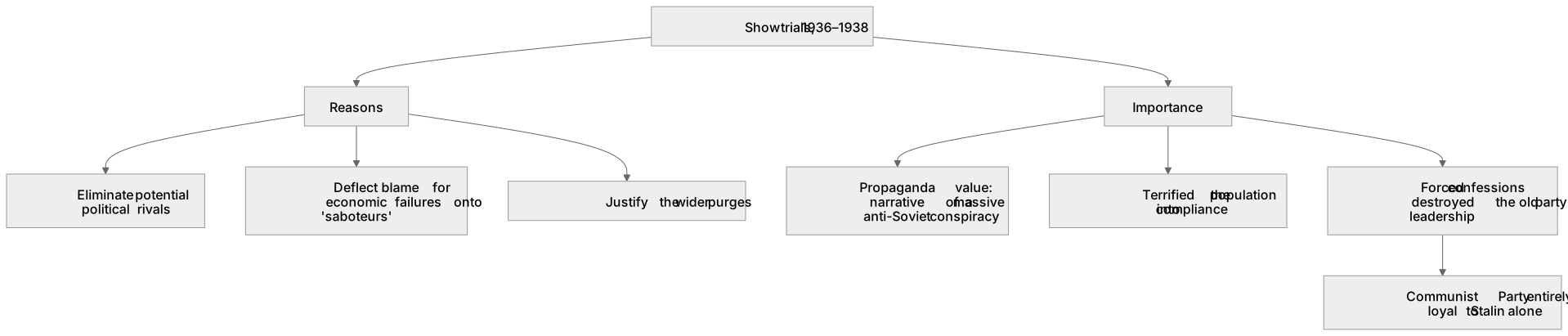
The show trials (1936–1938) were highly publicised, staged trials of prominent Old Bolsheviks, such as Zinoviev, Kamenev, and Bukharin. Stalin's reasons for these trials were to eliminate potential political rivals, deflect blame for economic failures onto 'saboteurs', and justify the wider purges to the Soviet public and the world. The importance of the show trials lay in their propaganda value; they created a narrative of a massive anti-Soviet conspiracy, terrifying the population into compliance. By forcing respected revolutionary leaders to publicly confess to treason—often after severe torture or threats to their families—Stalin destroyed the old party leadership, ensuring that the Communist Party was entirely loyal to him alone.
What earns the marks
- Identify the elimination of Old Bolshevik rivals (e.g., Zinoviev, Kamenev, Bukharin) as a primary reason for the show trials.
- Explain how the trials were used to scapegoat individuals for economic failures and industrial accidents.
- Discuss the importance of the trials as propaganda to justify the wider Great Terror to the Soviet public.
- Analyse how the forced confessions cemented Stalin's absolute control over the Communist Party by removing alternative leaders.
Common mistakes and how to put them right
Believing the trials were fair legal proceedings.
Put it right: Emphasise that the verdicts were predetermined and confessions were extracted through torture.
Confusing the show trials with the wider, secret purges.
Put it right: Distinguish the highly public nature of the show trials from the secret executions of millions of ordinary citizens.
Forgetting the specific dates and victims.
Put it right: Accurately name key figures like Zinoviev and Bukharin and place the trials between 1936 and 1938.
Exam tips
- Link the show trials to the assassination of Kirov in 1934, which Stalin used as the initial pretext for uncovering 'conspiracies'.
- Emphasise the psychological impact of seeing heroes of the 1917 Revolution confessing to being fascist spies.
- Use the show trials as evidence of Stalin's manipulation of the justice system for political ends.
Try the lesson
The start of the Option 30: Key topic 3: Stalin’s rise to power and dictatorship, 1924–41 - 2 The use of terror in the 1930s: The reasons for, and the importance of, the show trials of 1936–1938. lesson, made from checked teaching notes for this specification point.
Have a go first
What was the main purpose of the show trials held in the Soviet Union between 1936 and 1938?
Listen
The show trials (1936–1938) were highly publicised, staged trials of prominent Old Bolsheviks, such as Zinoviev, Kamenev, and Bukharin. Stalin's reasons for these trials were to eliminate potential political rivals, deflect blame for economic failures onto 'saboteurs', and justify the wider purges to the Soviet public and the world. The importance of the show trials lay in their propaganda value; they created a narrative of a massive anti-Soviet conspiracy, terrifying the population into compliance. By forcing respected revolutionary leaders to publicly confess to treason—often after severe torture or threats to their families—Stalin destroyed the old party leadership, ensuring that the Communist Party was entirely loyal to him alone. A strong answer earns marks for these points. Identify the elimination of Old Bolshevik rivals (e.g., Zinoviev, Kamenev, Bukharin) as a primary reason for the show trials. Explain how the trials were used to scapegoat individuals for economic failures and industrial accidents. Discuss the importance of the trials as propaganda to justify the wider Great Terror to the Soviet public. Analyse how the forced confessions cemented Stalin's absolute control over the Communist Party by removing alternative leaders. A common slip: Believing the trials were fair legal proceedings. Instead, emphasise that the verdicts were predetermined and confessions were extracted through torture. Exam tip: Link the show trials to the assassination of Kirov in 1934, which Stalin used as the initial pretext for uncovering 'conspiracies'.
See it
Key words
Say what each word means before you turn the card.
Political manipulation and propaganda
Try answering aloud or in your head before turning the card.
Elimination of opposition
Try answering aloud or in your head before turning the card.
The destruction of the Old Bolsheviks
Try answering aloud or in your head before turning the card.
The illusion of legality
Try answering aloud or in your head before turning the card.
See every definition
- Political manipulation and propaganda
- The trials were highly publicised and staged, creating a narrative of a massive anti-Soviet conspiracy that terrified the population into compliance.
- Elimination of opposition
- Stalin used the trials to remove potential political rivals and destroy the old party leadership, ensuring the Communist Party was entirely loyal to him alone.
- The destruction of the Old Bolsheviks
- Prominent Old Bolsheviks such as Zinoviev, Kamenev and Bukharin were forced to publicly confess to treason, often after severe torture or threats to their families.
- The illusion of legality
- The trials appeared to be legal proceedings, but the verdicts were predetermined and confessions were extracted through torture.
Label the diagram
Some boxes have lost their names. Pick the right name for each number.
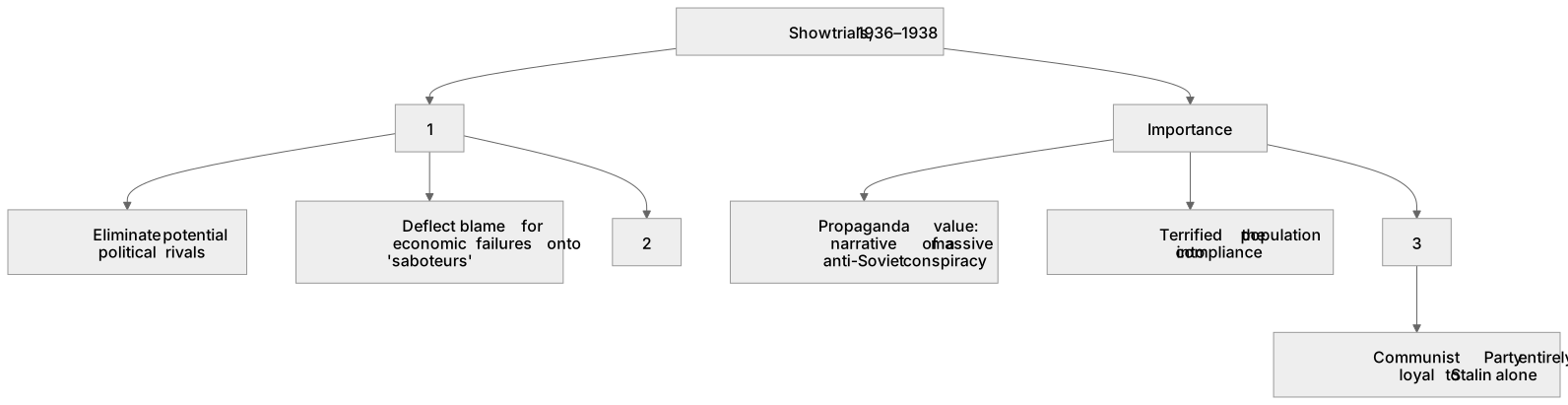
1Box 1
2Box 2
3Box 3
There is more to this lesson
The full lesson goes on to check your understanding and help you earn the marks. Create a free account to carry on, with your progress saved.
A week of Premium from your first lesson · Then the free plan continues · No card, no charge
Test your understanding of Option 30: Key topic 3: Stalin’s rise to power and dictatorship, 1924–41 - 2 The use of terror in the 1930s: The reasons for, and the importance of, the show trials of 1936–1938.
Active recall beats re-reading. Take an instant quiz now to test what you’ve learned and lock it into long-term memory.
A week of Premium from your first lesson · Then the free plan continues · No card, no charge