Pearson Edexcel · GCSE · History
Course version: 1HI0 · Version from Sept 2016
Key topic 3: Stalin’s rise to power and dictatorship, 1924–41 - 2 The use…
Full specification wording
Option 30: Key topic 3: Stalin’s rise to power and dictatorship, 1924–41 - 2 The use of terror in the 1930s: The work of the secret police (NKVD); the use of, and conditions in, the labour camps.
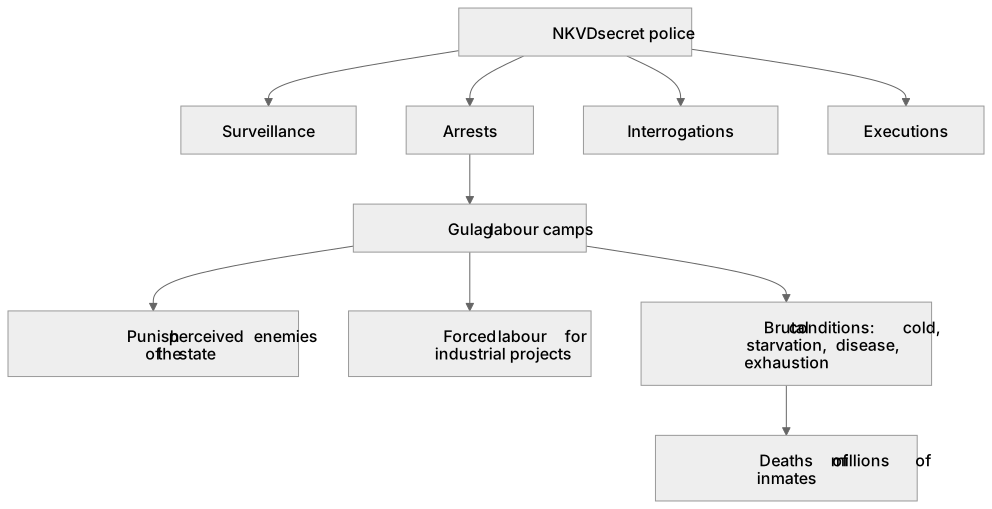
The NKVD, Stalin's secret police, was the primary instrument of state terror, responsible for surveillance, arrests, interrogations, and executions.
Checked against the Pearson Edexcel 1HI0 specification (opens in a new tab) on .
- Point 2 of 3
- 4 key terms
Study notes
From the checked teaching notes for this specification point.
The idea
The NKVD, Stalin's secret police, was the primary instrument of state terror, responsible for surveillance, arrests, interrogations, and executions. Under leaders like Yagoda, Yezhov, and Beria, the NKVD operated outside the law, using torture to extract false confessions. A key part of their work was managing the Gulag system—a vast network of labour camps. These camps were used to punish perceived enemies of the state and provide free slave labour for massive industrial projects, such as the White Sea Canal. Conditions in the labour camps were brutal, characterised by extreme cold, starvation rations, disease, and exhaustion, leading to the deaths of millions of inmates who were worked to death in appalling environments.
What earns the marks
- Describe the role of the NKVD in enforcing state terror through surveillance, arrests, and executions.
- Explain the use of the Gulag system as both a punitive measure for political prisoners and a source of forced labour for industrialisation.
- Detail the brutal conditions within the labour camps, including inadequate food, harsh weather, and high mortality rates.
- Identify key NKVD leaders (e.g., Yezhov) and their role in intensifying the terror during the 1930s.
Common mistakes and how to put them right
Assuming the NKVD only targeted high-profile politicians.
Put it right: Note that the NKVD arrested millions of ordinary citizens to meet arrest quotas.
Believing the labour camps were solely for extermination.
Put it right: Explain that while mortality was high, the primary purpose of the Gulags was economic exploitation through forced labour.
Confusing the NKVD with the earlier Cheka.
Put it right: Use the correct term (NKVD) for the secret police during the 1930s purges.
Exam tips
- Use the term 'Gulag' when referring to the network of labour camps and provide an example of a project built by forced labour, like the White Sea Canal.
- Discuss the dual purpose of the NKVD: eliminating political opposition and providing a slave labour force for the Five-Year Plans.
- Highlight the role of arrest quotas to demonstrate the arbitrary and systematic nature of NKVD terror.
Try the lesson
The start of the Option 30: Key topic 3: Stalin’s rise to power and dictatorship, 1924–41 - 2 The use of terror in the 1930s: The work of the secret police (NKVD); the use of, and conditions in, the labour camps. lesson, made from checked teaching notes for this specification point.
Have a go first
What was a key role of the secret police (NKVD) during the 1930s?
Listen
The NKVD, Stalin's secret police, was the primary instrument of state terror, responsible for surveillance, arrests, interrogations, and executions. Under leaders like Yagoda, Yezhov, and Beria, the NKVD operated outside the law, using torture to extract false confessions. A key part of their work was managing the Gulag system—a vast network of labour camps. These camps were used to punish perceived enemies of the state and provide free slave labour for massive industrial projects, such as the White Sea Canal. Conditions in the labour camps were brutal, characterised by extreme cold, starvation rations, disease, and exhaustion, leading to the deaths of millions of inmates who were worked to death in appalling environments. A strong answer earns marks for these points. Describe the role of the NKVD in enforcing state terror through surveillance, arrests, and executions. Explain the use of the Gulag system as both a punitive measure for political prisoners and a source of forced labour for industrialisation. Detail the brutal conditions within the labour camps, including inadequate food, harsh weather, and high mortality rates. Identify key NKVD leaders (e.g., Yezhov) and their role in intensifying the terror during the 1930s. A common slip: Assuming the NKVD only targeted high-profile politicians. Instead, note that the NKVD arrested millions of ordinary citizens to meet arrest quotas. Exam tip: Use the term 'Gulag' when referring to the network of labour camps and provide an example of a project built by forced labour, like the White Sea Canal.
See it
Key words
Say what each word means before you turn the card.
NKVD
Try answering aloud or in your head before turning the card.
Gulag
Try answering aloud or in your head before turning the card.
State terror
Try answering aloud or in your head before turning the card.
Forced labour
Try answering aloud or in your head before turning the card.
See every definition
- NKVD
- Stalin's secret police, the primary instrument of state terror, responsible for surveillance, arrests, interrogations and executions.
- Gulag
- A vast network of labour camps used to punish perceived enemies of the state and provide free slave labour for massive industrial projects.
- State terror
- Enforcement through the secret police's surveillance, arrests, interrogations and executions, operating outside the law and using torture to extract false confessions.
- Forced labour
- Free slave labour provided by labour camp inmates for massive industrial projects, such as the White Sea Canal.
Label the diagram
Some boxes have lost their names. Pick the right name for each number.
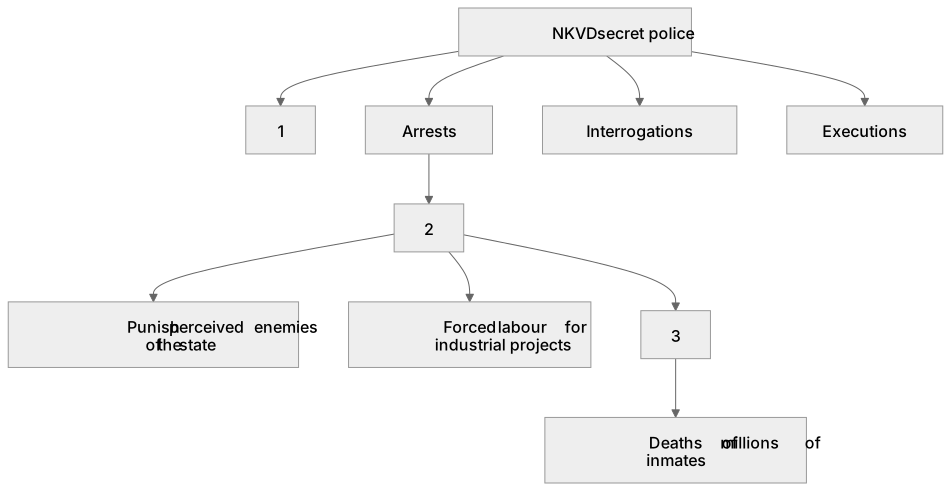
1Box 1
2Box 2
3Box 3
There is more to this lesson
The full lesson goes on to check your understanding and help you earn the marks. Create a free account to carry on, with your progress saved.
A week of Premium from your first lesson · Then the free plan continues · No card, no charge
Test your understanding of Option 30: Key topic 3: Stalin’s rise to power and dictatorship, 1924–41 - 2 The use of terror in the 1930s: The work of the secret police (NKVD); the use of, and conditions in, the labour camps.
Active recall beats re-reading. Take an instant quiz now to test what you’ve learned and lock it into long-term memory.
A week of Premium from your first lesson · Then the free plan continues · No card, no charge