Pearson Edexcel · GCSE · History
Course version: 1HI0 · Version from Sept 2016
Key topic 3: Stalin’s rise to power and dictatorship, 1924–41 - 4 The Cult…
Full specification wording
Option 30: Key topic 3: Stalin’s rise to power and dictatorship, 1924–41 - 4 The Cult of Stalin: How the Cult of Stalin was achieved.
The Cult of Stalin was achieved through relentless propaganda, censorship, and the rewriting of history.
Checked against the Pearson Edexcel 1HI0 specification (opens in a new tab) on .
- Point 2 of 2
- 4 key terms
Study notes
From the checked teaching notes for this specification point.
The idea
The Cult of Stalin was achieved through relentless propaganda, censorship, and the rewriting of history. Visual arts played a crucial role; millions of portraits and statues depicted Stalin as a heroic leader, often surrounded by adoring children. History was systematically altered, notably through the 'Short Course' on the history of the Communist Party, which exaggerated Stalin's role in the 1917 Revolution and erased rivals like Trotsky from photographs. Literature and music were heavily censored and directed to praise Stalin's genius. Furthermore, places were renamed in his honour, such as Stalingrad, ensuring his name and image permeated every aspect of daily Soviet life, making him an inescapable presence.
What earns the marks
- Describe the widespread use of visual propaganda, including posters, statues, and paintings, to project an idealised image of Stalin.
- Explain the role of censorship and the rewriting of history, such as the doctoring of photographs to remove political rivals.
- Identify the publication of the 'Short Course' as a key method of indoctrinating the population with a Stalin-centric version of history.
- Discuss the mobilisation of the arts, where writers and artists were forced to produce works glorifying Stalin (Socialist Realism).
- Note the renaming of cities, streets, and institutions after Stalin to ensure his constant presence in everyday life.
Common mistakes and how to put them right
Describing the cult's features without explaining the mechanisms used to enforce it.
Put it right: Focus on the active processes of censorship, state control of media, and the rewriting of history.
Confusing the Cult of Stalin with Lenin's cult.
Put it right: While Stalin built upon Lenin's cult, ensure examples specifically relate to how Stalin's own image was manufactured and promoted.
Stating that all Soviet citizens genuinely believed the propaganda.
Put it right: Acknowledge that while the cult was pervasive, many citizens conformed out of fear rather than genuine belief.
Exam tips
- Provide specific examples of how history was rewritten, such as the removal of Trotsky from revolutionary photographs.
- Mention the 'Short Course' as a specific piece of evidence when discussing how the cult was achieved through education and literature.
- Link the achievement of the cult to the concept of Socialist Realism, where all art had to serve the state and glorify the leader.
Try the lesson
The start of the Option 30: Key topic 3: Stalin’s rise to power and dictatorship, 1924–41 - 4 The Cult of Stalin: How the Cult of Stalin was achieved. lesson, made from checked teaching notes for this specification point.
Have a go first
Which method was widely used to promote the Cult of Stalin throughout the Soviet Union?
Listen
The Cult of Stalin was achieved through relentless propaganda, censorship, and the rewriting of history. Visual arts played a crucial role; millions of portraits and statues depicted Stalin as a heroic leader, often surrounded by adoring children. History was systematically altered, notably through the 'Short Course' on the history of the Communist Party, which exaggerated Stalin's role in the 1917 Revolution and erased rivals like Trotsky from photographs. Literature and music were heavily censored and directed to praise Stalin's genius. Furthermore, places were renamed in his honour, such as Stalingrad, ensuring his name and image permeated every aspect of daily Soviet life, making him an inescapable presence. A strong answer earns marks for these points. Describe the widespread use of visual propaganda, including posters, statues, and paintings, to project an idealised image of Stalin. Explain the role of censorship and the rewriting of history, such as the doctoring of photographs to remove political rivals. Identify the publication of the 'Short Course' as a key method of indoctrinating the population with a Stalin-centric version of history. Discuss the mobilisation of the arts, where writers and artists were forced to produce works glorifying Stalin (Socialist Realism). A common slip: Describing the cult's features without explaining the mechanisms used to enforce it. Instead, Focus on the active processes of censorship, state control of media, and the rewriting of history. Exam tip: Provide specific examples of how history was rewritten, such as the removal of Trotsky from revolutionary photographs.
See it
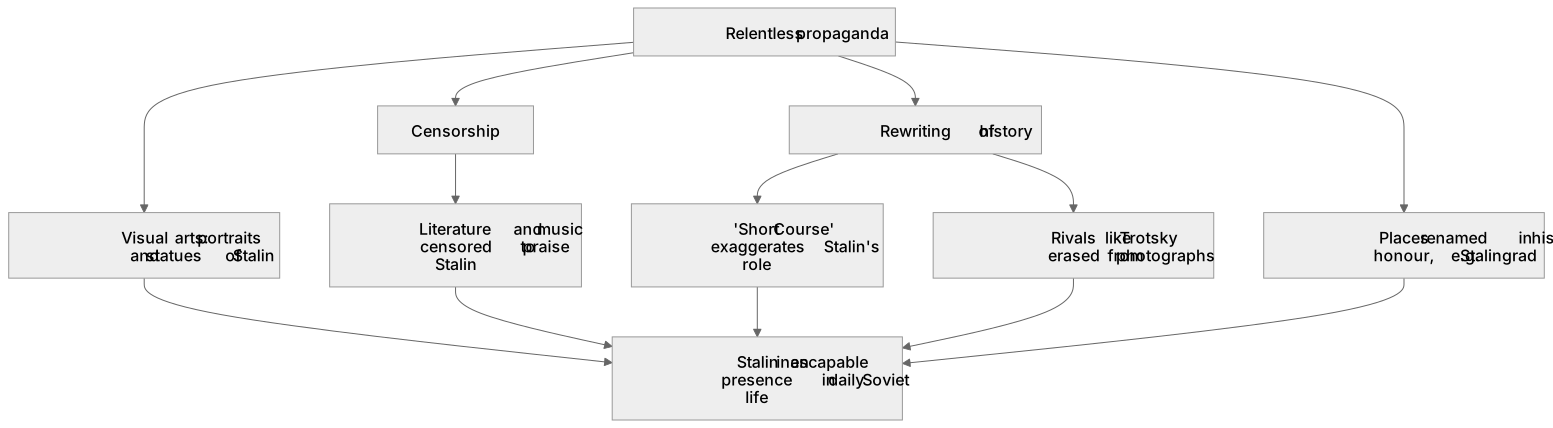
Key words
Say what each word means before you turn the card.
Propaganda and censorship
Try answering aloud or in your head before turning the card.
Rewriting history
Try answering aloud or in your head before turning the card.
The arts and Socialist Realism
Try answering aloud or in your head before turning the card.
Short Course
Try answering aloud or in your head before turning the card.
See every definition
- Propaganda and censorship
- Relentless propaganda and censorship were used to achieve the Cult of Stalin, with literature and music heavily censored and directed to praise Stalin's genius.
- Rewriting history
- History was systematically altered, notably through the 'Short Course' on the history of the Communist Party, which exaggerated Stalin's role in the 1917 Revolution and erased rivals like Trotsky from photographs.
- The arts and Socialist Realism
- Writers and artists were forced to produce works glorifying Stalin, and literature and music were directed to praise his genius.
- Short Course
- A publication on the history of the Communist Party that exaggerated Stalin's role in the 1917 Revolution and erased rivals like Trotsky from photographs.
Label the diagram
Some boxes have lost their names. Pick the right name for each number.
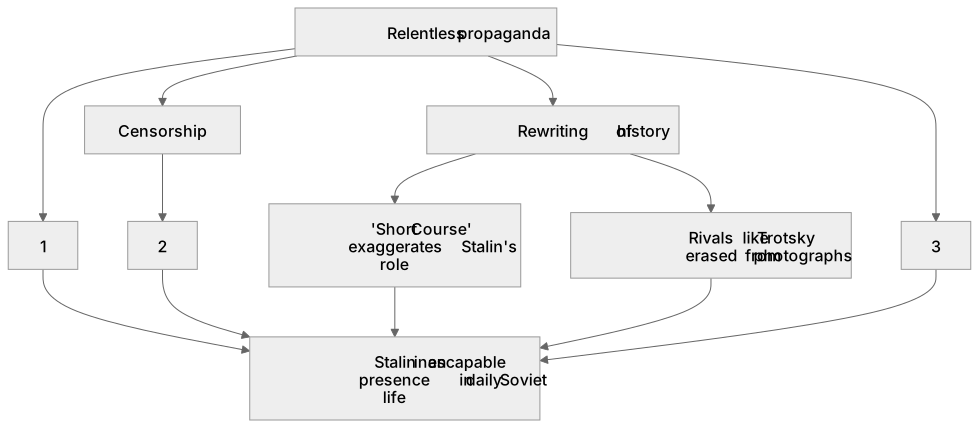
1Box 1
2Box 2
3Box 3
There is more to this lesson
The full lesson goes on to check your understanding and help you earn the marks. Create a free account to carry on, with your progress saved.
A week of Premium from your first lesson · Then the free plan continues · No card, no charge
Test your understanding of Option 30: Key topic 3: Stalin’s rise to power and dictatorship, 1924–41 - 4 The Cult of Stalin: How the Cult of Stalin was achieved.
Active recall beats re-reading. Take an instant quiz now to test what you’ve learned and lock it into long-term memory.
A week of Premium from your first lesson · Then the free plan continues · No card, no charge