Pearson Edexcel · GCSE · History
Course version: 1HI0 · Version from Sept 2016
Key topic 3: Stalin’s rise to power and dictatorship, 1924–41 - 4 The Cult…
Full specification wording
Option 30: Key topic 3: Stalin’s rise to power and dictatorship, 1924–41 - 4 The Cult of Stalin: The meaning of the Cult of Stalin and reasons for its introduction.
The Cult of Stalin was a state-sponsored propaganda campaign elevating Stalin to a god-like status, presenting him as an infallible leader, the 'father of the nation', and Lenin's rightful successor.
Checked against the Pearson Edexcel 1HI0 specification (opens in a new tab) on .
- Point 1 of 2
Study notes
From the checked teaching notes for this specification point.
The idea
The Cult of Stalin was a state-sponsored propaganda campaign elevating Stalin to a god-like status, presenting him as an infallible leader, the 'father of the nation', and Lenin's rightful successor. Its meaning lay in creating a unifying figurehead for the Soviet people during immense upheaval. The reasons for its introduction were multifaceted. Firstly, it aimed to consolidate Stalin's personal power by making him synonymous with the state, delegitimising any opposition. Secondly, it sought to inspire loyalty and motivate the workforce during the gruelling Five-Year Plans and collectivisation. Finally, it provided a sense of stability and reassurance amidst the chaos of rapid industrialisation and the terror of the purges.
What earns the marks
- Define the Cult of Stalin as the artificial creation of a god-like image of Stalin through propaganda.
- Explain how the cult portrayed Stalin as Lenin's closest comrade and the only legitimate heir to his legacy.
- Identify the consolidation of Stalin's absolute power as a primary reason for the cult's introduction.
- Discuss how the cult was used to motivate the Soviet population during the hardships of the Five-Year Plans and collectivisation.
- Analyse the psychological role of the cult in providing a reassuring father figure during the instability of the 1930s.
Common mistakes and how to put them right
Assuming the Cult of Stalin emerged naturally from genuine public adoration.
Put it right: Emphasise that the cult was a deliberately manufactured propaganda campaign orchestrated by the state.
Focusing only on the visual aspects of the cult without explaining its political purpose.
Put it right: Link the imagery of the cult to Stalin's need to secure his dictatorship and eliminate rivals.
Overlooking the connection between the cult and Lenin.
Put it right: Highlight that a key part of the cult was rewriting history to exaggerate Stalin's closeness to Lenin.
Exam tips
- Use the phrase 'father of the nation' to describe how Stalin was presented to the Soviet people.
- When explaining reasons for the cult, link it to the economic policies of the 1930s; Stalin needed a devoted workforce to achieve his ambitious targets.
- Consider how the cult acted as a substitute for religion, which the Communist Party was actively suppressing.
Try the lesson
The start of the Option 30: Key topic 3: Stalin’s rise to power and dictatorship, 1924–41 - 4 The Cult of Stalin: The meaning of the Cult of Stalin and reasons for its introduction. lesson, made from checked teaching notes for this specification point.
Have a go first
What was the primary meaning of the 'Cult of Stalin' in the Soviet Union?
Listen
The Cult of Stalin was a state-sponsored propaganda campaign elevating Stalin to a god-like status, presenting him as an infallible leader, the 'father of the nation', and Lenin's rightful successor. Its meaning lay in creating a unifying figurehead for the Soviet people during immense upheaval. The reasons for its introduction were multifaceted. Firstly, it aimed to consolidate Stalin's personal power by making him synonymous with the state, delegitimising any opposition. Secondly, it sought to inspire loyalty and motivate the workforce during the gruelling Five-Year Plans and collectivisation. Finally, it provided a sense of stability and reassurance amidst the chaos of rapid industrialisation and the terror of the purges. A strong answer earns marks for these points. Define the Cult of Stalin as the artificial creation of a god-like image of Stalin through propaganda. Explain how the cult portrayed Stalin as Lenin's closest comrade and the only legitimate heir to his legacy. Identify the consolidation of Stalin's absolute power as a primary reason for the cult's introduction. Discuss how the cult was used to motivate the Soviet population during the hardships of the Five-Year Plans and collectivisation. A common slip: Assuming the Cult of Stalin emerged naturally from genuine public adoration. Instead, Emphasise that the cult was a deliberately manufactured propaganda campaign orchestrated by the state. Exam tip: Use the phrase 'father of the nation' to describe how Stalin was presented to the Soviet people.
See it
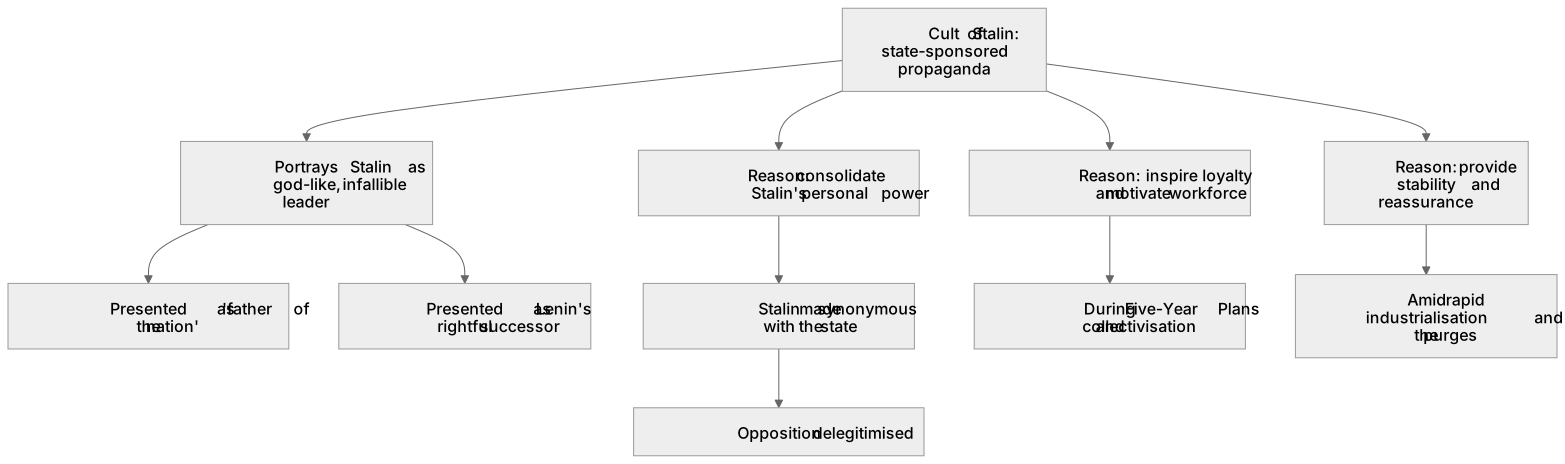
Label the diagram
Some boxes have lost their names. Pick the right name for each number.
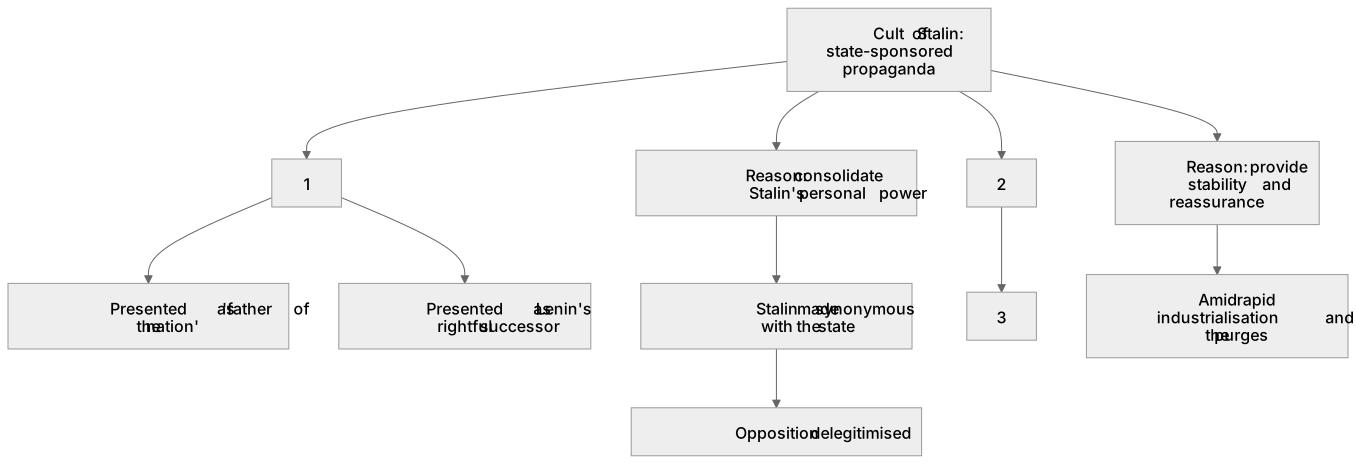
1Box 1
2Box 2
3Box 3
There is more to this lesson
The full lesson goes on to check your understanding and help you earn the marks. Create a free account to carry on, with your progress saved.
A week of Premium from your first lesson · Then the free plan continues · No card, no charge
Test your understanding of Option 30: Key topic 3: Stalin’s rise to power and dictatorship, 1924–41 - 4 The Cult of Stalin: The meaning of the Cult of Stalin and reasons for its introduction.
Active recall beats re-reading. Take an instant quiz now to test what you’ve learned and lock it into long-term memory.
A week of Premium from your first lesson · Then the free plan continues · No card, no charge