Pearson Edexcel · GCSE · History
Course version: 1HI0 · Version from Sept 2016
Key topic 4: Economic and social changes, 1924–41 - 3 Life in the Soviet…
Full specification wording
Option 30: Key topic 4: Economic and social changes, 1924–41 - 3 Life in the Soviet Union: Living and working conditions in towns and the countryside.
Life in the Soviet Union between 1924 and 1941 was characterised by harsh living and working conditions across both towns and the countryside.
Checked against the Pearson Edexcel 1HI0 specification (opens in a new tab) on .
- Point 1 of 2
- 4 key terms
Study notes
From the checked teaching notes for this specification point.
The idea
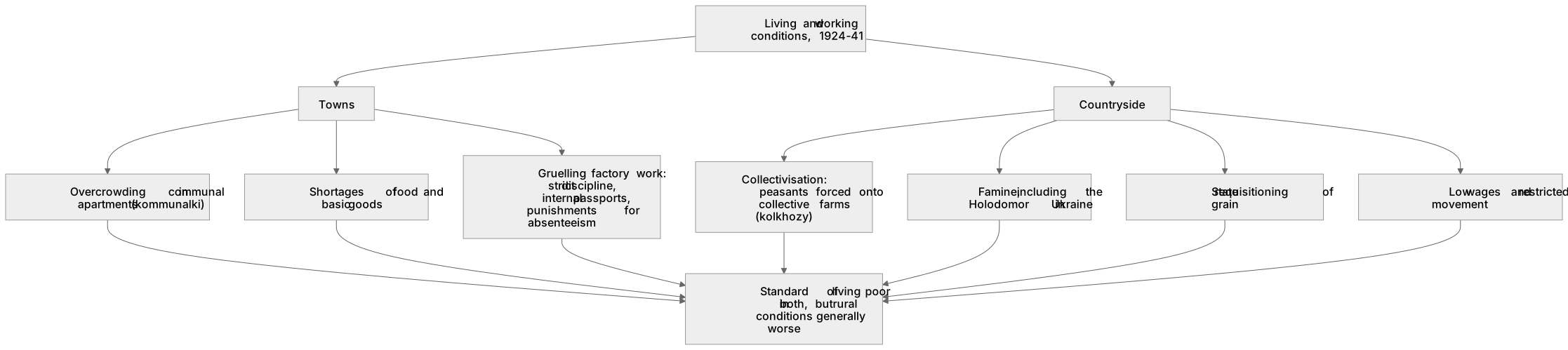
Life in the Soviet Union between 1924 and 1941 was characterised by harsh living and working conditions across both towns and the countryside. In towns, rapid urbanisation led to severe overcrowding, with families often sharing single rooms in communal apartments (kommunalki) and facing chronic shortages of food and basic goods. Working conditions in factories were gruelling, featuring strict discipline, internal passports, and severe punishments for absenteeism. In the countryside, collectivisation devastated rural life. Peasants were forced onto collective farms (kolkhozy), enduring famine, particularly the Holodomor in Ukraine, and brutal state requisitioning of grain. Agricultural workers faced low wages, restricted movement, and a standard of living that remained significantly lower than that of urban workers.
What earns the marks
- Describe the severe overcrowding and lack of privacy in urban communal apartments (kommunalki).
- Explain the strict labour discipline in factories, including the introduction of internal passports and harsh penalties for lateness.
- Detail the impact of collectivisation on the countryside, including the loss of peasant independence and the devastating famines of 1932-33.
- Compare the standard of living between urban and rural areas, noting that while both were poor, rural conditions were generally worse due to state requisitioning.
Common mistakes and how to put them right
Assuming urban workers had comfortable lives due to industrialisation.
Put it right: Explain that rapid urbanisation led to extreme overcrowding and poor sanitation.
Overlooking the severity of rural conditions.
Put it right: Explicitly mention the famines and the harsh realities of life on collective farms.
Treating towns and the countryside as having identical experiences.
Put it right: Highlight the specific differences, such as urban overcrowding versus rural starvation and grain requisitioning.
Exam tips
- Use the term 'kommunalki' to demonstrate specific knowledge of urban living conditions.
- Connect the working conditions in towns directly to the demands of the Five-Year Plans and the Stakhanovite movement.
- When discussing the countryside, ensure you mention the impact of state grain requisitioning on the daily lives and survival of the peasantry.
Try the lesson
The start of the Option 30: Key topic 4: Economic and social changes, 1924–41 - 3 Life in the Soviet Union: Living and working conditions in towns and the countryside. lesson, made from checked teaching notes for this specification point.
Have a go first
What was a common feature of living conditions in Soviet towns during the rapid industrialisation of the 1930s?
Listen
Life in the Soviet Union between 1924 and 1941 was characterised by harsh living and working conditions across both towns and the countryside. In towns, rapid urbanisation led to severe overcrowding, with families often sharing single rooms in communal apartments (kommunalki) and facing chronic shortages of food and basic goods. Working conditions in factories were gruelling, featuring strict discipline, internal passports, and severe punishments for absenteeism. In the countryside, collectivisation devastated rural life. Peasants were forced onto collective farms (kolkhozy), enduring famine, particularly the Holodomor in Ukraine, and brutal state requisitioning of grain. Agricultural workers faced low wages, restricted movement, and a standard of living that remained significantly lower than that of urban workers. A strong answer earns marks for these points. Describe the severe overcrowding and lack of privacy in urban communal apartments (kommunalki). Explain the strict labour discipline in factories, including the introduction of internal passports and harsh penalties for lateness. Detail the impact of collectivisation on the countryside, including the loss of peasant independence and the devastating famines of 1932-33. Compare the standard of living between urban and rural areas, noting that while both were poor, rural conditions were generally worse due to state requisitioning. A common slip: Assuming urban workers had comfortable lives due to industrialisation. Instead, explain that rapid urbanisation led to extreme overcrowding and poor sanitation. Exam tip: Use the term 'kommunalki' to demonstrate specific knowledge of urban living conditions.
See it
Key words
Say what each word means before you turn the card.
Urbanisation and housing
Try answering aloud or in your head before turning the card.
Labour discipline and state control
Try answering aloud or in your head before turning the card.
Rural hardship and collectivisation
Try answering aloud or in your head before turning the card.
Standard of living
Try answering aloud or in your head before turning the card.
See every definition
- Urbanisation and housing
- Rapid urbanisation led to severe overcrowding, with families often sharing single rooms in communal apartments and facing chronic shortages of food and basic goods.
- Labour discipline and state control
- Working conditions in factories were gruelling, featuring strict discipline, internal passports, and severe punishments for absenteeism.
- Rural hardship and collectivisation
- Collectivisation devastated rural life, as peasants were forced onto collective farms, enduring famine and brutal state requisitioning of grain.
- Standard of living
- Agricultural workers faced low wages and restricted movement, and their standard of living remained significantly lower than that of urban workers.
Label the diagram
Some boxes have lost their names. Pick the right name for each number.
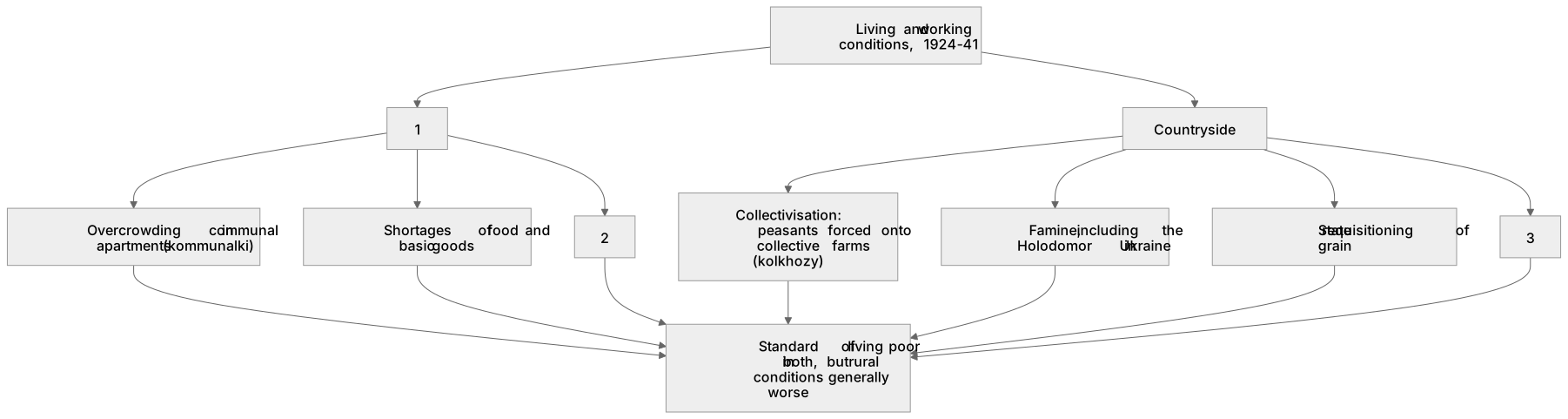
1Box 1
2Box 2
3Box 3
There is more to this lesson
The full lesson goes on to check your understanding and help you earn the marks. Create a free account to carry on, with your progress saved.
A week of Premium from your first lesson · Then the free plan continues · No card, no charge
Test your understanding of Option 30: Key topic 4: Economic and social changes, 1924–41 - 3 Life in the Soviet Union: Living and working conditions in towns and the countryside.
Active recall beats re-reading. Take an instant quiz now to test what you’ve learned and lock it into long-term memory.
A week of Premium from your first lesson · Then the free plan continues · No card, no charge