Pearson Edexcel · GCSE · History
Course version: 1HI0 · Version from Sept 2016
Key topic 4: Economic and social changes, 1924–41 - 3 Life in the Soviet…
Full specification wording
Option 30: Key topic 4: Economic and social changes, 1924–41 - 3 Life in the Soviet Union: The differing experiences of social groups.
The Soviet Union under Stalin saw vastly differing experiences among social groups, contradicting the communist ideal of an egalitarian society.
Checked against the Pearson Edexcel 1HI0 specification (opens in a new tab) on .
- Point 2 of 2
- 3 key terms
Study notes
From the checked teaching notes for this specification point.
The idea
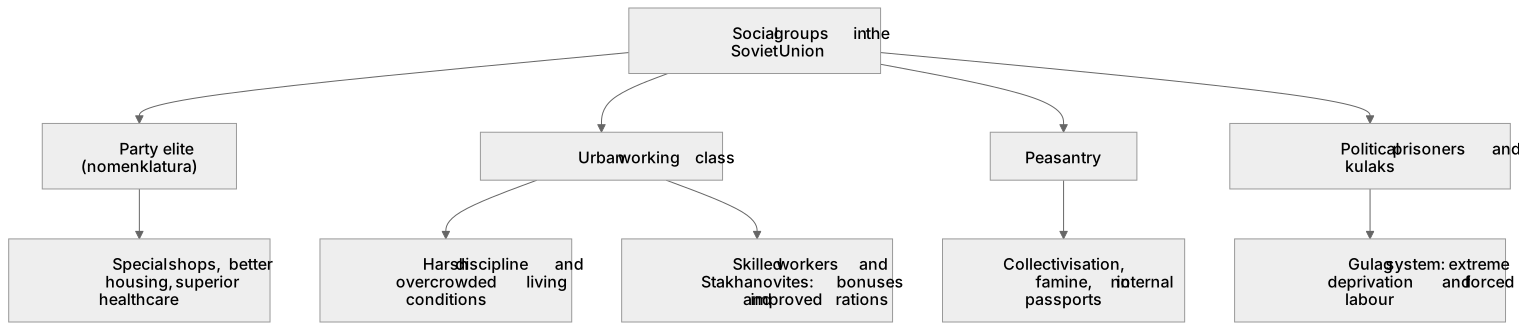
The Soviet Union under Stalin saw vastly differing experiences among social groups, contradicting the communist ideal of an egalitarian society. The Party elite, or nomenklatura, enjoyed significant privileges, including access to special shops, better housing, and superior healthcare. In contrast, the urban working class faced harsh discipline and overcrowded living conditions, although some skilled workers and Stakhanovites received bonuses and improved rations. The peasantry suffered the most, enduring the brutality of collectivisation, famine, and a lack of internal passports, which tied them to collective farms. Meanwhile, political prisoners and kulaks were relegated to the Gulag system, experiencing extreme deprivation and forced labour, highlighting the deep social stratification of the era.
What earns the marks
- Identify the privileges enjoyed by the nomenklatura, such as access to exclusive shops and better apartments.
- Explain how the Stakhanovite movement created a hierarchy among urban workers, rewarding high achievers with better pay and perks.
- Describe the severe hardships faced by the peasantry, including starvation and restricted movement compared to urban dwellers.
- Detail the extreme suffering of marginalised groups, such as kulaks and political prisoners, who were forced into the Gulag system.
Common mistakes and how to put them right
Stating that all Soviet citizens lived in equal poverty.
Put it right: Highlight the emergence of the privileged nomenklatura class.
Ignoring the differences within the working class.
Put it right: Explain that skilled workers and Stakhanovites had significantly better experiences than unskilled labourers.
Forgetting to include the peasantry as a distinct social group.
Put it right: Ensure the rural experience of collectivisation is contrasted with urban life.
Exam tips
- Use the term 'nomenklatura' to describe the privileged Party elite and provide examples of their specific benefits.
- Contrast the experiences of a Stakhanovite worker with an ordinary unskilled labourer to show depth of knowledge.
- Ensure you address at least three distinct social groups (e.g., elite, workers, peasants) when asked about differing experiences.
Try the lesson
The start of the Option 30: Key topic 4: Economic and social changes, 1924–41 - 3 Life in the Soviet Union: The differing experiences of social groups. lesson, made from checked teaching notes for this specification point.
Have a go first
Which social group in the Soviet Union generally experienced the most privileged lifestyle during the 1930s?
Listen
The Soviet Union under Stalin saw vastly differing experiences among social groups, contradicting the communist ideal of an egalitarian society. The Party elite, or nomenklatura, enjoyed significant privileges, including access to special shops, better housing, and superior healthcare. In contrast, the urban working class faced harsh discipline and overcrowded living conditions, although some skilled workers and Stakhanovites received bonuses and improved rations. The peasantry suffered the most, enduring the brutality of collectivisation, famine, and a lack of internal passports, which tied them to collective farms. Meanwhile, political prisoners and kulaks were relegated to the Gulag system, experiencing extreme deprivation and forced labour, highlighting the deep social stratification of the era. A strong answer earns marks for these points. Identify the privileges enjoyed by the nomenklatura, such as access to exclusive shops and better apartments. Explain how the Stakhanovite movement created a hierarchy among urban workers, rewarding high achievers with better pay and perks. Describe the severe hardships faced by the peasantry, including starvation and restricted movement compared to urban dwellers. Detail the extreme suffering of marginalised groups, such as kulaks and political prisoners, who were forced into the Gulag system. A common slip: Stating that all Soviet citizens lived in equal poverty. Instead, highlight the emergence of the privileged nomenklatura class. Exam tip: Use the term 'nomenklatura' to describe the privileged Party elite and provide examples of their specific benefits.
See it
Key words
Say what each word means before you turn the card.
Social stratification
Try answering aloud or in your head before turning the card.
Nomenklatura
Try answering aloud or in your head before turning the card.
Gulag system
Try answering aloud or in your head before turning the card.
See every definition
- Social stratification
- The deep division of Soviet society into groups with vastly differing experiences, contradicting the communist ideal of an egalitarian society.
- Nomenklatura
- The Party elite, who enjoyed significant privileges including access to special shops, better housing and superior healthcare.
- Gulag system
- Where political prisoners and kulaks were relegated, experiencing extreme deprivation and forced labour.
Label the diagram
Some boxes have lost their names. Pick the right name for each number.
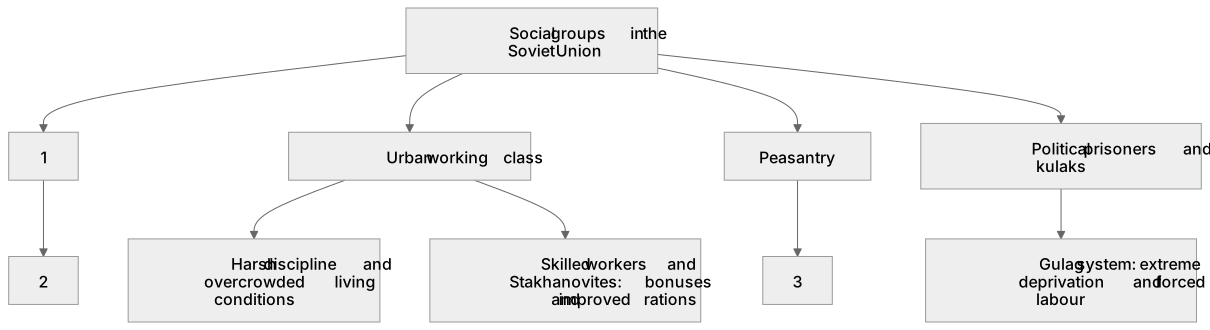
1Box 1
2Box 2
3Box 3
There is more to this lesson
The full lesson goes on to check your understanding and help you earn the marks. Create a free account to carry on, with your progress saved.
A week of Premium from your first lesson · Then the free plan continues · No card, no charge
Test your understanding of Option 30: Key topic 4: Economic and social changes, 1924–41 - 3 Life in the Soviet Union: The differing experiences of social groups.
Active recall beats re-reading. Take an instant quiz now to test what you’ve learned and lock it into long-term memory.
A week of Premium from your first lesson · Then the free plan continues · No card, no charge