Pearson Edexcel · GCSE · History
Course version: 1HI0 · Version from Sept 2016
Key topic 1: The Weimar Republic 1918–29 - 1 The origins of the Republic,…
Full specification wording
Option 31: Key topic 1: The Weimar Republic 1918–29 - 1 The origins of the Republic, 1918–19: The situation in Germany at the end of the War: political unrest, abdication of the Kaiser, armistice and new republic.
By November 1918, Germany faced severe political unrest driven by military defeat, naval mutinies at Kiel, and widespread starvation caused by the Allied blockade.
Checked against the Pearson Edexcel 1HI0 specification (opens in a new tab) on .
- Point 1 of 2
- 4 key terms
Study notes
From the checked teaching notes for this specification point.
The idea
By November 1918, Germany faced severe political unrest driven by military defeat, naval mutinies at Kiel, and widespread starvation caused by the Allied blockade. This turmoil forced the abdication of Kaiser Wilhelm II on 9 November, as he lost the support of the military and the public, fleeing to the Netherlands. Following his departure, a new republic was hastily declared by Philipp Scheidemann to prevent a communist revolution. Two days later, on 11 November, the representative of this new government, Matthias Erzberger, signed the armistice, ending the First World War. This sequence of events inextricably linked the birth of the new democratic republic with the trauma of defeat and surrender, creating immediate legitimacy issues.
What earns the marks
- Describe the causes of political unrest, including the Kiel Mutiny and civilian suffering from the Allied blockade.
- Explain the circumstances of the Kaiser's abdication on 9 November 1918 following the loss of military support.
- Detail the declaration of the new republic by Philipp Scheidemann to preempt a communist takeover.
- Identify the signing of the armistice on 11 November 1918 by the new government as a key source of future resentment.
Common mistakes and how to put them right
Stating the Kaiser signed the armistice.
Put it right: Clarify that the Kaiser abdicated before the armistice, which was signed by representatives of the new republic.
Confusing the armistice with the Treaty of Versailles.
Put it right: The armistice was the ceasefire in November 1918; the Treaty of Versailles was the peace settlement in June 1919.
Assuming the republic was planned long in advance.
Put it right: Emphasise that the republic was declared hastily to prevent a communist revolution led by the Spartacists.
Exam tips
- Create a clear timeline of events for November 1918 to ensure you sequence the mutiny, abdication, republic declaration, and armistice correctly.
- Use the term 'November Criminals' to link the signing of the armistice to the later unpopularity of the new republic.
- Highlight the role of the Kiel Mutiny as the catalyst that transformed military defeat into widespread political revolution.
Try the lesson
The start of the Option 31: Key topic 1: The Weimar Republic 1918–29 - 1 The origins of the Republic, 1918–19: The situation in Germany at the end of the War: political unrest, abdication of the Kaiser, armistice and new republic. lesson, made from checked teaching notes for this specification point.
Have a go first
Which event directly led to the creation of the new German Republic in November 1918?
Listen
By November 1918, Germany faced severe political unrest driven by military defeat, naval mutinies at Kiel, and widespread starvation caused by the Allied blockade. This turmoil forced the abdication of Kaiser Wilhelm II on 9 November, as he lost the support of the military and the public, fleeing to the Netherlands. Following his departure, a new republic was hastily declared by Philipp Scheidemann to prevent a communist revolution. Two days later, on 11 November, the representative of this new government, Matthias Erzberger, signed the armistice, ending the First World War. This sequence of events inextricably linked the birth of the new democratic republic with the trauma of defeat and surrender, creating immediate legitimacy issues. A strong answer earns marks for these points. Describe the causes of political unrest, including the Kiel Mutiny and civilian suffering from the Allied blockade. Explain the circumstances of the Kaiser's abdication on 9 November 1918 following the loss of military support. Detail the declaration of the new republic by Philipp Scheidemann to preempt a communist takeover. Identify the signing of the armistice on 11 November 1918 by the new government as a key source of future resentment. A common slip: Stating the Kaiser signed the armistice. Instead, Clarify that the Kaiser abdicated before the armistice, which was signed by representatives of the new republic. Exam tip: Create a clear timeline of events for November 1918 to ensure you sequence the mutiny, abdication, republic declaration, and armistice correctly.
See it
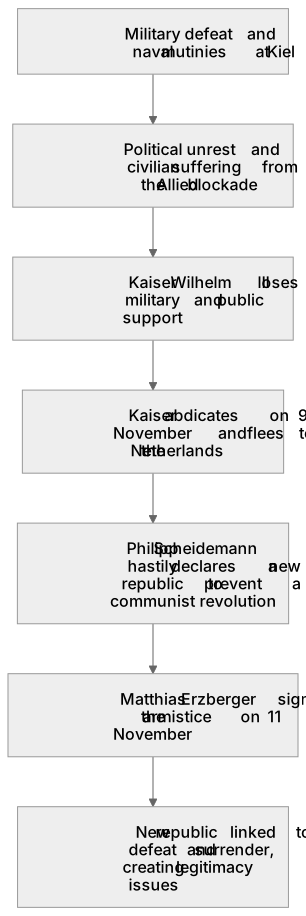
Put it in order
Put these steps in the order they happen.
- 1. New republic linked to defeat and surrender, creating legitimacy issues
- 2. Matthias Erzberger signs the armistice on 11 November
- 3. Kaiser Wilhelm II loses military and public support
- 4. Philipp Scheidemann hastily declares a new republic to prevent a communist revolution
- 5. Military defeat and naval mutinies at Kiel
- 6. Political unrest and civilian suffering from the Allied blockade
- 7. Kaiser abdicates on 9 November and flees to the Netherlands
Watch it explained
What is the one idea the video explains? Say it in a sentence.
Read the described scene instead
By November 1918, Germany was close to collapse. Four years of war had brought military defeat, and the Allied blockade had left civilians starving. Naval mutinies at Kiel spread quickly into wider political unrest across the country. Kaiser Wilhelm II had lost the support of the military and the public. On 9 November 1918 he abdicated and fled to the Netherlands. The old monarchy was gone, but nothing had yet been agreed to replace it. Fearing a communist revolution, the Social Democrat Philipp Scheidemann hastily declared a new republic from a balcony in Berlin. He acted to pre-empt the Spartacists rather than to carry out a long-planned design. The republic's birth was improvised and contested. Two days later, on 11 November 1918, Matthias Erzberger signed the armistice on behalf of the new government. It ended the fighting of the First World War. Because the new republic, not the Kaiser, signed, it was tied from the start to the trauma of surrender. Three errors are common. The Kaiser did not sign the armistice: he had already abdicated, and the new government's representative did. The armistice was a ceasefire in November 1918; the Treaty of Versailles was the peace settlement of June 1919. And the republic was not planned long in advance: it was declared to block a revolution. Pause and try ordering these four events yourself. There is a useful connection here. Each step made the republic's legitimacy harder to establish: revolution, defeat, a rushed transfer of power, and the surrender signed in its name. Critics later called those who signed the November Criminals. Order the timeline: mutiny, abdication, republic, armistice.
Key words
Say what each word means before you turn the card.
Revolution
Try answering aloud or in your head before turning the card.
Defeat
Try answering aloud or in your head before turning the card.
Transition of power
Try answering aloud or in your head before turning the card.
Political instability
Try answering aloud or in your head before turning the card.
See every definition
- Revolution
- A communist revolution was what the new republic was hastily declared to prevent.
- Defeat
- Military defeat drove severe political unrest in Germany by November 1918.
- Transition of power
- The abdication of the Kaiser led to a new republic being hastily declared.
- Political instability
- Political unrest, naval mutinies and widespread starvation forced the abdication of the Kaiser.
Label the diagram
Some boxes have lost their names. Pick the right name for each number.
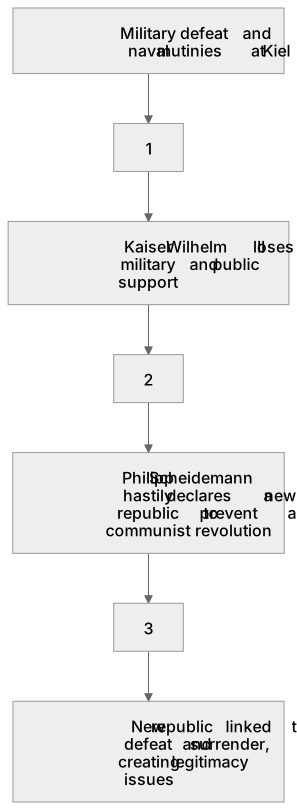
1Box 1
2Box 2
3Box 3
There is more to this lesson
The full lesson goes on to check your understanding and help you earn the marks. Create a free account to carry on, with your progress saved.
A week of Premium from your first lesson · Then the free plan continues · No card, no charge
Test your understanding of Option 31: Key topic 1: The Weimar Republic 1918–29 - 1 The origins of the Republic, 1918–19: The situation in Germany at the end of the War: political unrest, abdication of the Kaiser, armistice and new republic.
Active recall beats re-reading. Take an instant quiz now to test what you’ve learned and lock it into long-term memory.
A week of Premium from your first lesson · Then the free plan continues · No card, no charge