Pearson Edexcel · GCSE · History
Course version: 1HI0 · Version from Sept 2016
Key topic 1: The Weimar Republic 1918–29 - 1 The origins of the Republic,…
Full specification wording
Option 31: Key topic 1: The Weimar Republic 1918–29 - 1 The origins of the Republic, 1918–19: The strengths and weaknesses of the new Weimar Constitution.
The Weimar Constitution, established in 1919, was designed to be highly democratic but contained fatal flaws.
Checked against the Pearson Edexcel 1HI0 specification (opens in a new tab) on .
- Point 2 of 2
Study notes
From the checked teaching notes for this specification point.
The idea
The Weimar Constitution, established in 1919, was designed to be highly democratic but contained fatal flaws. Its strengths included universal suffrage for men and women over 20, a strong bill of rights guaranteeing freedom of speech and religion, and a system of checks and balances between the President, Chancellor, and the Reichstag. However, its weaknesses severely undermined the new republic. Proportional representation led to a proliferation of small, extremist parties and weak, short-lived coalition governments that struggled to pass laws. Furthermore, Article 48 gave the President emergency powers to bypass the Reichstag and rule by decree, a loophole that was later exploited to dismantle German democracy entirely.
What earns the marks
- Identify universal suffrage and the protection of civil liberties as key democratic strengths of the constitution.
- Explain how proportional representation resulted in weak coalition governments and political instability.
- Describe the function of Article 48 and how it undermined the democratic process by allowing rule by decree.
- Analyse the system of checks and balances designed to prevent any single person or group from gaining too much power.
Common mistakes and how to put them right
Claiming proportional representation is inherently bad.
Put it right: State that while it is highly democratic and fair, in Weimar Germany it led to unstable coalitions and gave extremist parties a platform.
Confusing the roles of the President and the Chancellor.
Put it right: The President was elected every seven years and controlled Article 48; the Chancellor was appointed by the President and ran the day-to-day government.
Stating Article 48 was only used by Hitler.
Put it right: Note that earlier Presidents, like Ebert and Hindenburg, used Article 48 frequently during crises before Hitler became Chancellor.
Exam tips
- Memorise specific details, such as the voting age of 20 and the specific number of the emergency decree clause, Article 48.
- When evaluating the constitution, balance your answer by explicitly contrasting a democratic strength with a practical weakness.
- Link the weakness of proportional representation directly to the difficulty the Weimar Republic faced in dealing with economic crises.
Try the lesson
The start of the Option 31: Key topic 1: The Weimar Republic 1918–29 - 1 The origins of the Republic, 1918–19: The strengths and weaknesses of the new Weimar Constitution. lesson, made from checked teaching notes for this specification point.
Have a go first
Which of the following was a key strength of the new Weimar Constitution established in 1919?
Listen
The Weimar Constitution, established in 1919, was designed to be highly democratic but contained fatal flaws. Its strengths included universal suffrage for men and women over 20, a strong bill of rights guaranteeing freedom of speech and religion, and a system of checks and balances between the President, Chancellor, and the Reichstag. However, its weaknesses severely undermined the new republic. Proportional representation led to a proliferation of small, extremist parties and weak, short-lived coalition governments that struggled to pass laws. Furthermore, Article 48 gave the President emergency powers to bypass the Reichstag and rule by decree, a loophole that was later exploited to dismantle German democracy entirely. A strong answer earns marks for these points. Identify universal suffrage and the protection of civil liberties as key democratic strengths of the constitution. Explain how proportional representation resulted in weak coalition governments and political instability. Describe the function of Article 48 and how it undermined the democratic process by allowing rule by decree. Analyse the system of checks and balances designed to prevent any single person or group from gaining too much power. A common slip: Claiming proportional representation is inherently bad. Instead, State that while it is highly democratic and fair, in Weimar Germany it led to unstable coalitions and gave extremist parties a platform. Exam tip: Memorise specific details, such as the voting age of 20 and the specific number of the emergency decree clause, Article 48.
See it
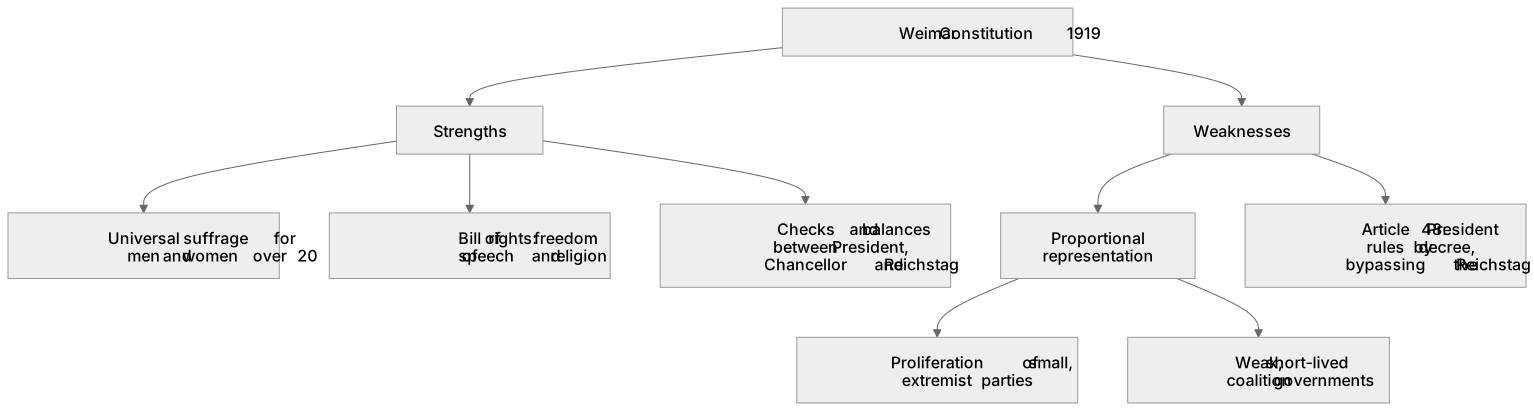
Label the diagram
Some boxes have lost their names. Pick the right name for each number.
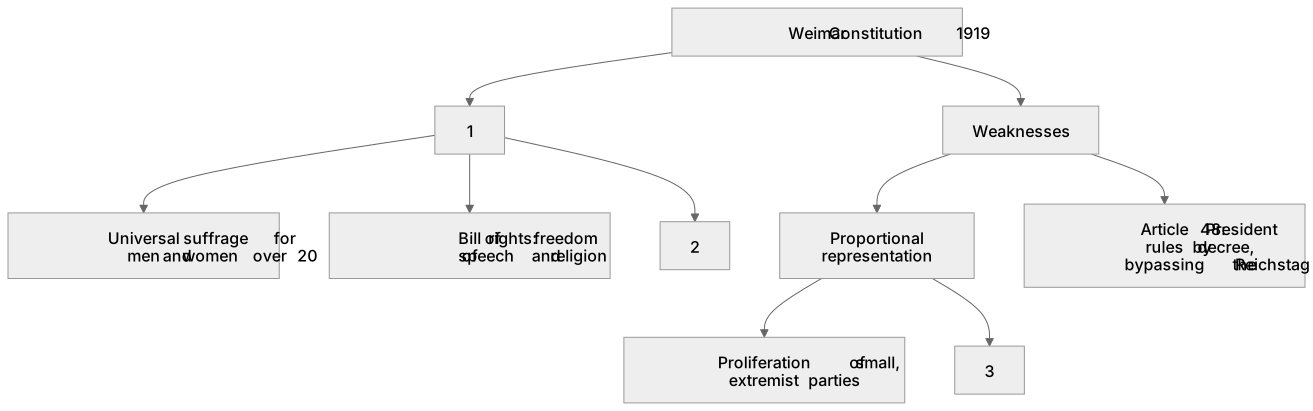
1Box 1
2Box 2
3Box 3
There is more to this lesson
The full lesson goes on to check your understanding and help you earn the marks. Create a free account to carry on, with your progress saved.
A week of Premium from your first lesson · Then the free plan continues · No card, no charge
Test your understanding of Option 31: Key topic 1: The Weimar Republic 1918–29 - 1 The origins of the Republic, 1918–19: The strengths and weaknesses of the new Weimar Constitution.
Active recall beats re-reading. Take an instant quiz now to test what you’ve learned and lock it into long-term memory.
A week of Premium from your first lesson · Then the free plan continues · No card, no charge