Pearson Edexcel · GCSE · History
Course version: 1HI0 · Version from Sept 2016
Key topic 1: The Weimar Republic 1918–29 - 2 The early challenges to the…
Full specification wording
Option 31: Key topic 1: The Weimar Republic 1918–29 - 2 The early challenges to the Weimar Republic, 1919–23: Reasons for the early unpopularity of the Republic, including the ‘stab in the back’ theory and the key terms of the Treaty of Versailles.
The Weimar Republic faced immediate unpopularity due to its association with Germany's defeat and humiliation.
Checked against the Pearson Edexcel 1HI0 specification (opens in a new tab) on .
- Point 1 of 3
- 4 key terms
Study notes
From the checked teaching notes for this specification point.
The idea
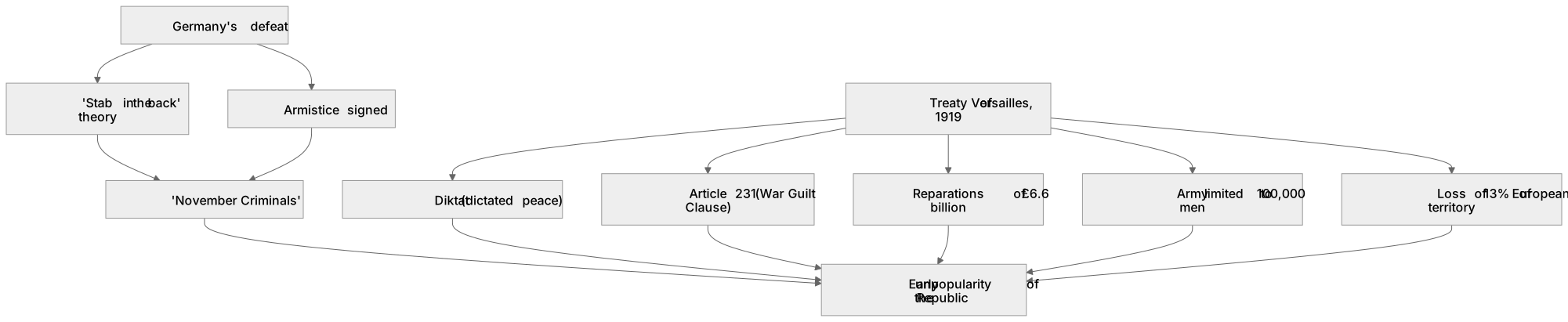
The Weimar Republic faced immediate unpopularity due to its association with Germany's defeat and humiliation. A primary reason was the 'stab in the back' theory (Dolchstoßlegende), which falsely claimed the undefeated German army was betrayed by socialist and Jewish politicians at home who signed the armistice. This branded the government as the 'November Criminals'. Unpopularity was cemented by the Treaty of Versailles in 1919, a dictated peace (Diktat) that the Republic was forced to sign. Key terms that outraged Germans included Article 231 (the War Guilt Clause), massive reparations of £6.6 billion, severe military restrictions (limiting the army to 100,000 men), and the loss of 13% of European territory.
What earns the marks
- Explain the 'stab in the back' theory and how it shifted blame for the war's loss from the military to the new democratic politicians.
- Identify the 'November Criminals' as a derogatory term used to undermine the legitimacy of the Weimar government.
- Detail the economic impact of the Treaty of Versailles, specifically the £6.6 billion reparations figure.
- Describe the territorial and military terms of the Treaty, such as the loss of 13% of land and the reduction of the army to 100,000 men.
Common mistakes and how to put them right
Stating that Germany negotiated the Treaty of Versailles.
Put it right: Emphasise that it was a 'Diktat' (dictated peace) and Germany was excluded from the negotiations.
Confusing the armistice with the Treaty of Versailles.
Put it right: The armistice in November 1918 sparked the 'stab in the back' myth, while the Treaty in June 1919 imposed the punishing terms.
Providing vague descriptions of the Treaty's terms.
Put it right: Use specific figures, such as £6.6 billion for reparations and 100,000 men for the army limit.
Exam tips
- Use the German terms 'Dolchstoßlegende' (stab in the back) and 'Diktat' (dictated peace) to demonstrate strong subject knowledge.
- Link the War Guilt Clause (Article 231) directly to the reparations, as accepting blame provided the legal justification for the financial penalty.
- Explain how right-wing groups used these early unpopular events as propaganda to attack the Republic throughout the 1920s.
Try the lesson
The start of the Option 31: Key topic 1: The Weimar Republic 1918–29 - 2 The early challenges to the Weimar Republic, 1919–23: Reasons for the early unpopularity of the Republic, including the ‘stab in the back’ theory and the key terms of the Treaty of Versailles. lesson, made from checked teaching notes for this specification point.
Have a go first
Which term of the Treaty of Versailles caused widespread anger and contributed to the early unpopularity of the Weimar Republic?
Listen
The Weimar Republic faced immediate unpopularity due to its association with Germany's defeat and humiliation. A primary reason was the 'stab in the back' theory (Dolchstoßlegende), which falsely claimed the undefeated German army was betrayed by socialist and Jewish politicians at home who signed the armistice. This branded the government as the 'November Criminals'. Unpopularity was cemented by the Treaty of Versailles in 1919, a dictated peace (Diktat) that the Republic was forced to sign. Key terms that outraged Germans included Article 231 (the War Guilt Clause), massive reparations of £6.6 billion, severe military restrictions (limiting the army to 100,000 men), and the loss of 13% of European territory. A strong answer earns marks for these points. Explain the 'stab in the back' theory and how it shifted blame for the war's loss from the military to the new democratic politicians. Identify the 'November Criminals' as a derogatory term used to undermine the legitimacy of the Weimar government. Detail the economic impact of the Treaty of Versailles, specifically the £6.6 billion reparations figure. Describe the territorial and military terms of the Treaty, such as the loss of 13% of land and the reduction of the army to 100,000 men. A common slip: Stating that Germany negotiated the Treaty of Versailles. Instead, Emphasise that it was a 'Diktat' (dictated peace) and Germany was excluded from the negotiations. Exam tip: Use the German terms 'Dolchstoßlegende' (stab in the back) and 'Diktat' (dictated peace) to demonstrate strong subject knowledge.
See it
Key words
Say what each word means before you turn the card.
Stab in the back theory
Try answering aloud or in your head before turning the card.
November Criminals
Try answering aloud or in your head before turning the card.
Diktat
Try answering aloud or in your head before turning the card.
War Guilt Clause
Try answering aloud or in your head before turning the card.
See every definition
- Stab in the back theory
- The false claim that the undefeated German army was betrayed by socialist and Jewish politicians at home who signed the armistice.
- November Criminals
- A derogatory term used to brand the government and undermine the legitimacy of the Weimar government.
- Diktat
- A dictated peace that the Republic was forced to sign.
- War Guilt Clause
- Article 231, a key term of the Treaty of Versailles that outraged Germans.
Label the diagram
Some boxes have lost their names. Pick the right name for each number.
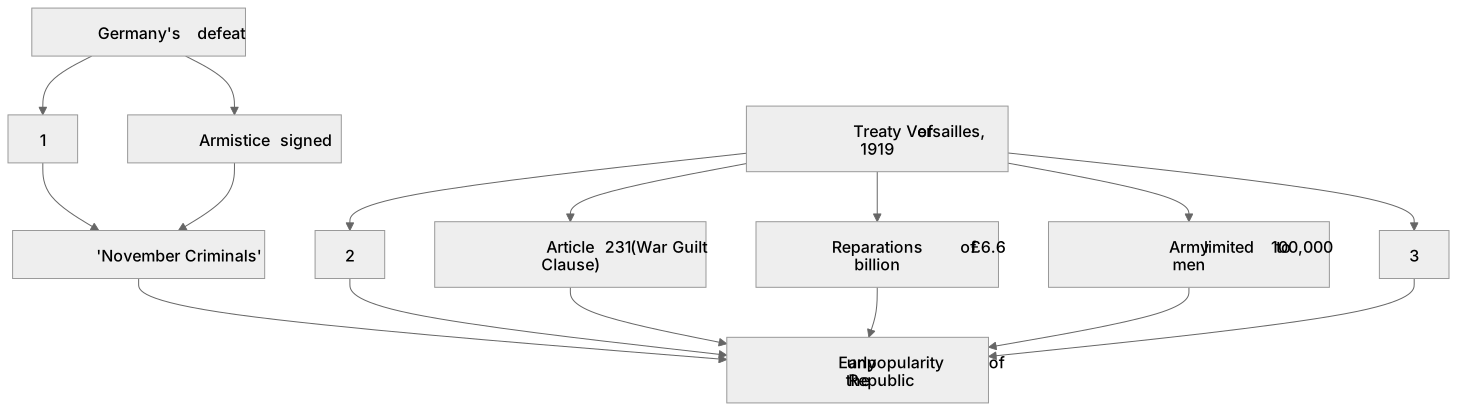
1Box 1
2Box 2
3Box 3
There is more to this lesson
The full lesson goes on to check your understanding and help you earn the marks. Create a free account to carry on, with your progress saved.
A week of Premium from your first lesson · Then the free plan continues · No card, no charge
Test your understanding of Option 31: Key topic 1: The Weimar Republic 1918–29 - 2 The early challenges to the Weimar Republic, 1919–23: Reasons for the early unpopularity of the Republic, including the ‘stab in the back’ theory and the key terms of the Treaty of Versailles.
Active recall beats re-reading. Take an instant quiz now to test what you’ve learned and lock it into long-term memory.
A week of Premium from your first lesson · Then the free plan continues · No card, no charge