Pearson Edexcel · GCSE · History
Course version: 1HI0 · Version from Sept 2016
Key topic 1: The Weimar Republic 1918–29 - 2 The early challenges to the…
Full specification wording
Option 31: Key topic 1: The Weimar Republic 1918–29 - 2 The early challenges to the Weimar Republic, 1919–23: Challenges to the Republic from Left and Right: Spartacists, Freikorps, the Kapp Putsch.
The early Weimar Republic faced severe political instability from both extremes.
Checked against the Pearson Edexcel 1HI0 specification (opens in a new tab) on .
- Point 2 of 3
- 4 key terms
Study notes
From the checked teaching notes for this specification point.
The idea
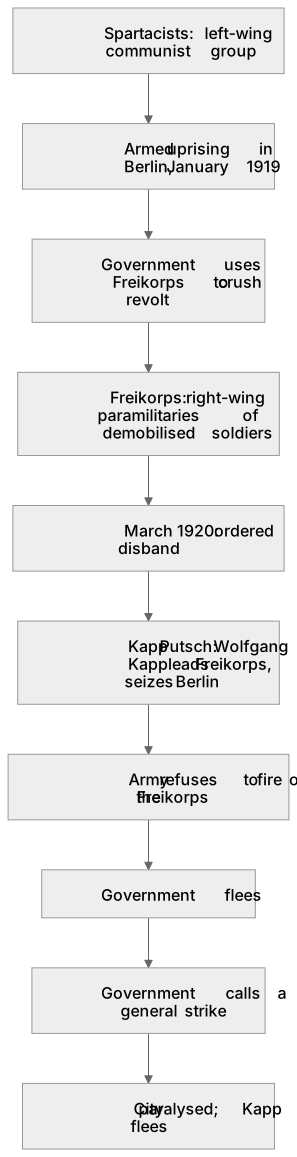
The early Weimar Republic faced severe political instability from both extremes. From the Left, the Spartacists attempted an armed uprising in Berlin in January 1919 to establish a communist state. The government relied on the Freikorps—right-wing paramilitary groups of demobilised soldiers—to crush the revolt. However, the Freikorps posed a threat from the Right. In March 1920, when ordered to disband, Wolfgang Kapp led them in the Kapp Putsch, seizing Berlin. The army refused to fire on the Freikorps, forcing the government to flee. The Putsch was only defeated when the government called a general strike, paralysing the city and forcing Kapp to flee. This highlights the Republic's vulnerability and reliance on unreliable forces.
What earns the marks
- Identify the Spartacists as a left-wing communist group aiming to overthrow the Weimar government in 1919.
- Explain the role of the Freikorps as right-wing paramilitaries used by Ebert to suppress the Spartacist uprising.
- Describe the Kapp Putsch of 1920 as a right-wing challenge led by Wolfgang Kapp and supported by the Freikorps.
- Analyse the government's response to the Kapp Putsch, specifically the successful use of a general strike by the workers.
- Evaluate the underlying weakness of the Weimar government, demonstrated by the army's refusal to fire on the Freikorps during the Kapp Putsch.
Common mistakes and how to put them right
Confusing the political alignment of the groups.
Put it right: Clearly state that the Spartacists were extreme Left (communist) and the Freikorps and Kapp Putsch were extreme Right (nationalist).
Stating that the army defeated the Kapp Putsch.
Put it right: Explain that the army refused to act, and it was a general strike by workers that defeated the Putsch.
Believing the Freikorps were part of the official regular army.
Put it right: Describe the Freikorps as unofficial paramilitary units made up of demobilised soldiers.
Exam tips
- When explaining challenges to the Republic, explicitly link the events to the political spectrum (Left or Right).
- Use the Spartacist uprising and the Kapp Putsch to demonstrate the government's reliance on different groups (the Freikorps and the workers) to survive.
- Highlight the contrast in the army's response to left-wing versus right-wing threats to show the inherent bias within the military.
Try the lesson
The start of the Option 31: Key topic 1: The Weimar Republic 1918–29 - 2 The early challenges to the Weimar Republic, 1919–23: Challenges to the Republic from Left and Right: Spartacists, Freikorps, the Kapp Putsch. lesson, made from checked teaching notes for this specification point.
Have a go first
Which group led a left-wing armed uprising against the Weimar Republic in Berlin in January 1919?
Listen
The early Weimar Republic faced severe political instability from both extremes. From the Left, the Spartacists attempted an armed uprising in Berlin in January 1919 to establish a communist state. The government relied on the Freikorps—right-wing paramilitary groups of demobilised soldiers—to crush the revolt. However, the Freikorps posed a threat from the Right. In March 1920, when ordered to disband, Wolfgang Kapp led them in the Kapp Putsch, seizing Berlin. The army refused to fire on the Freikorps, forcing the government to flee. The Putsch was only defeated when the government called a general strike, paralysing the city and forcing Kapp to flee. This highlights the Republic's vulnerability and reliance on unreliable forces. A strong answer earns marks for these points. Identify the Spartacists as a left-wing communist group aiming to overthrow the Weimar government in 1919. Explain the role of the Freikorps as right-wing paramilitaries used by Ebert to suppress the Spartacist uprising. Describe the Kapp Putsch of 1920 as a right-wing challenge led by Wolfgang Kapp and supported by the Freikorps. Analyse the government's response to the Kapp Putsch, specifically the successful use of a general strike by the workers. A common slip: Confusing the political alignment of the groups. Instead, clearly state that the Spartacists were extreme Left (communist) and the Freikorps and Kapp Putsch were extreme Right (nationalist). Exam tip: When explaining challenges to the Republic, explicitly link the events to the political spectrum (Left or Right).
See it
Key words
Say what each word means before you turn the card.
Spartacists
Try answering aloud or in your head before turning the card.
Freikorps
Try answering aloud or in your head before turning the card.
Kapp Putsch
Try answering aloud or in your head before turning the card.
general strike
Try answering aloud or in your head before turning the card.
See every definition
- Spartacists
- A left-wing communist group that attempted an armed uprising in Berlin in January 1919 to establish a communist state.
- Freikorps
- Right-wing paramilitary groups of demobilised soldiers, used by the government to crush the Spartacist revolt but who also posed a threat from the Right.
- Kapp Putsch
- A right-wing challenge in March 1920, when Wolfgang Kapp led the Freikorps in seizing Berlin after being ordered to disband.
- general strike
- The response called by the government which paralysed the city and forced Kapp to flee, defeating the Putsch.
Label the diagram
Some boxes have lost their names. Pick the right name for each number.
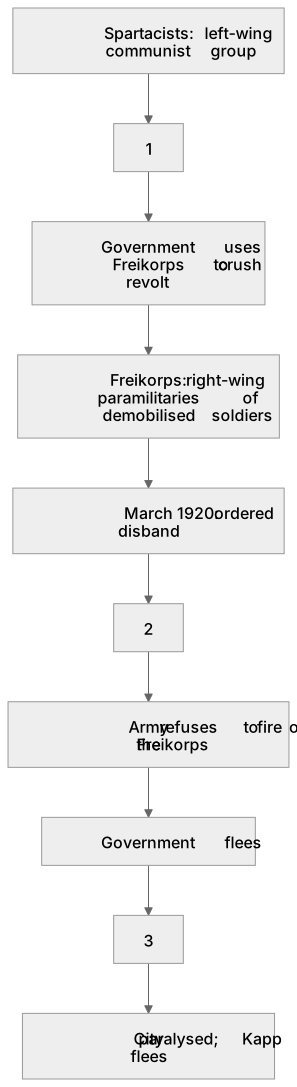
1Box 1
2Box 2
3Box 3
There is more to this lesson
The full lesson goes on to check your understanding and help you earn the marks. Create a free account to carry on, with your progress saved.
A week of Premium from your first lesson · Then the free plan continues · No card, no charge
Test your understanding of Option 31: Key topic 1: The Weimar Republic 1918–29 - 2 The early challenges to the Weimar Republic, 1919–23: Challenges to the Republic from Left and Right: Spartacists, Freikorps, the Kapp Putsch.
Active recall beats re-reading. Take an instant quiz now to test what you’ve learned and lock it into long-term memory.
A week of Premium from your first lesson · Then the free plan continues · No card, no charge