Pearson Edexcel · GCSE · History
Course version: 1HI0 · Version from Sept 2016
Key topic 1: The Weimar Republic 1918–29 - 2 The early challenges to the…
Full specification wording
Option 31: Key topic 1: The Weimar Republic 1918–29 - 2 The early challenges to the Weimar Republic, 1919–23: The challenges of 1923: hyperinflation; the reasons for, and effects of, the French occupation of the Ruhr.
In 1923, Germany faced a profound crisis triggered by defaulting on reparations.
Checked against the Pearson Edexcel 1HI0 specification (opens in a new tab) on .
- Point 3 of 3
- 4 key terms
Study notes
From the checked teaching notes for this specification point.
The idea
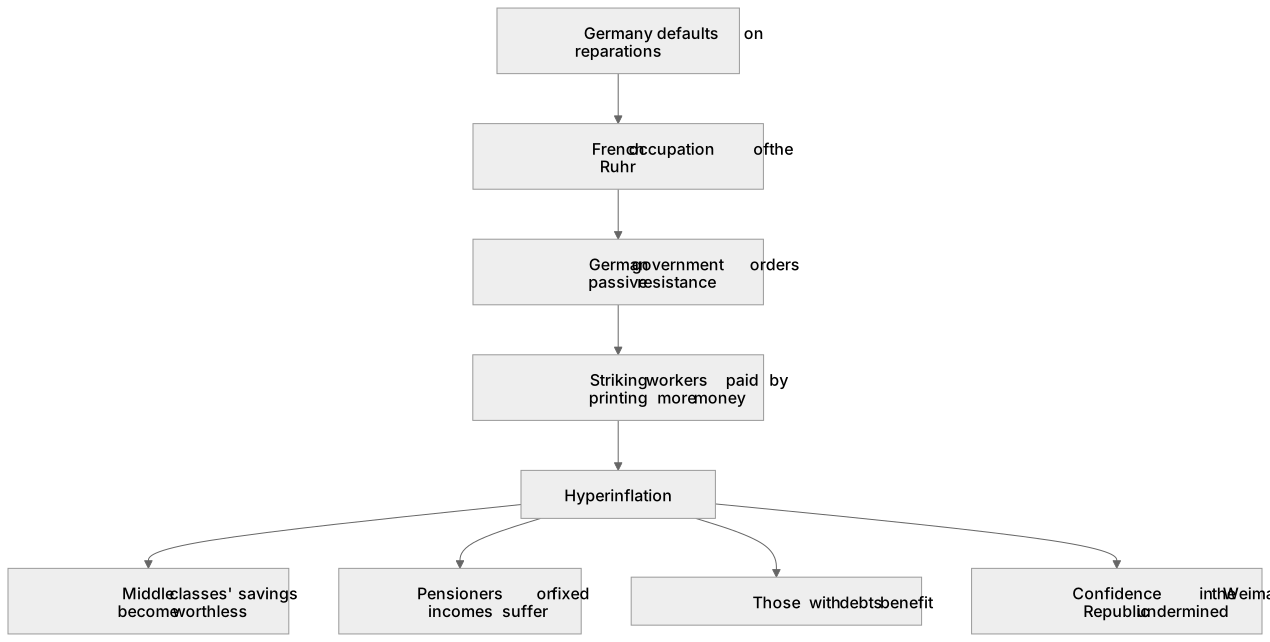
In 1923, Germany faced a profound crisis triggered by defaulting on reparations. The reason for the French occupation of the Ruhr was to extract unpaid reparations in the form of goods and raw materials. The German government responded by ordering passive resistance, paying striking workers by printing more money. This exacerbated existing inflation, leading to hyperinflation. The effects of the occupation included violence, economic paralysis, and a collapse in the mark's value. Hyperinflation devastated the middle classes, whose savings became worthless, and pensioners on fixed incomes. Conversely, those with debts benefited as they could pay them off with devalued currency. This crisis severely undermined confidence in the Weimar Republic.
What earns the marks
- Identify the failure to pay reparations as the main reason for the French occupation of the Ruhr in 1923.
- Explain the German government's policy of passive resistance and its economic cost.
- Describe the link between printing money to pay striking workers and the onset of hyperinflation.
- Analyse the negative effects of hyperinflation on specific groups, such as the middle classes losing their savings.
- Identify the groups that benefited from hyperinflation, such as people with fixed-rate debts or mortgages.
Common mistakes and how to put them right
Claiming that hyperinflation was caused solely by the Treaty of Versailles.
Put it right: Explain that while reparations were a factor, the immediate trigger was the government printing money to fund passive resistance in the Ruhr.
Stating that everyone in Germany suffered equally during hyperinflation.
Put it right: Specify that while savers and pensioners suffered greatly, debtors and some businessmen benefited.
Confusing inflation with hyperinflation.
Put it right: Define hyperinflation as a rapid, uncontrollable devaluation of currency, distinct from normal inflation.
Exam tips
- Clearly distinguish between the reasons for the Ruhr occupation and the effects of the occupation.
- Use specific examples of how different social groups were impacted by hyperinflation to demonstrate a nuanced understanding.
- Connect the events of 1923 to the broader theme of the Weimar Republic's unpopularity and instability.
Try the lesson
The start of the Option 31: Key topic 1: The Weimar Republic 1918–29 - 2 The early challenges to the Weimar Republic, 1919–23: The challenges of 1923: hyperinflation; the reasons for, and effects of, the French occupation of the Ruhr. lesson, made from checked teaching notes for this specification point.
Have a go first
Why did French and Belgian troops occupy the Ruhr region of Germany in January 1923?
Listen
In 1923, Germany faced a profound crisis triggered by defaulting on reparations. The reason for the French occupation of the Ruhr was to extract unpaid reparations in the form of goods and raw materials. The German government responded by ordering passive resistance, paying striking workers by printing more money. This exacerbated existing inflation, leading to hyperinflation. The effects of the occupation included violence, economic paralysis, and a collapse in the mark's value. Hyperinflation devastated the middle classes, whose savings became worthless, and pensioners on fixed incomes. Conversely, those with debts benefited as they could pay them off with devalued currency. This crisis severely undermined confidence in the Weimar Republic. A strong answer earns marks for these points. Identify the failure to pay reparations as the main reason for the French occupation of the Ruhr in 1923. Explain the German government's policy of passive resistance and its economic cost. Describe the link between printing money to pay striking workers and the onset of hyperinflation. Analyse the negative effects of hyperinflation on specific groups, such as the middle classes losing their savings. A common slip: Claiming that hyperinflation was caused solely by the Treaty of Versailles. Instead, explain that while reparations were a factor, the immediate trigger was the government printing money to fund passive resistance in the Ruhr. Exam tip: Clearly distinguish between the reasons for the Ruhr occupation and the effects of the occupation.
See it
Key words
Say what each word means before you turn the card.
Hyperinflation
Try answering aloud or in your head before turning the card.
Passive resistance
Try answering aloud or in your head before turning the card.
Reparations
Try answering aloud or in your head before turning the card.
French occupation of the Ruhr
Try answering aloud or in your head before turning the card.
See every definition
- Hyperinflation
- A rapid, uncontrollable devaluation of currency, distinct from normal inflation, which devastated the middle classes whose savings became worthless and pensioners on fixed incomes.
- Passive resistance
- The policy ordered by the German government in response to the French occupation, paying striking workers by printing more money.
- Reparations
- Payments Germany defaulted on in 1923, which the French sought to extract in the form of goods and raw materials.
- French occupation of the Ruhr
- Action taken to extract unpaid reparations in the form of goods and raw materials, whose effects included violence, economic paralysis and a collapse in the mark's value.
Label the diagram
Some boxes have lost their names. Pick the right name for each number.
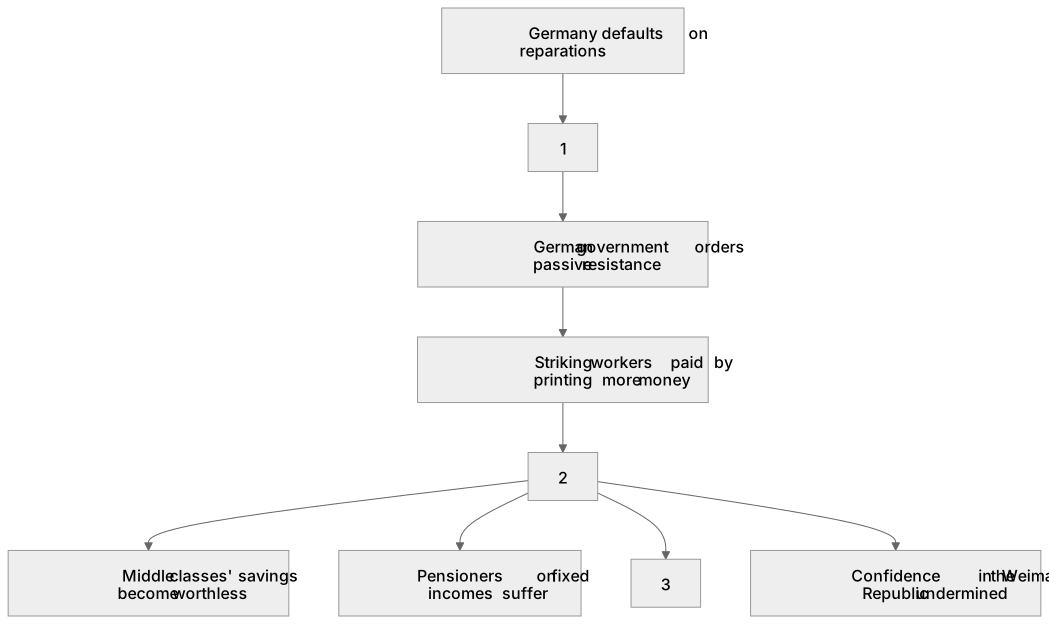
1Box 1
2Box 2
3Box 3
There is more to this lesson
The full lesson goes on to check your understanding and help you earn the marks. Create a free account to carry on, with your progress saved.
A week of Premium from your first lesson · Then the free plan continues · No card, no charge
Test your understanding of Option 31: Key topic 1: The Weimar Republic 1918–29 - 2 The early challenges to the Weimar Republic, 1919–23: The challenges of 1923: hyperinflation; the reasons for, and effects of, the French occupation of the Ruhr.
Active recall beats re-reading. Take an instant quiz now to test what you’ve learned and lock it into long-term memory.
A week of Premium from your first lesson · Then the free plan continues · No card, no charge