Pearson Edexcel · GCSE · History
Course version: 1HI0 · Version from Sept 2016
Key topic 2: Hitler’s rise to power, 1919–33 - 2 The Munich Putsch and the…
Full specification wording
Option 31: Key topic 2: Hitler’s rise to power, 1919–33 - 2 The Munich Putsch and the Nazi Party, 1923–28: Reasons for limited support for the Nazi Party, 1924–28. Party reorganisation, including the Bamberg Conference of 1926.
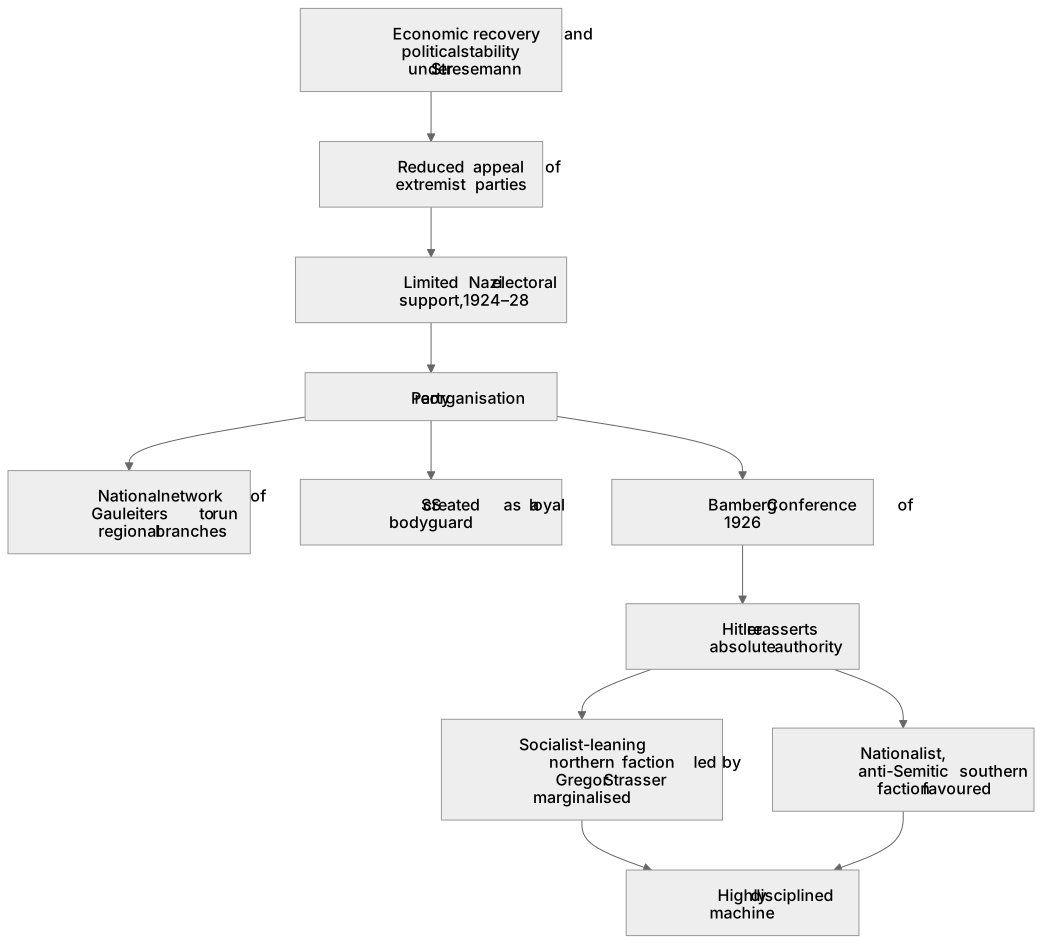
Between 1924 and 1928, Nazi electoral support remained limited, largely due to the economic recovery and political stability of the 'Golden Age' under Stresemann.
Checked against the Pearson Edexcel 1HI0 specification (opens in a new tab) on .
- Point 2 of 2
- 4 key terms
Study notes
From the checked teaching notes for this specification point.
The idea
Between 1924 and 1928, Nazi electoral support remained limited, largely due to the economic recovery and political stability of the 'Golden Age' under Stresemann. The introduction of the Rentenmark and the Dawes Plan reduced extremist appeal, leaving the Nazis with just 12 Reichstag seats in 1928. Despite this, Hitler focused on extensive party reorganisation. He established a national network of Gauleiters to run regional branches and created the SS as a loyal bodyguard. The pivotal 1926 Bamberg Conference allowed Hitler to reassert his absolute authority, marginalising the socialist-leaning northern faction led by Gregor Strasser in favour of the nationalist, anti-Semitic southern faction, creating a highly disciplined machine.
What earns the marks
- Explain how Stresemann's economic policies, such as the Dawes Plan, reduced the appeal of extremist parties like the Nazis.
- Describe the structural reorganisation of the party, including the creation of Gauleiters to build a nationwide presence.
- Identify the formation of the SS and the Hitler Youth as key elements of expanding the party's organisational reach.
- Analyse the significance of the Bamberg Conference in centralising Hitler's power and defeating the socialist wing of the party.
Common mistakes and how to put them right
Assuming the Nazi Party was inactive or declining internally between 1924 and 1928.
Put it right: Highlight that while electoral support was low, this was a crucial period of internal growth, restructuring, and consolidation of leadership.
Confusing the outcomes of the Bamberg Conference.
Put it right: Ensure it is clear that Hitler defeated the socialist-leaning northern faction and cemented the nationalist, anti-Semitic agenda.
Attributing the lack of support solely to Hitler's imprisonment.
Put it right: Focus on the broader context of Weimar's economic recovery and political stability under Stresemann as the primary reason for reduced extremist support.
Exam tips
- Use the phrase 'lean years' to describe this period, but always balance the lack of electoral success with the vital internal reorganisation that took place.
- When discussing the Bamberg Conference, explicitly mention the ideological split between the northern and southern factions of the party to show depth of knowledge.
- Connect the creation of the Gauleiter system to the party's later ability to campaign effectively on a national scale once the Depression hit.
Try the lesson
The start of the Option 31: Key topic 2: Hitler’s rise to power, 1919–33 - 2 The Munich Putsch and the Nazi Party, 1923–28: Reasons for limited support for the Nazi Party, 1924–28. Party reorganisation, including the Bamberg Conference of 1926. lesson, made from checked teaching notes for this specification point.
Have a go first
Which of the following was a major reason for the limited electoral support for the Nazi Party between 1924 and 1928?
Listen
Between 1924 and 1928, Nazi electoral support remained limited, largely due to the economic recovery and political stability of the 'Golden Age' under Stresemann. The introduction of the Rentenmark and the Dawes Plan reduced extremist appeal, leaving the Nazis with just 12 Reichstag seats in 1928. Despite this, Hitler focused on extensive party reorganisation. He established a national network of Gauleiters to run regional branches and created the SS as a loyal bodyguard. The pivotal 1926 Bamberg Conference allowed Hitler to reassert his absolute authority, marginalising the socialist-leaning northern faction led by Gregor Strasser in favour of the nationalist, anti-Semitic southern faction, creating a highly disciplined machine. A strong answer earns marks for these points. Explain how Stresemann's economic policies, such as the Dawes Plan, reduced the appeal of extremist parties like the Nazis. Describe the structural reorganisation of the party, including the creation of Gauleiters to build a nationwide presence. Identify the formation of the SS and the Hitler Youth as key elements of expanding the party's organisational reach. Analyse the significance of the Bamberg Conference in centralising Hitler's power and defeating the socialist wing of the party. A common slip: Assuming the Nazi Party was inactive or declining internally between 1924 and 1928. Instead, Highlight that while electoral support was low, this was a crucial period of internal growth, restructuring, and consolidation of leadership. Exam tip: Use the phrase 'lean years' to describe this period, but always balance the lack of electoral success with the vital internal reorganisation that took place.
See it
Key words
Say what each word means before you turn the card.
Political stability
Try answering aloud or in your head before turning the card.
Party reorganisation
Try answering aloud or in your head before turning the card.
Leadership and authority
Try answering aloud or in your head before turning the card.
Ideological consolidation
Try answering aloud or in your head before turning the card.
See every definition
- Political stability
- A condition between 1924 and 1928, largely under Stresemann, which helped keep Nazi electoral support limited.
- Party reorganisation
- Extensive restructuring by Hitler, including a national network of Gauleiters to run regional branches and the creation of the SS as a loyal bodyguard.
- Leadership and authority
- Hitler's absolute control, reasserted at the 1926 Bamberg Conference by marginalising the socialist-leaning northern faction led by Gregor Strasser.
- Ideological consolidation
- The victory of the nationalist, anti-Semitic southern faction over the socialist-leaning northern faction, creating a highly disciplined machine.
Label the diagram
Some boxes have lost their names. Pick the right name for each number.
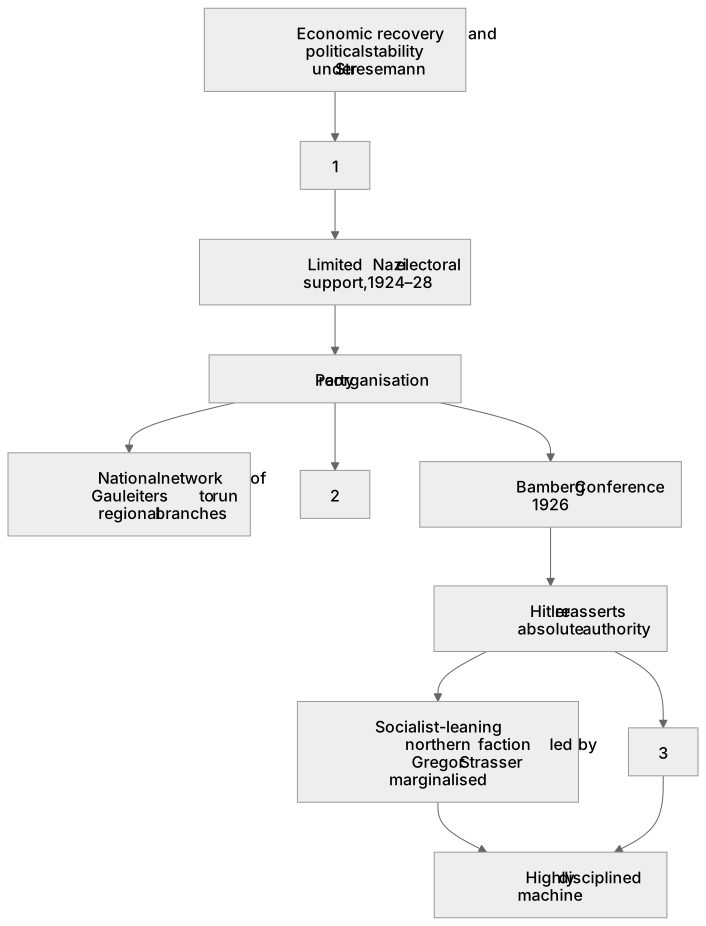
1Box 1
2Box 2
3Box 3
There is more to this lesson
The full lesson goes on to check your understanding and help you earn the marks. Create a free account to carry on, with your progress saved.
A week of Premium from your first lesson · Then the free plan continues · No card, no charge
Test your understanding of Option 31: Key topic 2: Hitler’s rise to power, 1919–33 - 2 The Munich Putsch and the Nazi Party, 1923–28: Reasons for limited support for the Nazi Party, 1924–28. Party reorganisation, including the Bamberg Conference of 1926.
Active recall beats re-reading. Take an instant quiz now to test what you’ve learned and lock it into long-term memory.
A week of Premium from your first lesson · Then the free plan continues · No card, no charge