Pearson Edexcel · GCSE · History
Course version: 1HI0 · Version from Sept 2016
Key topic 2: Hitler’s rise to power, 1919–33 - 2 The Munich Putsch and the…
Full specification wording
Option 31: Key topic 2: Hitler’s rise to power, 1919–33 - 2 The Munich Putsch and the Nazi Party, 1923–28: The reasons for, events and consequences of the Munich Putsch; Mein Kampf.
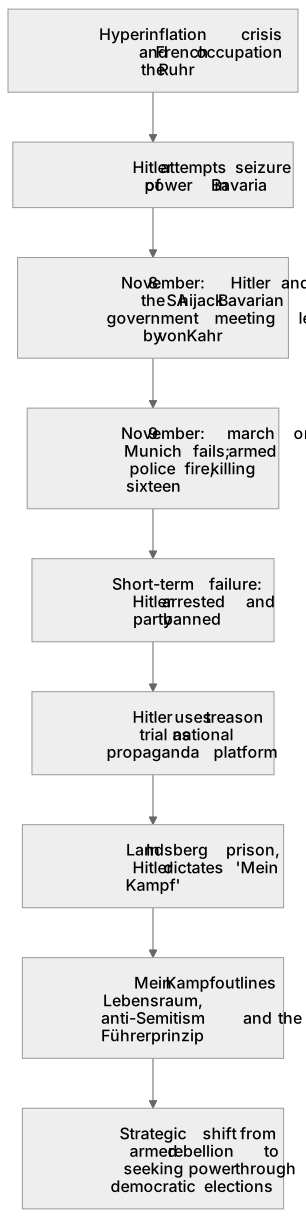
The 1923 Munich Putsch was triggered by Weimar's perceived weakness during the hyperinflation crisis and the French occupation of the Ruhr, inspiring Hitler to attempt a seizure of power in Bavaria.
Checked against the Pearson Edexcel 1HI0 specification (opens in a new tab) on .
- Point 1 of 2
- 4 key terms
Study notes
From the checked teaching notes for this specification point.
The idea
The 1923 Munich Putsch was triggered by Weimar's perceived weakness during the hyperinflation crisis and the French occupation of the Ruhr, inspiring Hitler to attempt a seizure of power in Bavaria. On 8 November, Hitler and the SA hijacked a Bavarian government meeting led by von Kahr. The following day, a march on Munich failed when armed police fired on the Nazis, killing sixteen. Although a short-term failure resulting in Hitler's arrest and the party's ban, the consequences were transformative. Hitler used his trial for high treason as a national propaganda platform. While imprisoned in Landsberg, he dictated 'Mein Kampf', outlining his core ideological beliefs, including Lebensraum, anti-Semitism, and the Führerprinzip.
What earns the marks
- Identify the hyperinflation crisis and the Ruhr occupation as key short-term triggers for the Munich Putsch.
- Describe the events of 8-9 November 1923, including the confrontation at the Bürgerbräukeller and the fatal march.
- Explain how Hitler turned his treason trial into a national propaganda victory, gaining nationwide recognition.
- Analyse the ideological significance of 'Mein Kampf', specifically its articulation of Lebensraum and anti-Semitism.
- Evaluate the strategic shift from armed rebellion to seeking power through democratic elections as a consequence of the Putsch.
Common mistakes and how to put them right
Stating the Munich Putsch was a complete disaster for the Nazis.
Put it right: Emphasise that while it failed militarily, it was a long-term propaganda success that gave Hitler national prominence.
Claiming Hitler seized control of Berlin during the Putsch.
Put it right: Specify that the Putsch was confined to Munich in the region of Bavaria, with the ultimate but unfulfilled goal of marching on Berlin.
Describing 'Mein Kampf' merely as an autobiography.
Put it right: Define it primarily as a political manifesto that laid out the ideological blueprint for the future Nazi state.
Exam tips
- Link the causes of the Munich Putsch directly to the broader economic and political crises facing the Weimar Republic in 1923.
- When discussing consequences, contrast the short-term failure of imprisonment with the long-term successes of national profile and strategic rethink.
- Use specific concepts from 'Mein Kampf', such as Lebensraum or the Führerprinzip, to demonstrate detailed knowledge of Nazi ideology.
Try the lesson
The start of the Option 31: Key topic 2: Hitler’s rise to power, 1919–33 - 2 The Munich Putsch and the Nazi Party, 1923–28: The reasons for, events and consequences of the Munich Putsch; Mein Kampf. lesson, made from checked teaching notes for this specification point.
Have a go first
What was the immediate consequence for Adolf Hitler following the failure of the Munich Putsch in November 1923?
Listen
The 1923 Munich Putsch was triggered by Weimar's perceived weakness during the hyperinflation crisis and the French occupation of the Ruhr, inspiring Hitler to attempt a seizure of power in Bavaria. On 8 November, Hitler and the SA hijacked a Bavarian government meeting led by von Kahr. The following day, a march on Munich failed when armed police fired on the Nazis, killing sixteen. Although a short-term failure resulting in Hitler's arrest and the party's ban, the consequences were transformative. Hitler used his trial for high treason as a national propaganda platform. While imprisoned in Landsberg, he dictated 'Mein Kampf', outlining his core ideological beliefs, including Lebensraum, anti-Semitism, and the Führerprinzip. A strong answer earns marks for these points. Identify the hyperinflation crisis and the Ruhr occupation as key short-term triggers for the Munich Putsch. Describe the events of 8-9 November 1923, including the confrontation at the Bürgerbräukeller and the fatal march. Explain how Hitler turned his treason trial into a national propaganda victory, gaining nationwide recognition. Analyse the ideological significance of 'Mein Kampf', specifically its articulation of Lebensraum and anti-Semitism. A common slip: Stating the Munich Putsch was a complete disaster for the Nazis. Instead, Emphasise that while it failed militarily, it was a long-term propaganda success that gave Hitler national prominence. Exam tip: Link the causes of the Munich Putsch directly to the broader economic and political crises facing the Weimar Republic in 1923.
See it
Key words
Say what each word means before you turn the card.
Propaganda
Try answering aloud or in your head before turning the card.
Ideological foundations
Try answering aloud or in your head before turning the card.
Strategic adaptation
Try answering aloud or in your head before turning the card.
Political instability
Try answering aloud or in your head before turning the card.
See every definition
- Propaganda
- Hitler used his trial for high treason as a national platform of this kind, turning a short-term failure into a long-term success.
- Ideological foundations
- 'Mein Kampf' outlined core beliefs including Lebensraum, anti-Semitism and the Führerprinzip, acting as the ideological blueprint for the future Nazi state.
- Strategic adaptation
- A consequence of the Putsch was a shift from armed rebellion to seeking power through democratic elections.
- Political instability
- Weimar's perceived weakness during the hyperinflation crisis and the French occupation of the Ruhr triggered the Munich Putsch.
Label the diagram
Some boxes have lost their names. Pick the right name for each number.
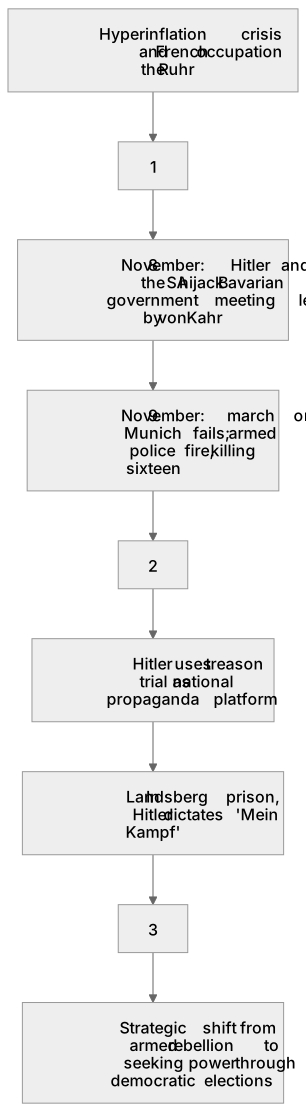
1Box 1
2Box 2
3Box 3
There is more to this lesson
The full lesson goes on to check your understanding and help you earn the marks. Create a free account to carry on, with your progress saved.
A week of Premium from your first lesson · Then the free plan continues · No card, no charge
Test your understanding of Option 31: Key topic 2: Hitler’s rise to power, 1919–33 - 2 The Munich Putsch and the Nazi Party, 1923–28: The reasons for, events and consequences of the Munich Putsch; Mein Kampf.
Active recall beats re-reading. Take an instant quiz now to test what you’ve learned and lock it into long-term memory.
A week of Premium from your first lesson · Then the free plan continues · No card, no charge