Pearson Edexcel · GCSE · History
Course version: 1HI0 · Version from Sept 2016
Key topic 3: Nazi control and dictatorship, 1933–39 - 3 Controlling and…
Full specification wording
Option 31: Key topic 3: Nazi control and dictatorship, 1933–39 - 3 Controlling and influencing attitudes: Goebbels and the Ministry of Propaganda: censorship, Nazi use of media, rallies and sport, including the Berlin Olympics (1936).
Joseph Goebbels directed the Ministry of Propaganda to control German attitudes through censorship and media manipulation.
Checked against the Pearson Edexcel 1HI0 specification (opens in a new tab) on .
- Point 1 of 3
- 4 key terms
Study notes
From the checked teaching notes for this specification point.
The idea
Joseph Goebbels directed the Ministry of Propaganda to control German attitudes through censorship and media manipulation. The press, radio, and cinema were strictly censored to eliminate dissenting views and promote Nazi ideology. Cheap radios (the People's Receiver) were mass-produced to broadcast Hitler's speeches directly into homes. The Nazis also utilised grand spectacles, such as the annual Nuremberg Rallies, to project an image of unity, order, and overwhelming power. Sport was heavily politicised to promote physical fitness and Aryan superiority. The 1936 Berlin Olympics served as a global propaganda showcase, designed to present a peaceful, prosperous Germany while masking the regime's antisemitic policies.
What earns the marks
- Identify Goebbels' role in centralising control over information via the Ministry of Propaganda.
- Explain how censorship of the press and the mass production of cheap radios ensured only Nazi messages reached the public.
- Describe the purpose of the Nuremberg Rallies in creating a sense of national unity and demonstrating state power.
- Analyse the use of the 1936 Berlin Olympics as a tool to promote the illusion of Aryan superiority and a peaceful Germany to the world.
Common mistakes and how to put them right
Treating propaganda and censorship as the same thing.
Put it right: Propaganda promotes a specific message, while censorship suppresses opposing information.
Stating that the Berlin Olympics were a complete propaganda failure because of Jesse Owens.
Put it right: While Owens challenged Aryan supremacy, the event was largely successful in presenting a positive image of Germany globally.
Overlooking the role of sport outside the Olympics.
Put it right: Sport was a daily tool used to prepare youth for military service and promote racial ideals.
Exam tips
- Use the 'People's Receiver' (Volksempfänger) as a specific example of how the Nazis monopolised radio broadcasting.
- Discuss how the Nuremberg Rallies appealed to emotions rather than intellect, creating a quasi-religious atmosphere.
- When evaluating the Berlin Olympics, acknowledge both the regime's success in international public relations and the ideological contradictions exposed by non-Aryan victories.
Try the lesson
The start of the Option 31: Key topic 3: Nazi control and dictatorship, 1933–39 - 3 Controlling and influencing attitudes: Goebbels and the Ministry of Propaganda: censorship, Nazi use of media, rallies and sport, including the Berlin Olympics (1936). lesson, made from checked teaching notes for this specification point.
Have a go first
What was the main purpose of the 1936 Berlin Olympics for the Nazi regime?
Listen
Joseph Goebbels directed the Ministry of Propaganda to control German attitudes through censorship and media manipulation. The press, radio, and cinema were strictly censored to eliminate dissenting views and promote Nazi ideology. Cheap radios (the People's Receiver) were mass-produced to broadcast Hitler's speeches directly into homes. The Nazis also utilised grand spectacles, such as the annual Nuremberg Rallies, to project an image of unity, order, and overwhelming power. Sport was heavily politicised to promote physical fitness and Aryan superiority. The 1936 Berlin Olympics served as a global propaganda showcase, designed to present a peaceful, prosperous Germany while masking the regime's antisemitic policies. A strong answer earns marks for these points. Identify Goebbels' role in centralising control over information via the Ministry of Propaganda. Explain how censorship of the press and the mass production of cheap radios ensured only Nazi messages reached the public. Describe the purpose of the Nuremberg Rallies in creating a sense of national unity and demonstrating state power. Analyse the use of the 1936 Berlin Olympics as a tool to promote the illusion of Aryan superiority and a peaceful Germany to the world. Exam tip: Use the 'People's Receiver' (Volksempfänger) as a specific example of how the Nazis monopolised radio broadcasting.
See it

Key words
Say what each word means before you turn the card.
Propaganda and censorship
Try answering aloud or in your head before turning the card.
Ministry of Propaganda
Try answering aloud or in your head before turning the card.
People's Receiver
Try answering aloud or in your head before turning the card.
Nuremberg Rallies
Try answering aloud or in your head before turning the card.
See every definition
- Propaganda and censorship
- Propaganda promotes a specific message, while censorship suppresses opposing information; Goebbels used both to control German attitudes.
- Ministry of Propaganda
- Body directed by Joseph Goebbels to control German attitudes through censorship and media manipulation.
- People's Receiver
- Cheap radio mass-produced to broadcast Hitler's speeches directly into homes.
- Nuremberg Rallies
- Annual grand spectacles used to project an image of unity, order and overwhelming power.
Label the diagram
Some boxes have lost their names. Pick the right name for each number.
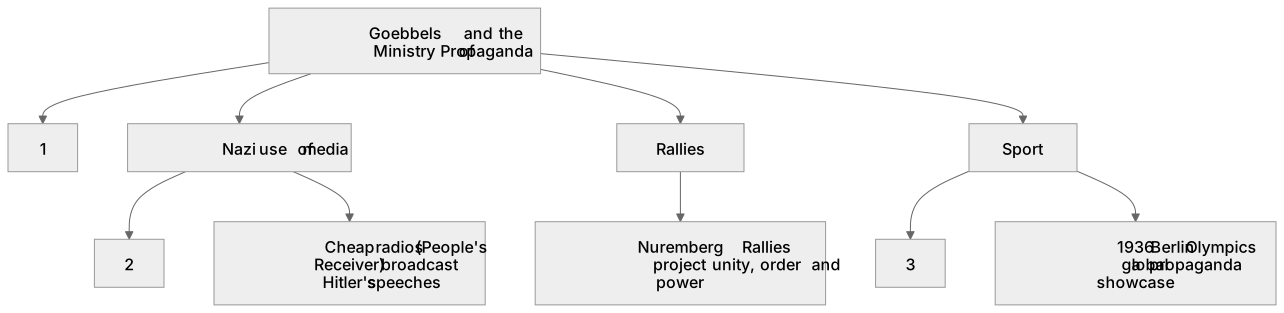
1Box 1
2Box 2
3Box 3
There is more to this lesson
The full lesson goes on to check your understanding and help you earn the marks. Create a free account to carry on, with your progress saved.
A week of Premium from your first lesson · Then the free plan continues · No card, no charge
Test your understanding of Option 31: Key topic 3: Nazi control and dictatorship, 1933–39 - 3 Controlling and influencing attitudes: Goebbels and the Ministry of Propaganda: censorship, Nazi use of media, rallies and sport, including the Berlin Olympics (1936).
Active recall beats re-reading. Take an instant quiz now to test what you’ve learned and lock it into long-term memory.
A week of Premium from your first lesson · Then the free plan continues · No card, no charge