Pearson Edexcel · GCSE · History
Course version: 1HI0 · Version from Sept 2016
Key topic 3: Nazi control and dictatorship, 1933–39 - 3 Controlling and…
Full specification wording
Option 31: Key topic 3: Nazi control and dictatorship, 1933–39 - 3 Controlling and influencing attitudes: Nazi attempts to control the Catholic and Protestant Churches: the Concordat and the Reich Church.
The Nazi regime viewed Christianity as a threat because it offered an alternative loyalty to Hitler.
Checked against the Pearson Edexcel 1HI0 specification (opens in a new tab) on .
- Point 3 of 3
- 3 key terms
Study notes
From the checked teaching notes for this specification point.
The idea
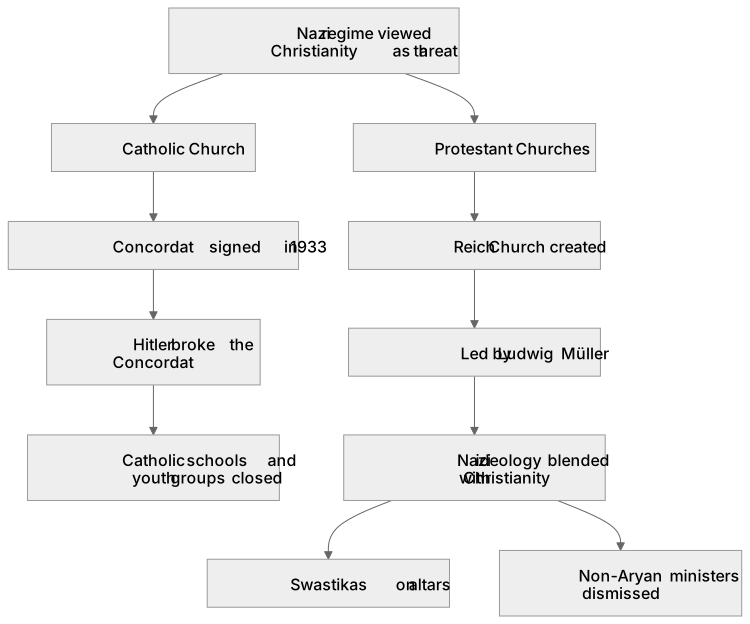
The Nazi regime viewed Christianity as a threat because it offered an alternative loyalty to Hitler. To neutralise the Catholic Church, Hitler signed the Concordat in 1933, promising non-interference if the Church stayed out of politics. However, he soon broke this by closing Catholic schools and youth groups. For Protestants, the Nazis created the Reich Church, led by Ludwig Müller, which blended Nazi ideology with Christianity, displaying swastikas on altars and dismissing non-Aryan ministers. This dual approach aimed to absorb or suppress religious independence.
What earns the marks
- Identify the Concordat as a 1933 agreement between Hitler and the Pope to not interfere in each other's affairs.
- Explain how Hitler broke the Concordat by harassing priests and closing Catholic youth organisations.
- Describe the Reich Church as an attempt to unify Protestant factions under Nazi control.
- Detail the methods used by the Reich Church, such as removing Jewish teachings from the Old Testament and wearing Nazi uniforms.
Common mistakes and how to put them right
Believing the Concordat was a permanent alliance.
Put it right: Understand that it was a temporary tactical agreement that Hitler quickly broke.
Confusing the Reich Church with the Confessing Church.
Put it right: The Reich Church was the pro-Nazi Protestant organisation, whereas the Confessing Church opposed Nazi interference.
Assuming the Nazis immediately banned all churches.
Put it right: Recognise that the Nazis initially tried to control and co-opt the churches before increasing persecution.
Exam tips
- When discussing Nazi control, contrast their approach to the international Catholic Church with their approach to the national Protestant Church.
- Use specific examples of how the Concordat was broken, such as the banning of the Catholic Youth League.
- Link the creation of the Reich Church to the broader Nazi policy of Gleichschaltung (co-ordination).
Try the lesson
The start of the Option 31: Key topic 3: Nazi control and dictatorship, 1933–39 - 3 Controlling and influencing attitudes: Nazi attempts to control the Catholic and Protestant Churches: the Concordat and the Reich Church. lesson, made from checked teaching notes for this specification point.
Have a go first
What was the main agreement made in the 1933 Concordat between the Nazi government and the Catholic Church?
Listen
The Nazi regime viewed Christianity as a threat because it offered an alternative loyalty to Hitler. To neutralise the Catholic Church, Hitler signed the Concordat in 1933, promising non-interference if the Church stayed out of politics. However, he soon broke this by closing Catholic schools and youth groups. For Protestants, the Nazis created the Reich Church, led by Ludwig Müller, which blended Nazi ideology with Christianity, displaying swastikas on altars and dismissing non-Aryan ministers. This dual approach aimed to absorb or suppress religious independence. A strong answer earns marks for these points. Identify the Concordat as a 1933 agreement between Hitler and the Pope to not interfere in each other's affairs. Explain how Hitler broke the Concordat by harassing priests and closing Catholic youth organisations. Describe the Reich Church as an attempt to unify Protestant factions under Nazi control. Detail the methods used by the Reich Church, such as removing Jewish teachings from the Old Testament and wearing Nazi uniforms. A common slip: Believing the Concordat was a permanent alliance. Instead, Understand that it was a temporary tactical agreement that Hitler quickly broke. Exam tip: When discussing Nazi control, contrast their approach to the international Catholic Church with their approach to the national Protestant Church.
See it
Key words
Say what each word means before you turn the card.
Concordat
Try answering aloud or in your head before turning the card.
Reich Church
Try answering aloud or in your head before turning the card.
Gleichschaltung
Try answering aloud or in your head before turning the card.
See every definition
- Concordat
- A 1933 agreement between Hitler and the Pope to not interfere in each other's affairs, which Hitler quickly broke.
- Reich Church
- An attempt to unify Protestant factions under Nazi control, led by Ludwig Müller, which blended Nazi ideology with Christianity.
- Gleichschaltung
- The broader Nazi policy of co-ordination, to which the creation of the Reich Church is linked.
Label the diagram
Some boxes have lost their names. Pick the right name for each number.
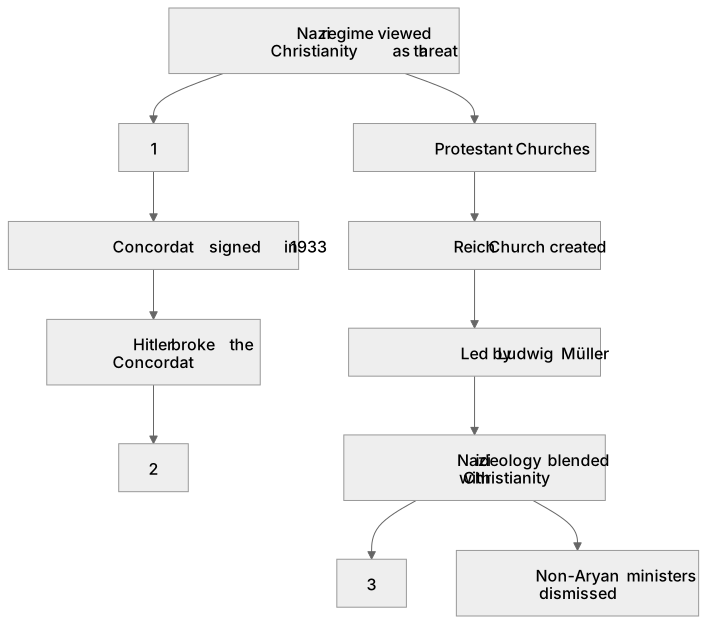
1Box 1
2Box 2
3Box 3
There is more to this lesson
The full lesson goes on to check your understanding and help you earn the marks. Create a free account to carry on, with your progress saved.
A week of Premium from your first lesson · Then the free plan continues · No card, no charge
Test your understanding of Option 31: Key topic 3: Nazi control and dictatorship, 1933–39 - 3 Controlling and influencing attitudes: Nazi attempts to control the Catholic and Protestant Churches: the Concordat and the Reich Church.
Active recall beats re-reading. Take an instant quiz now to test what you’ve learned and lock it into long-term memory.
A week of Premium from your first lesson · Then the free plan continues · No card, no charge