Pearson Edexcel · GCSE · History
Course version: 1HI0 · Version from Sept 2016
Key topic 3: Nazi control and dictatorship, 1933–39 - 4 Opposition,…
Full specification wording
Option 31: Key topic 3: Nazi control and dictatorship, 1933–39 - 4 Opposition, resistance and conformity: The extent of support for the Nazi regime.
Assessing the true level of support for the Nazi regime is challenging due to the pervasive atmosphere of terror and propaganda.
Checked against the Pearson Edexcel 1HI0 specification (opens in a new tab) on .
- Point 1 of 3
Study notes
From the checked teaching notes for this specification point.
The idea
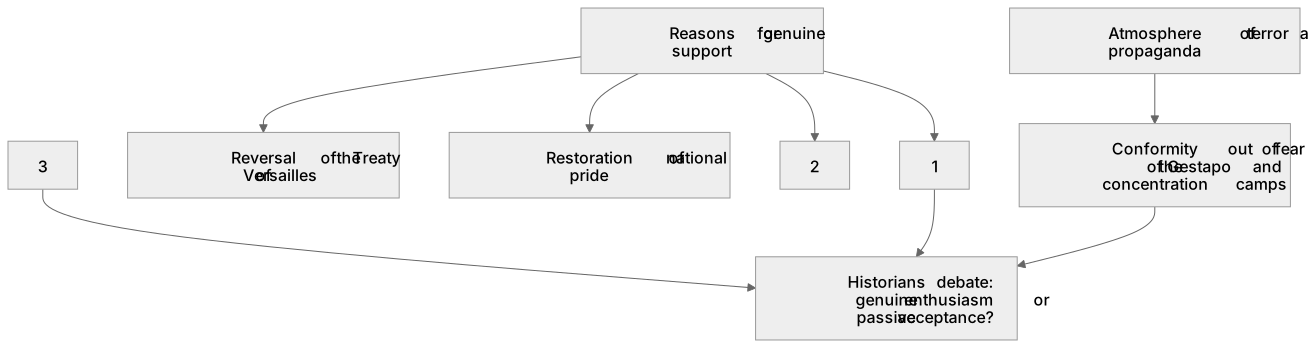
Assessing the true level of support for the Nazi regime is challenging due to the pervasive atmosphere of terror and propaganda. While many Germans genuinely supported Hitler due to economic recovery, the reversal of the Treaty of Versailles, and the restoration of national pride, others merely conformed out of fear of the Gestapo and concentration camps. The 'Hitler Myth' cultivated by Goebbels created widespread admiration for the Führer, even when the Nazi Party itself was unpopular. Historians debate whether the lack of mass opposition indicates genuine enthusiasm or passive acceptance.
What earns the marks
- Identify economic recovery and reduced unemployment as key reasons for genuine support.
- Explain the role of the 'Hitler Myth' in separating Hitler's personal popularity from the actions of the Nazi Party.
- Discuss how foreign policy successes, such as remilitarising the Rhineland, boosted national pride and support.
- Evaluate the difficulty of measuring true support in a totalitarian state where opposition was severely punished.
Common mistakes and how to put them right
Assuming all Germans were brainwashed by propaganda.
Put it right: Acknowledge that many supported the regime for practical reasons like employment, while others conformed out of fear.
Equating a lack of rebellion with total support.
Put it right: Differentiate between active support, passive conformity, and silent opposition in a totalitarian state.
Believing the Gestapo was everywhere.
Put it right: Note that the Gestapo was relatively small and relied heavily on denunciations from ordinary citizens, showing a complex layer of support.
Exam tips
- Use the concept of 'conformity' to explain why people who did not actively support the Nazis still obeyed them.
- Provide specific examples of policies that generated support, such as the Strength Through Joy (KdF) programme.
- When evaluating support, always mention the context of terror and the fear of the Gestapo.
Try the lesson
The start of the Option 31: Key topic 3: Nazi control and dictatorship, 1933–39 - 4 Opposition, resistance and conformity: The extent of support for the Nazi regime. lesson, made from checked teaching notes for this specification point.
Have a go first
Which of the following was a major reason why many German people supported the Nazi regime during the 1930s?
Listen
Assessing the true level of support for the Nazi regime is challenging due to the pervasive atmosphere of terror and propaganda. While many Germans genuinely supported Hitler due to economic recovery, the reversal of the Treaty of Versailles, and the restoration of national pride, others merely conformed out of fear of the Gestapo and concentration camps. The 'Hitler Myth' cultivated by Goebbels created widespread admiration for the Führer, even when the Nazi Party itself was unpopular. Historians debate whether the lack of mass opposition indicates genuine enthusiasm or passive acceptance. A strong answer earns marks for these points. Identify economic recovery and reduced unemployment as key reasons for genuine support. Explain the role of the 'Hitler Myth' in separating Hitler's personal popularity from the actions of the Nazi Party. Discuss how foreign policy successes, such as remilitarising the Rhineland, boosted national pride and support. Evaluate the difficulty of measuring true support in a totalitarian state where opposition was severely punished. A common slip: Assuming all Germans were brainwashed by propaganda. Instead, Acknowledge that many supported the regime for practical reasons like employment, while others conformed out of fear. Exam tip: Use the concept of 'conformity' to explain why people who did not actively support the Nazis still obeyed them.
See it

Label the diagram
Some boxes have lost their names. Pick the right name for each number.
1Box 1
2Box 2
3Box 3
There is more to this lesson
The full lesson goes on to check your understanding and help you earn the marks. Create a free account to carry on, with your progress saved.
A week of Premium from your first lesson · Then the free plan continues · No card, no charge
Test your understanding of Option 31: Key topic 3: Nazi control and dictatorship, 1933–39 - 4 Opposition, resistance and conformity: The extent of support for the Nazi regime.
Active recall beats re-reading. Take an instant quiz now to test what you’ve learned and lock it into long-term memory.
A week of Premium from your first lesson · Then the free plan continues · No card, no charge