Pearson Edexcel · GCSE · History
Course version: 1HI0 · Version from Sept 2016
Key topic 3: Nazi control and dictatorship, 1933–39 - 4 Opposition,…
Full specification wording
Option 31: Key topic 3: Nazi control and dictatorship, 1933–39 - 4 Opposition, resistance and conformity: Opposition from the Churches, including the role of Pastor Niemöller.
Despite Nazi attempts at control, significant religious opposition emerged.
Checked against the Pearson Edexcel 1HI0 specification (opens in a new tab) on .
- Point 2 of 3
- 4 key terms
Study notes
From the checked teaching notes for this specification point.
The idea
Despite Nazi attempts at control, significant religious opposition emerged. In the Protestant Church, Pastor Martin Niemöller helped establish the Confessing Church in 1934, which rejected the Nazi-aligned Reich Church and the dismissal of Jewish converts. Niemöller's outspoken sermons led to his arrest in 1937 and imprisonment in a concentration camp from 1938. Catholic opposition also grew, notably when Pope Pius XI issued the encyclical 'With Burning Anxiety' in 1937, condemning Nazi breaches of the Concordat and their racial ideology. Both examples highlight moral resistance to totalitarianism.
What earns the marks
- Describe the formation of the Confessing Church as a direct reaction against the pro-Nazi Reich Church.
- Explain Pastor Niemöller's role in leading Protestant opposition, his arrest in 1937, and his subsequent imprisonment in 1938.
- Identify the 1937 papal encyclical 'Mit brennender Sorge' as a key moment of Catholic opposition.
- Analyse the limitations of Church opposition, noting it rarely challenged the regime's broader political existence.
Common mistakes and how to put them right
Thinking Niemöller opposed the Nazis from the very beginning.
Put it right: Note that Niemöller initially welcomed Hitler's rise but turned against the regime when it interfered with the Church.
Assuming the Churches opposed the Holocaust.
Put it right: Clarify that Church opposition was primarily focused on defending their own institutions and opposing interference, rather than speaking out against the persecution of Jews.
Believing the Pope supported Hitler.
Put it right: Recognise that Pope Pius XI publicly condemned Nazi policies and breaches of the Concordat in his 1937 encyclical.
Exam tips
- Contrast the methods of opposition used by Protestant leaders like Niemöller with the institutional opposition of the Catholic Church.
- Remember that Church opposition was largely defensive, aiming to protect religious independence rather than overthrowing Hitler.
- Use Niemöller's arrest in 1937 and imprisonment in 1938 as evidence of the regime's intolerance for any dissenting voices.
Try the lesson
The start of the Option 31: Key topic 3: Nazi control and dictatorship, 1933–39 - 4 Opposition, resistance and conformity: Opposition from the Churches, including the role of Pastor Niemöller. lesson, made from checked teaching notes for this specification point.
Have a go first
What organisation did Pastor Martin Niemöller help to establish in 1934 to oppose Nazi interference in religion?
Listen
Despite Nazi attempts at control, significant religious opposition emerged. In the Protestant Church, Pastor Martin Niemöller helped establish the Confessing Church in 1934, which rejected the Nazi-aligned Reich Church and the dismissal of Jewish converts. Niemöller's outspoken sermons led to his arrest in 1937 and imprisonment in a concentration camp from 1938. Catholic opposition also grew, notably when Pope Pius XI issued the encyclical 'With Burning Anxiety' in 1937, condemning Nazi breaches of the Concordat and their racial ideology. Both examples highlight moral resistance to totalitarianism. A strong answer earns marks for these points. Describe the formation of the Confessing Church as a direct reaction against the pro-Nazi Reich Church. Explain Pastor Niemöller's role in leading Protestant opposition, his arrest in 1937, and his subsequent imprisonment in 1938. Identify the 1937 papal encyclical 'Mit brennender Sorge' as a key moment of Catholic opposition. Analyse the limitations of Church opposition, noting it rarely challenged the regime's broader political existence. A common slip: Thinking Niemöller opposed the Nazis from the very beginning. Instead, Note that Niemöller initially welcomed Hitler's rise but turned against the regime when it interfered with the Church. Exam tip: Contrast the methods of opposition used by Protestant leaders like Niemöller with the institutional opposition of the Catholic Church.
See it
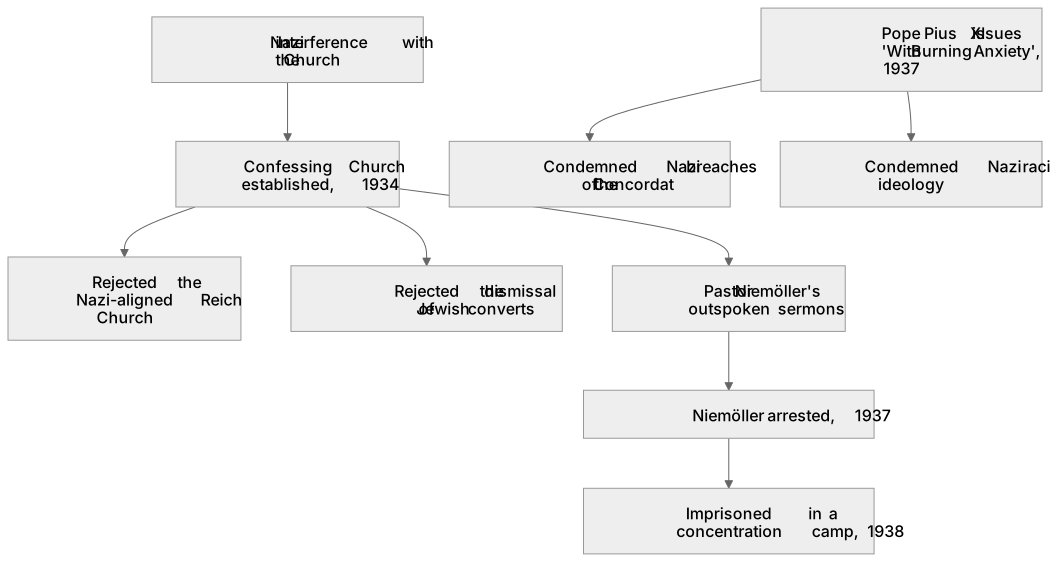
Put the events in order
Put these events in the order they happened, earliest first.
- 1. Confessing Church established with Niemöller's help
- 2. Niemöller imprisoned in a concentration camp
- 3. Niemöller arrested after outspoken sermons
Key words
Say what each word means before you turn the card.
Confessing Church
Try answering aloud or in your head before turning the card.
Pastor Niemöller
Try answering aloud or in your head before turning the card.
encyclical 'With Burning Anxiety'
Try answering aloud or in your head before turning the card.
moral resistance
Try answering aloud or in your head before turning the card.
See every definition
- Confessing Church
- Protestant Church established in 1934 which rejected the Nazi-aligned Reich Church and the dismissal of Jewish converts.
- Pastor Niemöller
- Helped establish the Confessing Church and was arrested in 1937, then imprisoned in a concentration camp from 1938.
- encyclical 'With Burning Anxiety'
- Issued by Pope Pius XI in 1937, condemning Nazi breaches of the Concordat and their racial ideology.
- moral resistance
- Opposition to totalitarianism shown by both the Protestant and Catholic examples.
Label the diagram
Some boxes have lost their names. Pick the right name for each number.
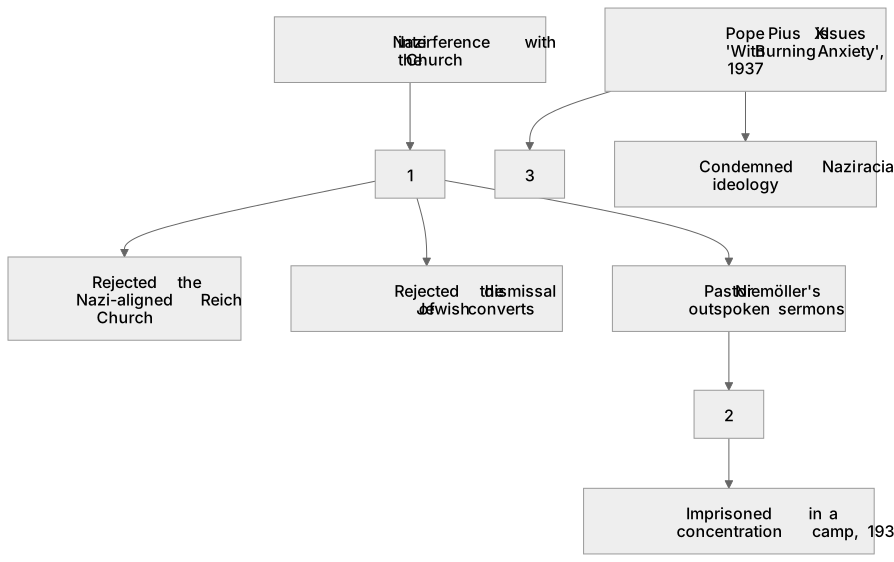
1Box 1
2Box 2
3Box 3
There is more to this lesson
The full lesson goes on to check your understanding and help you earn the marks. Create a free account to carry on, with your progress saved.
A week of Premium from your first lesson · Then the free plan continues · No card, no charge
Test your understanding of Option 31: Key topic 3: Nazi control and dictatorship, 1933–39 - 4 Opposition, resistance and conformity: Opposition from the Churches, including the role of Pastor Niemöller.
Active recall beats re-reading. Take an instant quiz now to test what you’ve learned and lock it into long-term memory.
A week of Premium from your first lesson · Then the free plan continues · No card, no charge