Pearson Edexcel · GCSE · History
Course version: 1HI0 · Version from Sept 2016
Key topic 1: Establishing communist rule, 1945–59 - 1 The Civil War,…
Full specification wording
Option 32: Key topic 1: Establishing communist rule, 1945–59 - 1 The Civil War, 1945–49: The relative strengths and weaknesses of the CCP and the Guomindang at the start of the Civil War.
At the start of the 1946 Civil War, the Guomindang (GMD) and the Chinese Communist Party (CCP) had distinct relative strengths and weaknesses.
Checked against the Pearson Edexcel 1HI0 specification (opens in a new tab) on .
- Point 1 of 2
Study notes
From the checked teaching notes for this specification point.
The idea
At the start of the 1946 Civil War, the Guomindang (GMD) and the Chinese Communist Party (CCP) had distinct relative strengths and weaknesses. The GMD initially held major advantages: a larger, better-equipped army of 2.8 million, control of key cities, and substantial US financial backing. However, their weaknesses included widespread corruption, low troop morale, and a lack of popular support due to hyperinflation. Conversely, the CCP's People's Liberation Army was smaller (1.2 million) and poorly equipped, representing a significant weakness. Yet, their strengths lay in high morale, effective guerrilla warfare tactics, and immense popular support from the peasantry, secured through promises of land reform.
What earns the marks
- Identify the GMD's initial numerical and technological superiority, backed by US funding.
- Explain how GMD corruption and hyperinflation alienated their support base.
- Describe the CCP's initial weakness in troop numbers and heavy weaponry.
- Analyse how the CCP's land reform policies generated strong peasant support and high morale.
Common mistakes and how to put them right
Stating the CCP had a larger army at the start of the war.
Put it right: Note that the GMD had a significantly larger and better-equipped army in 1946.
Ignoring the role of the USA.
Put it right: Include the fact that the USA provided substantial financial and military aid to the GMD.
Assuming the GMD had strong popular support.
Put it right: Explain that despite holding cities, the GMD was deeply unpopular due to corruption and economic mismanagement.
Exam tips
- When comparing strengths and weaknesses, directly contrast the GMD's material advantages with the CCP's ideological and morale advantages.
- Use specific examples, such as the impact of hyperinflation on GMD support, to strengthen your analysis.
- Ensure you focus on the 'start' of the Civil War (1946) rather than the later stages when the balance of power shifted.
Try the lesson
The start of the Option 32: Key topic 1: Establishing communist rule, 1945–59 - 1 The Civil War, 1945–49: The relative strengths and weaknesses of the CCP and the Guomindang at the start of the Civil War. lesson, made from checked teaching notes for this specification point.
Have a go first
Which of the following was a key strength of the Guomindang (GMD) at the start of the Civil War in 1945?
Listen
At the start of the 1946 Civil War, the Guomindang (GMD) and the Chinese Communist Party (CCP) had distinct relative strengths and weaknesses. The GMD initially held major advantages: a larger, better-equipped army of 2.8 million, control of key cities, and substantial US financial backing. However, their weaknesses included widespread corruption, low troop morale, and a lack of popular support due to hyperinflation. Conversely, the CCP's People's Liberation Army was smaller (1.2 million) and poorly equipped, representing a significant weakness. Yet, their strengths lay in high morale, effective guerrilla warfare tactics, and immense popular support from the peasantry, secured through promises of land reform. A strong answer earns marks for these points. Identify the GMD's initial numerical and technological superiority, backed by US funding. Explain how GMD corruption and hyperinflation alienated their support base. Describe the CCP's initial weakness in troop numbers and heavy weaponry. Analyse how the CCP's land reform policies generated strong peasant support and high morale. A common slip: Stating the CCP had a larger army at the start of the war. Instead, Note that the GMD had a significantly larger and better-equipped army in 1946. Exam tip: When comparing strengths and weaknesses, directly contrast the GMD's material advantages with the CCP's ideological and morale advantages.
See it
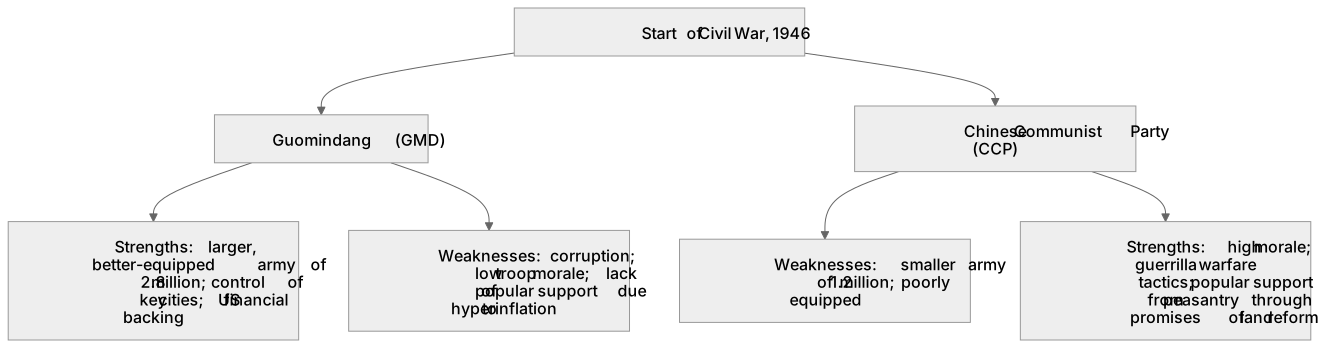
Label the diagram
Some boxes have lost their names. Pick the right name for each number.
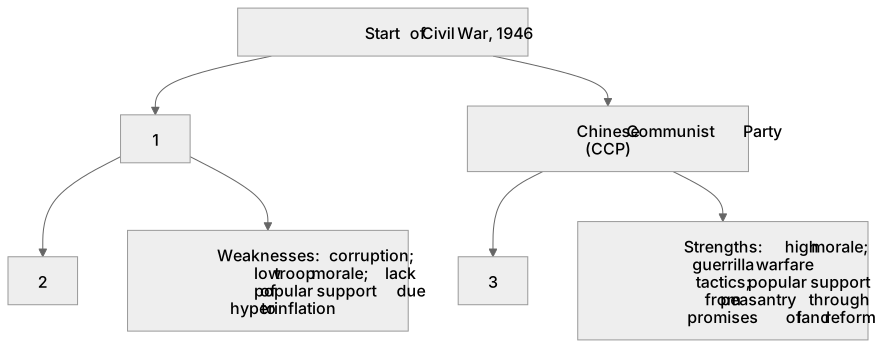
1Box 1
2Box 2
3Box 3
There is more to this lesson
The full lesson goes on to check your understanding and help you earn the marks. Create a free account to carry on, with your progress saved.
A week of Premium from your first lesson · Then the free plan continues · No card, no charge
Test your understanding of Option 32: Key topic 1: Establishing communist rule, 1945–59 - 1 The Civil War, 1945–49: The relative strengths and weaknesses of the CCP and the Guomindang at the start of the Civil War.
Active recall beats re-reading. Take an instant quiz now to test what you’ve learned and lock it into long-term memory.
A week of Premium from your first lesson · Then the free plan continues · No card, no charge