Pearson Edexcel · GCSE · History
Course version: 1HI0 · Version from Sept 2016
Key topic 1: Establishing communist rule, 1945–59 - 3 Consolidating the…
Full specification wording
Option 32: Key topic 1: Establishing communist rule, 1945–59 - 3 Consolidating the CCP’s hold on power, 1951–52: The ‘three antis’ and ‘five antis’ movements.
The 'Three Antis' (Sanfan) and 'Five Antis' (Wufan) movements were launched by Mao in 1951 and 1952 to consolidate CCP control over the economy and urban populations.
Checked against the Pearson Edexcel 1HI0 specification (opens in a new tab) on .
- Point 2 of 2
- 4 key terms
Study notes
From the checked teaching notes for this specification point.
The idea
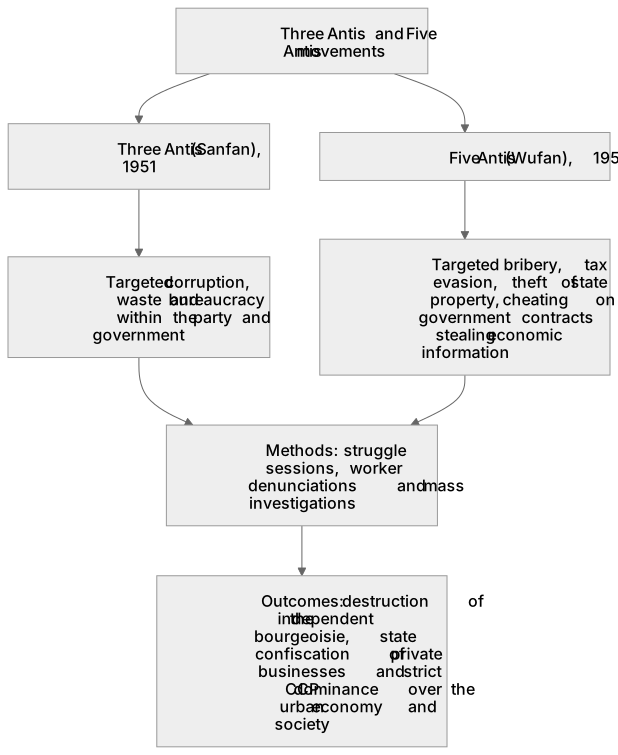
The 'Three Antis' (Sanfan) and 'Five Antis' (Wufan) movements were launched by Mao in 1951 and 1952 to consolidate CCP control over the economy and urban populations. The Three Antis targeted corruption, waste, and bureaucracy within the party and government, aiming to discipline officials and remove GMD sympathisers. The Five Antis targeted the capitalist class, focusing on bribery, tax evasion, theft of state property, cheating on government contracts, and stealing economic information. Workers were encouraged to denounce their bosses in struggle sessions, leading to mass suicides and the state confiscation of private businesses. These movements successfully destroyed the independent bourgeoisie, enriched the state through massive fines, and established strict CCP dominance over China's urban economy and society.
What earns the marks
- Define the targets of the Three Antis movement: corruption, waste, and bureaucracy within the party and state apparatus.
- Define the targets of the Five Antis movement: bribery, tax evasion, theft of state property, cheating on contracts, and stealing economic information.
- Explain the methods used, such as struggle sessions, worker denunciations, and mass investigations.
- Analyse the outcomes, including the destruction of the capitalist class, state acquisition of private businesses, and increased CCP control.
Common mistakes and how to put them right
Confusing the targets of the two movements.
Put it right: The Three Antis targeted party and government officials, while the Five Antis targeted the urban bourgeoisie and business owners.
Believing the movements were purely economic.
Put it right: While they had economic goals, they were primarily political tools to eliminate opposition and consolidate CCP power.
Stating that all business owners were executed.
Put it right: Many were heavily fined, sent to labour camps, or driven to suicide, rather than being formally executed.
Exam tips
- Clearly distinguish between the specific aims of the Three Antis and the Five Antis in your answers.
- Discuss how these movements helped the CCP transition from a rural-based power to controlling urban centres.
- Use these movements as evidence of how Mao used mass mobilisation and class warfare to achieve political goals.
Try the lesson
The start of the Option 32: Key topic 1: Establishing communist rule, 1945–59 - 3 Consolidating the CCP’s hold on power, 1951–52: The ‘three antis’ and ‘five antis’ movements. lesson, made from checked teaching notes for this specification point.
Have a go first
Which of the following was one of the specific targets of the 'Three Antis' movement launched in 1951?
Listen
The 'Three Antis' (Sanfan) and 'Five Antis' (Wufan) movements were launched by Mao in 1951 and 1952 to consolidate CCP control over the economy and urban populations. The Three Antis targeted corruption, waste, and bureaucracy within the party and government, aiming to discipline officials and remove GMD sympathisers. The Five Antis targeted the capitalist class, focusing on bribery, tax evasion, theft of state property, cheating on government contracts, and stealing economic information. Workers were encouraged to denounce their bosses in struggle sessions, leading to mass suicides and the state confiscation of private businesses. These movements successfully destroyed the independent bourgeoisie, enriched the state through massive fines, and established strict CCP dominance over China's urban economy and society. A strong answer earns marks for these points. Define the targets of the Three Antis movement: corruption, waste, and bureaucracy within the party and state apparatus. Define the targets of the Five Antis movement: bribery, tax evasion, theft of state property, cheating on contracts, and stealing economic information. Explain the methods used, such as struggle sessions, worker denunciations, and mass investigations. Analyse the outcomes, including the destruction of the capitalist class, state acquisition of private businesses, and increased CCP control. A common slip: Confusing the targets of the two movements. Instead, the Three Antis targeted party and government officials, while the Five Antis targeted the urban bourgeoisie and business owners. Exam tip: Clearly distinguish between the specific aims of the Three Antis and the Five Antis in your answers.
See it
Key words
Say what each word means before you turn the card.
Three Antis
Try answering aloud or in your head before turning the card.
Five Antis
Try answering aloud or in your head before turning the card.
Struggle sessions
Try answering aloud or in your head before turning the card.
Mass mobilisation
Try answering aloud or in your head before turning the card.
See every definition
- Three Antis
- Movement launched by Mao in 1951 that targeted corruption, waste and bureaucracy within the party and government, aiming to discipline officials and remove GMD sympathisers.
- Five Antis
- Movement launched by Mao in 1952 that targeted the capitalist class, focusing on bribery, tax evasion, theft of state property, cheating on government contracts and stealing economic information.
- Struggle sessions
- Method in which workers were encouraged to denounce their bosses, leading to mass suicides and the state confiscation of private businesses.
- Mass mobilisation
- Method used by Mao, alongside class warfare, to achieve political goals such as destroying the independent bourgeoisie and establishing strict CCP dominance over China's urban economy and society.
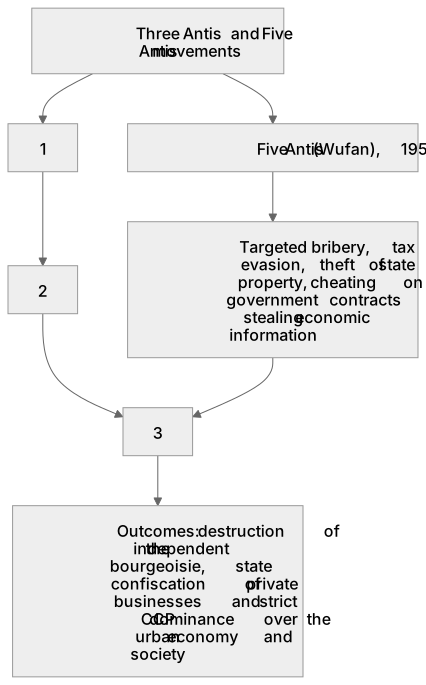
Label the diagram
Some boxes have lost their names. Pick the right name for each number.
1Box 1
2Box 2
3Box 3
There is more to this lesson
The full lesson goes on to check your understanding and help you earn the marks. Create a free account to carry on, with your progress saved.
A week of Premium from your first lesson · Then the free plan continues · No card, no charge
Test your understanding of Option 32: Key topic 1: Establishing communist rule, 1945–59 - 3 Consolidating the CCP’s hold on power, 1951–52: The ‘three antis’ and ‘five antis’ movements.
Active recall beats re-reading. Take an instant quiz now to test what you’ve learned and lock it into long-term memory.
A week of Premium from your first lesson · Then the free plan continues · No card, no charge