Pearson Edexcel · GCSE · History
Course version: 1HI0 · Version from Sept 2016
Key topic 2: Economic policy, 1949–65 - 1 Early changes in agriculture,…
Full specification wording
Option 32: Key topic 2: Economic policy, 1949–65 - 1 Early changes in agriculture, 1949–57: Moves towards agricultural cooperation.
Following the initial redistribution of land, the CCP began gradual moves towards agricultural cooperation to increase efficiency and prevent the re-emergence of a wealthy peasant class.
Checked against the Pearson Edexcel 1HI0 specification (opens in a new tab) on .
- Point 2 of 3
- 3 key terms
Study notes
From the checked teaching notes for this specification point.
The idea
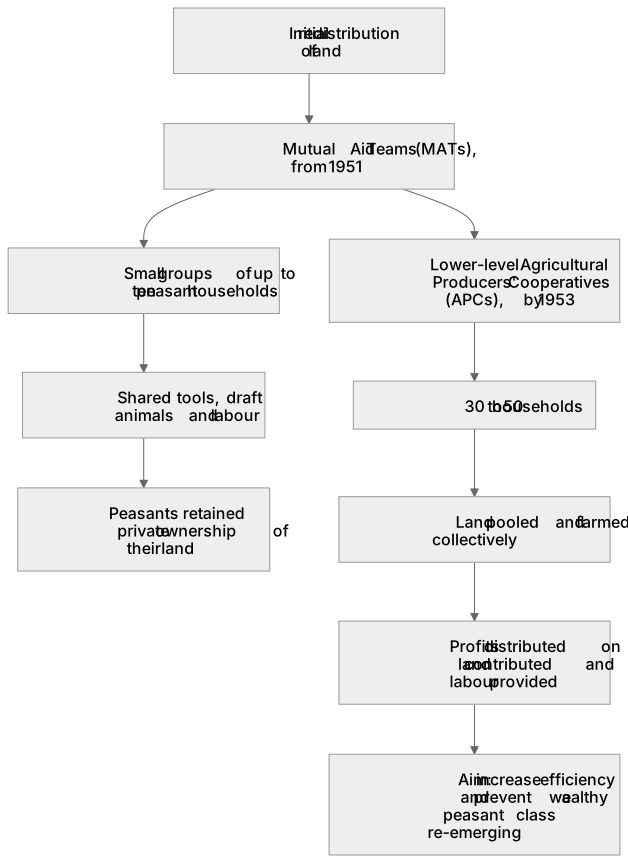
Following the initial redistribution of land, the CCP began gradual moves towards agricultural cooperation to increase efficiency and prevent the re-emergence of a wealthy peasant class. The process started in 1951 with Mutual Aid Teams (MATs), where small groups of up to ten peasant households shared tools, draft animals, and labour, while retaining private ownership of their land. By 1953, this progressed to lower-level Agricultural Producers' Cooperatives (APCs), comprising 30 to 50 households. In APCs, land was pooled and farmed collectively, and profits were distributed based on both the amount of land contributed and the labour provided. These gradual steps aimed to accustom peasants to socialist farming methods without provoking the resistance seen during Soviet collectivisation.
What earns the marks
- Identify Mutual Aid Teams (MATs) as the first step, involving the sharing of labour and tools among small groups of households.
- Explain the progression to lower-level Agricultural Producers' Cooperatives (APCs), which pooled land from 30-50 households.
- Describe how profits in lower-level APCs were distributed based on both land contribution and labour.
- Explain the CCP's rationale: increasing agricultural output and preventing the rise of a new 'rich peasant' class.
Common mistakes and how to put them right
Confusing Mutual Aid Teams with full communes.
Put it right: Ensure you distinguish between the early, small-scale MATs (sharing tools/labour) and the later, massive communes of the Great Leap Forward.
Stating that peasants lost all private property in the early cooperative stages.
Put it right: Emphasise that in MATs and lower-level APCs, peasants still retained private ownership of their land.
Assuming the move to cooperation was entirely forced from the beginning.
Put it right: Note that early moves like MATs were largely voluntary and built on traditional peasant practices of seasonal sharing.
Exam tips
- Trace the chronological progression clearly: Land Reform to Mutual Aid Teams (MATs) to lower-level APCs.
- Explain why the CCP felt cooperation was necessary after land reform (e.g., small plots were inefficient, fear of capitalism returning).
- Use specific numbers, such as MATs involving around 10 households and lower-level APCs involving 30-50, to show precise knowledge.
Try the lesson
The start of the Option 32: Key topic 2: Economic policy, 1949–65 - 1 Early changes in agriculture, 1949–57: Moves towards agricultural cooperation. lesson, made from checked teaching notes for this specification point.
Have a go first
What was the first step introduced by the Chinese Communist Party to encourage agricultural cooperation among peasants?
Listen
Following the initial redistribution of land, the CCP began gradual moves towards agricultural cooperation to increase efficiency and prevent the re-emergence of a wealthy peasant class. The process started in 1951 with Mutual Aid Teams (MATs), where small groups of up to ten peasant households shared tools, draft animals, and labour, while retaining private ownership of their land. By 1953, this progressed to lower-level Agricultural Producers' Cooperatives (APCs), comprising 30 to 50 households. In APCs, land was pooled and farmed collectively, and profits were distributed based on both the amount of land contributed and the labour provided. These gradual steps aimed to accustom peasants to socialist farming methods without provoking the resistance seen during Soviet collectivisation. A strong answer earns marks for these points. Identify Mutual Aid Teams (MATs) as the first step, involving the sharing of labour and tools among small groups of households. Explain the progression to lower-level Agricultural Producers' Cooperatives (APCs), which pooled land from 30-50 households. Describe how profits in lower-level APCs were distributed based on both land contribution and labour. Explain the CCP's rationale: increasing agricultural output and preventing the rise of a new 'rich peasant' class. A common slip: Confusing Mutual Aid Teams with full communes. Instead, Ensure you distinguish between the early, small-scale MATs (sharing tools/labour) and the later, massive communes of the Great Leap Forward. Exam tip: Trace the chronological progression clearly: Land Reform to Mutual Aid Teams (MATs) to lower-level APCs.
See it
Key words
Say what each word means before you turn the card.
Mutual Aid Teams (MATs)
Try answering aloud or in your head before turning the card.
Agricultural Producers' Cooperatives (APCs)
Try answering aloud or in your head before turning the card.
Agricultural cooperation
Try answering aloud or in your head before turning the card.
See every definition
- Mutual Aid Teams (MATs)
- Small groups of up to ten peasant households who shared tools, draft animals and labour while retaining private ownership of their land.
- Agricultural Producers' Cooperatives (APCs)
- Lower-level cooperatives of 30 to 50 households in which land was pooled and farmed collectively.
- Agricultural cooperation
- Gradual moves towards collective farming intended to increase efficiency and prevent the re-emergence of a wealthy peasant class.
Label the diagram
Some boxes have lost their names. Pick the right name for each number.
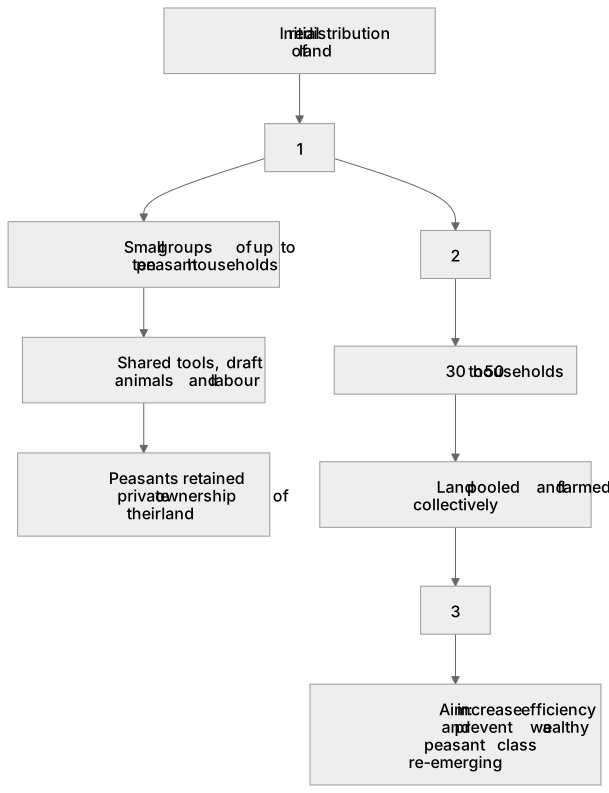
1Box 1
2Box 2
3Box 3
There is more to this lesson
The full lesson goes on to check your understanding and help you earn the marks. Create a free account to carry on, with your progress saved.
A week of Premium from your first lesson · Then the free plan continues · No card, no charge
Test your understanding of Option 32: Key topic 2: Economic policy, 1949–65 - 1 Early changes in agriculture, 1949–57: Moves towards agricultural cooperation.
Active recall beats re-reading. Take an instant quiz now to test what you’ve learned and lock it into long-term memory.
A week of Premium from your first lesson · Then the free plan continues · No card, no charge