Pearson Edexcel · GCSE · History
Course version: 1HI0 · Version from Sept 2016
Key topic 2: Economic policy, 1949–65 - 1 Early changes in agriculture,…
Full specification wording
Option 32: Key topic 2: Economic policy, 1949–65 - 1 Early changes in agriculture, 1949–57: Reasons for, and features of, the attacks on landlordism and the redistribution of land.
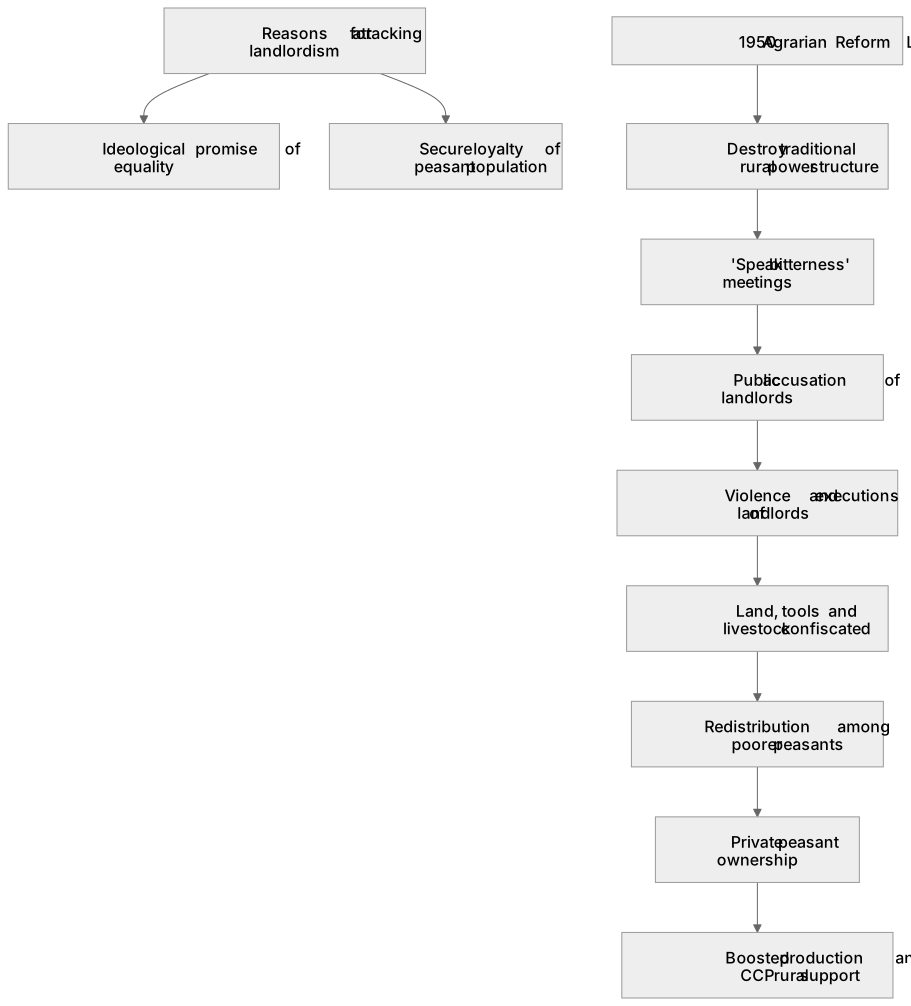
The Chinese Communist Party (CCP) attacked landlordism to fulfil ideological promises of equality and to secure the loyalty of the vast peasant population.
Checked against the Pearson Edexcel 1HI0 specification (opens in a new tab) on .
- Point 1 of 3
- 4 key terms
Study notes
From the checked teaching notes for this specification point.
The idea
The Chinese Communist Party (CCP) attacked landlordism to fulfil ideological promises of equality and to secure the loyalty of the vast peasant population. The 1950 Agrarian Reform Law was the primary mechanism for this, aiming to destroy the traditional rural power structure. Features of these attacks included 'speak bitterness' meetings, where peasants were encouraged to publicly accuse landlords of past abuses. This often escalated into violence, resulting in the execution of up to two million landlords. Following these attacks, land, tools, and livestock were confiscated and redistributed among the poorer peasants. This redistribution temporarily created a system of private peasant ownership, boosting agricultural production and cementing CCP support in rural areas.
What earns the marks
- Explain the ideological and political reasons for attacking landlords, such as fulfilling Marxist principles and gaining peasant support.
- Describe the 1950 Agrarian Reform Law as the legal basis for land redistribution.
- Detail the features of the attacks, including 'speak bitterness' meetings, public humiliation, and widespread executions.
- Outline the process of redistribution, where confiscated land and property were given to poor and middle peasants.
Common mistakes and how to put them right
Assuming land redistribution immediately created collective farms.
Put it right: Clarify that the initial redistribution gave private ownership to peasants; collectivisation came later.
Believing the attacks on landlords were purely legal and peaceful.
Put it right: Highlight the violent nature of the 'speak bitterness' meetings and the mass executions of landlords.
Stating that all peasants were treated equally during redistribution.
Put it right: Note that peasants were classified into categories (e.g., rich, middle, poor), which determined how they were treated and what they received.
Exam tips
- Clearly separate the reasons for the policy (ideology, peasant support) from the features (speak bitterness meetings, violence, redistribution).
- Use the term 'Agrarian Reform Law of 1950' to anchor your answer in specific historical legislation.
- Discuss the psychological impact of forcing peasants to condemn landlords, which made them complicit in the revolution.
Try the lesson
The start of the Option 32: Key topic 2: Economic policy, 1949–65 - 1 Early changes in agriculture, 1949–57: Reasons for, and features of, the attacks on landlordism and the redistribution of land. lesson, made from checked teaching notes for this specification point.
Have a go first
Which 1950 law provided the legal framework for the attacks on landlordism and the redistribution of land in China?
Listen
The Chinese Communist Party (CCP) attacked landlordism to fulfil ideological promises of equality and to secure the loyalty of the vast peasant population. The 1950 Agrarian Reform Law was the primary mechanism for this, aiming to destroy the traditional rural power structure. Features of these attacks included 'speak bitterness' meetings, where peasants were encouraged to publicly accuse landlords of past abuses. This often escalated into violence, resulting in the execution of up to two million landlords. Following these attacks, land, tools, and livestock were confiscated and redistributed among the poorer peasants. This redistribution temporarily created a system of private peasant ownership, boosting agricultural production and cementing CCP support in rural areas. A strong answer earns marks for these points. Explain the ideological and political reasons for attacking landlords, such as fulfilling Marxist principles and gaining peasant support. Describe the 1950 Agrarian Reform Law as the legal basis for land redistribution. Detail the features of the attacks, including 'speak bitterness' meetings, public humiliation, and widespread executions. Outline the process of redistribution, where confiscated land and property were given to poor and middle peasants. A common slip: Assuming land redistribution immediately created collective farms. Instead, Clarify that the initial redistribution gave private ownership to peasants; collectivisation came later. Exam tip: Clearly separate the reasons for the policy (ideology, peasant support) from the features (speak bitterness meetings, violence, redistribution).
See it
Key words
Say what each word means before you turn the card.
Landlordism
Try answering aloud or in your head before turning the card.
Agrarian Reform Law
Try answering aloud or in your head before turning the card.
Speak bitterness meetings
Try answering aloud or in your head before turning the card.
Redistribution
Try answering aloud or in your head before turning the card.
See every definition
- Landlordism
- The traditional rural power structure that the Chinese Communist Party attacked in order to fulfil ideological promises of equality and secure peasant loyalty.
- Agrarian Reform Law
- The 1950 law that was the primary mechanism for attacking landlordism and aiming to destroy the traditional rural power structure.
- Speak bitterness meetings
- Meetings where peasants were encouraged to publicly accuse landlords of past abuses, often escalating into violence and executions.
- Redistribution
- The process in which land, tools and livestock were confiscated and given among the poorer peasants, temporarily creating private peasant ownership.
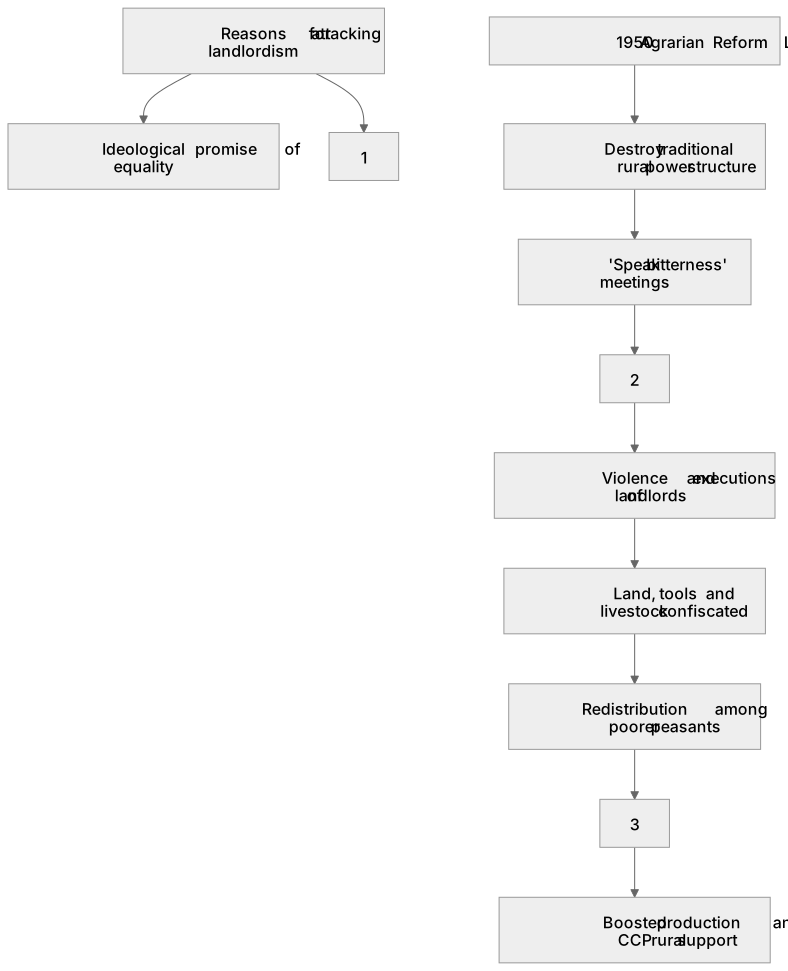
Label the diagram
Some boxes have lost their names. Pick the right name for each number.
1Box 1
2Box 2
3Box 3
There is more to this lesson
The full lesson goes on to check your understanding and help you earn the marks. Create a free account to carry on, with your progress saved.
A week of Premium from your first lesson · Then the free plan continues · No card, no charge
Test your understanding of Option 32: Key topic 2: Economic policy, 1949–65 - 1 Early changes in agriculture, 1949–57: Reasons for, and features of, the attacks on landlordism and the redistribution of land.
Active recall beats re-reading. Take an instant quiz now to test what you’ve learned and lock it into long-term memory.
A week of Premium from your first lesson · Then the free plan continues · No card, no charge