Pearson Edexcel · GCSE · History
Course version: 1HI0 · Version from Sept 2016
Key topic 2: Economic policy, 1949–65 - 3 The Great Leap Forward: Mao’s…
Full specification wording
Option 32: Key topic 2: Economic policy, 1949–65 - 3 The Great Leap Forward: Mao’s reasons for the second Five-Year Plan (the Great Leap Forward), 1958–62.
Mao launched the second Five-Year Plan, known as the Great Leap Forward (1958–62), to rapidly transform China into a modern industrial and agricultural power.
Checked against the Pearson Edexcel 1HI0 specification (opens in a new tab) on .
- Point 1 of 4
- 3 key terms
Study notes
From the checked teaching notes for this specification point.
The idea
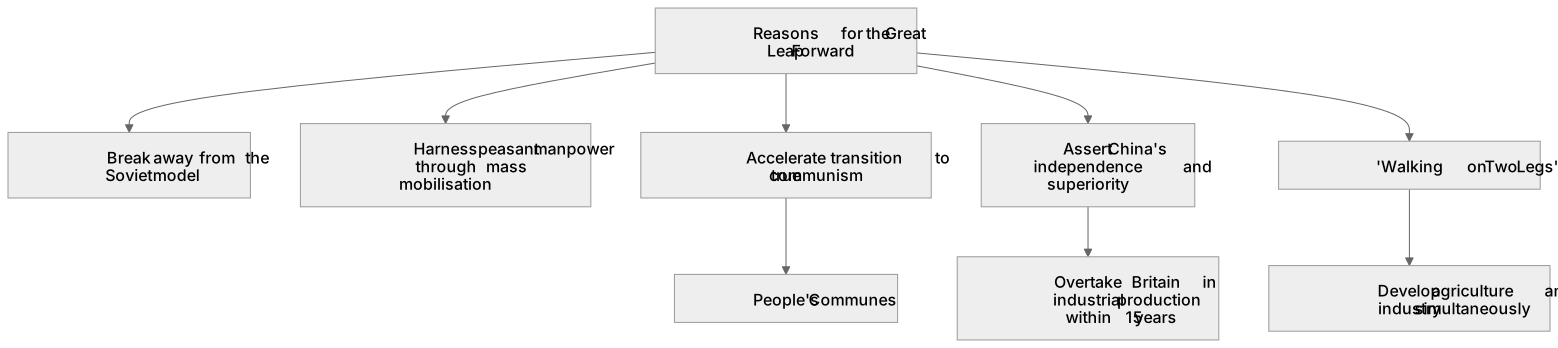
Mao launched the second Five-Year Plan, known as the Great Leap Forward (1958–62), to rapidly transform China into a modern industrial and agricultural power. A key reason was Mao's desire to break away from the Soviet economic model, which he felt relied too heavily on experts and urban industry. Instead, he wanted to harness the sheer manpower of the Chinese peasantry through mass mobilisation. Ideologically, Mao aimed to accelerate the transition to true communism by establishing People's Communes. Furthermore, Mao wanted to assert China's independence and superiority on the world stage, famously declaring that China would overtake Britain in industrial production within 15 years, driven by his belief in 'Walking on Two Legs'.
What earns the marks
- Explain Mao's ideological desire to accelerate the transition to communism through the creation of People's Communes.
- Describe Mao's intention to move away from the Soviet model of relying on technical experts and central planning.
- Identify the concept of 'Walking on Two Legs', aiming to develop both agriculture and industry simultaneously.
- Discuss Mao's nationalistic goal to make China an independent superpower capable of overtaking Western nations like Britain in production.
Common mistakes and how to put them right
Confusing the reasons for the first and second Five-Year Plans.
Put it right: The first relied on Soviet expertise, while the second explicitly rejected it in favour of mass peasant mobilisation.
Believing the Great Leap Forward only focused on agriculture.
Put it right: It aimed to boost both agriculture and industry simultaneously ('Walking on Two Legs').
Overlooking the political context.
Put it right: Include Mao's desire to reassert his authority and prove his ideological purity after the Hundred Flowers Campaign.
Exam tips
- Clearly distinguish between economic reasons (boosting production) and ideological reasons (achieving true communism).
- Use the phrase 'Walking on Two Legs' to demonstrate your understanding of Mao's dual focus on industry and agriculture.
- Connect Mao's deteriorating relationship with Khrushchev to his desire for China to become economically self-sufficient.
Try the lesson
The start of the Option 32: Key topic 2: Economic policy, 1949–65 - 3 The Great Leap Forward: Mao’s reasons for the second Five-Year Plan (the Great Leap Forward), 1958–62. lesson, made from checked teaching notes for this specification point.
Have a go first
What was one of Mao Zedong's main economic goals for the Great Leap Forward?
Listen
Mao launched the second Five-Year Plan, known as the Great Leap Forward (1958–62), to rapidly transform China into a modern industrial and agricultural power. A key reason was Mao's desire to break away from the Soviet economic model, which he felt relied too heavily on experts and urban industry. Instead, he wanted to harness the sheer manpower of the Chinese peasantry through mass mobilisation. Ideologically, Mao aimed to accelerate the transition to true communism by establishing People's Communes. Furthermore, Mao wanted to assert China's independence and superiority on the world stage, famously declaring that China would overtake Britain in industrial production within 15 years, driven by his belief in 'Walking on Two Legs'. A strong answer earns marks for these points. Explain Mao's ideological desire to accelerate the transition to communism through the creation of People's Communes. Describe Mao's intention to move away from the Soviet model of relying on technical experts and central planning. Identify the concept of 'Walking on Two Legs', aiming to develop both agriculture and industry simultaneously. Discuss Mao's nationalistic goal to make China an independent superpower capable of overtaking Western nations like Britain in production. A common slip: Confusing the reasons for the first and second Five-Year Plans. Instead, the first relied on Soviet expertise, while the second explicitly rejected it in favour of mass peasant mobilisation. Exam tip: Clearly distinguish between economic reasons (boosting production) and ideological reasons (achieving true communism).
See it
Key words
Say what each word means before you turn the card.
Mass mobilisation
Try answering aloud or in your head before turning the card.
Walking on Two Legs
Try answering aloud or in your head before turning the card.
People's Communes
Try answering aloud or in your head before turning the card.
See every definition
- Mass mobilisation
- Harnessing the sheer manpower of the Chinese peasantry to rapidly transform China into a modern industrial and agricultural power.
- Walking on Two Legs
- Mao's belief in developing both agriculture and industry simultaneously.
- People's Communes
- The means by which Mao aimed to accelerate the transition to true communism.
Label the diagram
Some boxes have lost their names. Pick the right name for each number.
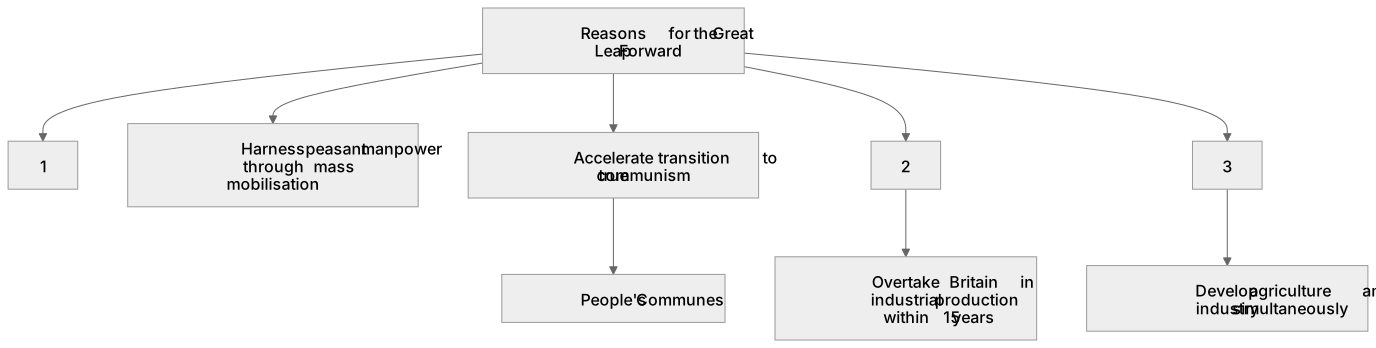
1Box 1
2Box 2
3Box 3
There is more to this lesson
The full lesson goes on to check your understanding and help you earn the marks. Create a free account to carry on, with your progress saved.
A week of Premium from your first lesson · Then the free plan continues · No card, no charge
Test your understanding of Option 32: Key topic 2: Economic policy, 1949–65 - 3 The Great Leap Forward: Mao’s reasons for the second Five-Year Plan (the Great Leap Forward), 1958–62.
Active recall beats re-reading. Take an instant quiz now to test what you’ve learned and lock it into long-term memory.
A week of Premium from your first lesson · Then the free plan continues · No card, no charge