Pearson Edexcel · GCSE · History
Course version: 1HI0 · Version from Sept 2016
Key topic 2: Economic policy, 1949–65 - 3 The Great Leap Forward: The…
Full specification wording
Option 32: Key topic 2: Economic policy, 1949–65 - 3 The Great Leap Forward: The successes and failures of the Great Leap Forward. Reasons for failures. The importance of the Lushan Conference (1959).
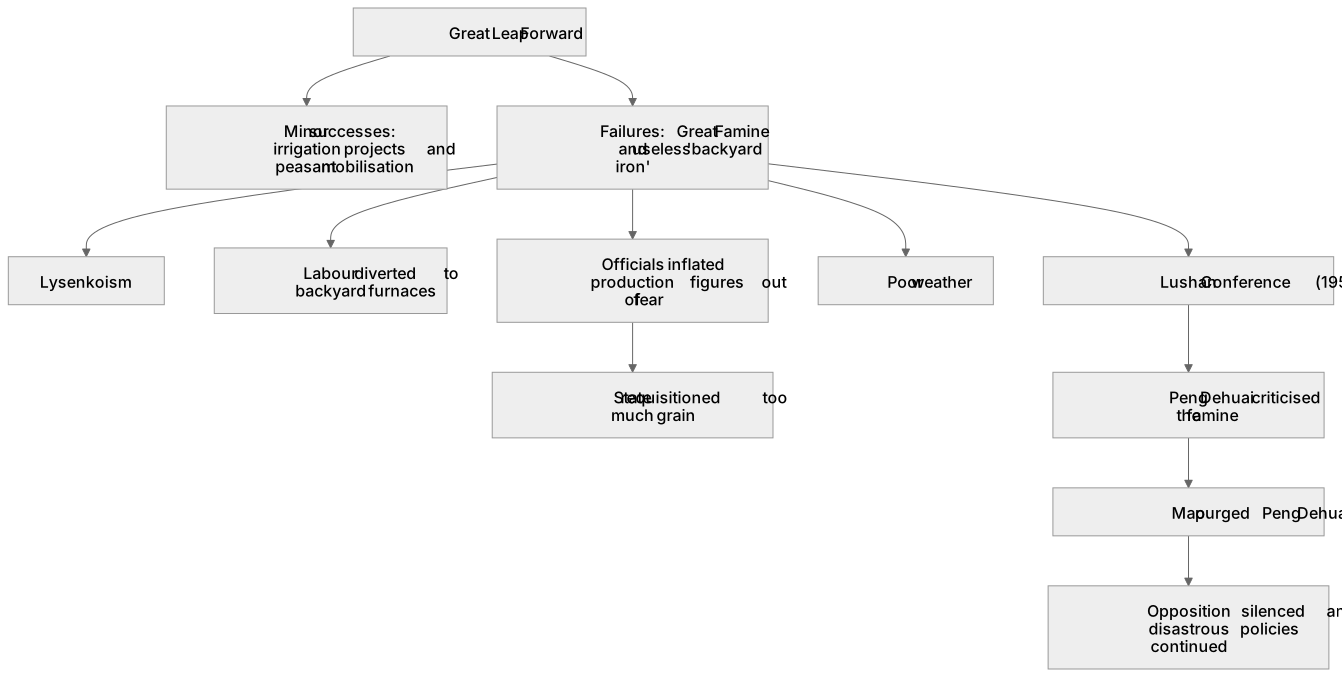
The Great Leap Forward (1958–62) had minor successes, such as the construction of irrigation projects and the ideological mobilisation of the peasantry.
Checked against the Pearson Edexcel 1HI0 specification (opens in a new tab) on .
- Point 2 of 4
- 4 key terms
Study notes
From the checked teaching notes for this specification point.
The idea
The Great Leap Forward (1958–62) had minor successes, such as the construction of irrigation projects and the ideological mobilisation of the peasantry. However, it was a catastrophic failure, resulting in the Great Famine which killed millions. Failures stemmed from absurd agricultural policies like Lysenkoism, the diversion of peasant labour to produce useless 'backyard iron', and local officials inflating production figures out of fear, leading the state to requisition too much grain. The 1959 Lushan Conference was highly important; when Peng Dehuai criticised the famine, Mao purged him. This silenced all opposition, ensuring the disastrous policies continued and demonstrating Mao's absolute, dictatorial control over the Party.
What earns the marks
- Identify the limited successes, such as mass mobilisation for large-scale irrigation and terracing projects.
- Detail the catastrophic failures, primarily the Great Famine and the production of worthless pig iron in backyard furnaces.
- Explain the reasons for failure, including pseudo-scientific agricultural methods (Lysenkoism), inflated production figures, and poor weather.
- Analyse the importance of the Lushan Conference in silencing opposition, as Peng Dehuai's purge deterred others from speaking the truth about the famine.
Common mistakes and how to put them right
Stating that the backyard furnaces produced useful steel.
Put it right: The furnaces produced brittle, useless 'pig iron' that could not be used for manufacturing.
Blaming the famine entirely on natural disasters.
Put it right: While bad weather contributed, the primary causes were disastrous government policies and inflated reporting.
Misunderstanding the outcome of the Lushan Conference.
Put it right: Rather than fixing the policies, the conference entrenched them because Mao refused to accept criticism.
Exam tips
- When discussing reasons for failure, ensure you link the fear of Mao to the inflated production figures reported by local cadres.
- Use the Lushan Conference as key evidence of Mao's dictatorial power and the lack of democratic debate within the CCP.
- Be prepared to weigh the impact of human error (policies) against natural disasters when explaining the causes of the Great Famine.
Try the lesson
The start of the Option 32: Key topic 2: Economic policy, 1949–65 - 3 The Great Leap Forward: The successes and failures of the Great Leap Forward. Reasons for failures. The importance of the Lushan Conference (1959). lesson, made from checked teaching notes for this specification point.
Have a go first
What was a major cause of the catastrophic famine during the Great Leap Forward?
Listen
The Great Leap Forward (1958–62) had minor successes, such as the construction of irrigation projects and the ideological mobilisation of the peasantry. However, it was a catastrophic failure, resulting in the Great Famine which killed millions. Failures stemmed from absurd agricultural policies like Lysenkoism, the diversion of peasant labour to produce useless 'backyard iron', and local officials inflating production figures out of fear, leading the state to requisition too much grain. The 1959 Lushan Conference was highly important; when Peng Dehuai criticised the famine, Mao purged him. This silenced all opposition, ensuring the disastrous policies continued and demonstrating Mao's absolute, dictatorial control over the Party. A strong answer earns marks for these points. Identify the limited successes, such as mass mobilisation for large-scale irrigation and terracing projects. Detail the catastrophic failures, primarily the Great Famine and the production of worthless pig iron in backyard furnaces. Explain the reasons for failure, including pseudo-scientific agricultural methods (Lysenkoism), inflated production figures, and poor weather. Analyse the importance of the Lushan Conference in silencing opposition, as Peng Dehuai's purge deterred others from speaking the truth about the famine. A common slip: Stating that the backyard furnaces produced useful steel. Instead, the furnaces produced brittle, useless 'pig iron' that could not be used for manufacturing. Exam tip: When discussing reasons for failure, ensure you link the fear of Mao to the inflated production figures reported by local cadres.
See it
Key words
Say what each word means before you turn the card.
The Great Famine
Try answering aloud or in your head before turning the card.
Political purge and fear
Try answering aloud or in your head before turning the card.
Agricultural mismanagement
Try answering aloud or in your head before turning the card.
Dictatorial power
Try answering aloud or in your head before turning the card.
See every definition
- The Great Famine
- The catastrophic failure of the Great Leap Forward which killed millions.
- Political purge and fear
- Local officials inflated production figures out of fear, and Mao purged Peng Dehuai, silencing all opposition.
- Agricultural mismanagement
- Absurd agricultural policies like Lysenkoism and the diversion of peasant labour to produce useless 'backyard iron'.
- Dictatorial power
- Mao's absolute control over the Party, demonstrated when he purged Peng Dehuai at the Lushan Conference.
Label the diagram
Some boxes have lost their names. Pick the right name for each number.
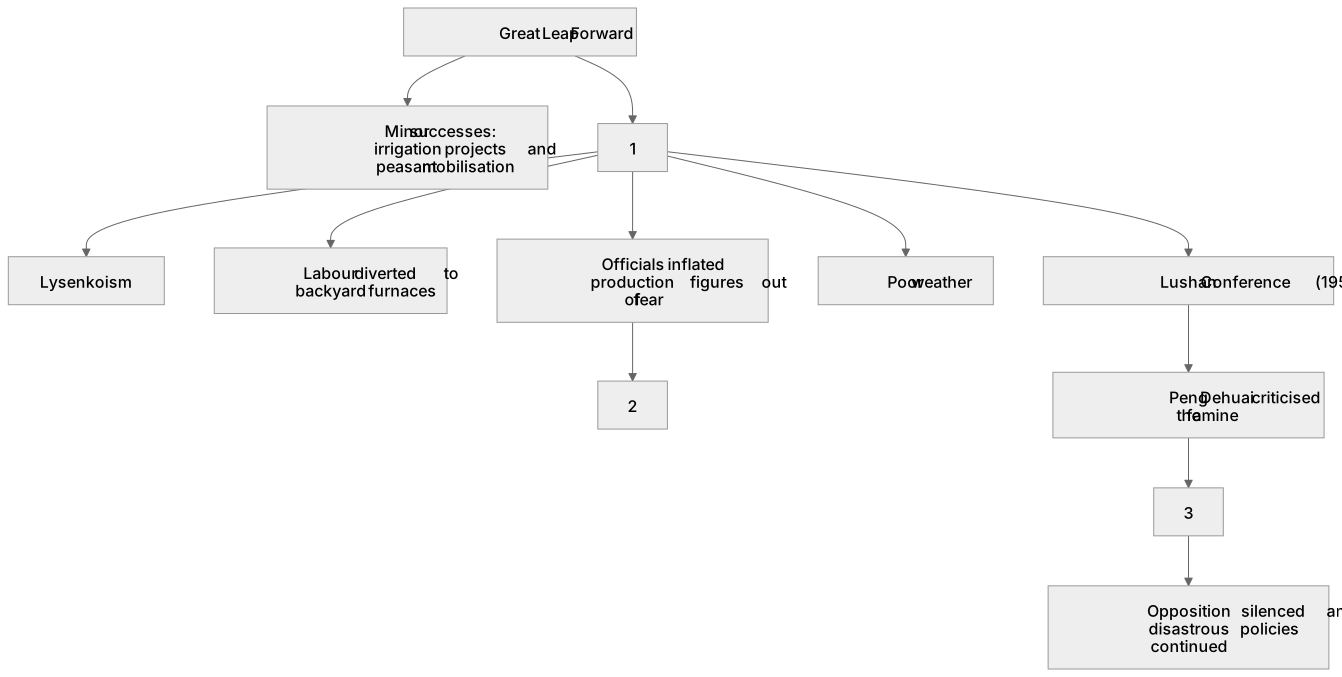
1Box 1
2Box 2
3Box 3
There is more to this lesson
The full lesson goes on to check your understanding and help you earn the marks. Create a free account to carry on, with your progress saved.
A week of Premium from your first lesson · Then the free plan continues · No card, no charge
Test your understanding of Option 32: Key topic 2: Economic policy, 1949–65 - 3 The Great Leap Forward: The successes and failures of the Great Leap Forward. Reasons for failures. The importance of the Lushan Conference (1959).
Active recall beats re-reading. Take an instant quiz now to test what you’ve learned and lock it into long-term memory.
A week of Premium from your first lesson · Then the free plan continues · No card, no charge