Pearson Edexcel · GCSE · History
Course version: 1HI0 · Version from Sept 2016
Key topic 2: Economic policy, 1949–65 - 3 The Great Leap Forward: The…
Full specification wording
Option 32: Key topic 2: Economic policy, 1949–65 - 3 The Great Leap Forward: The causes and impact of the Great Famine, 1958–62.
The Great Famine (1958–62) was a catastrophic event caused by disastrous government policies and extreme weather.
Checked against the Pearson Edexcel 1HI0 specification (opens in a new tab) on .
- Point 4 of 4
Study notes
From the checked teaching notes for this specification point.
The idea
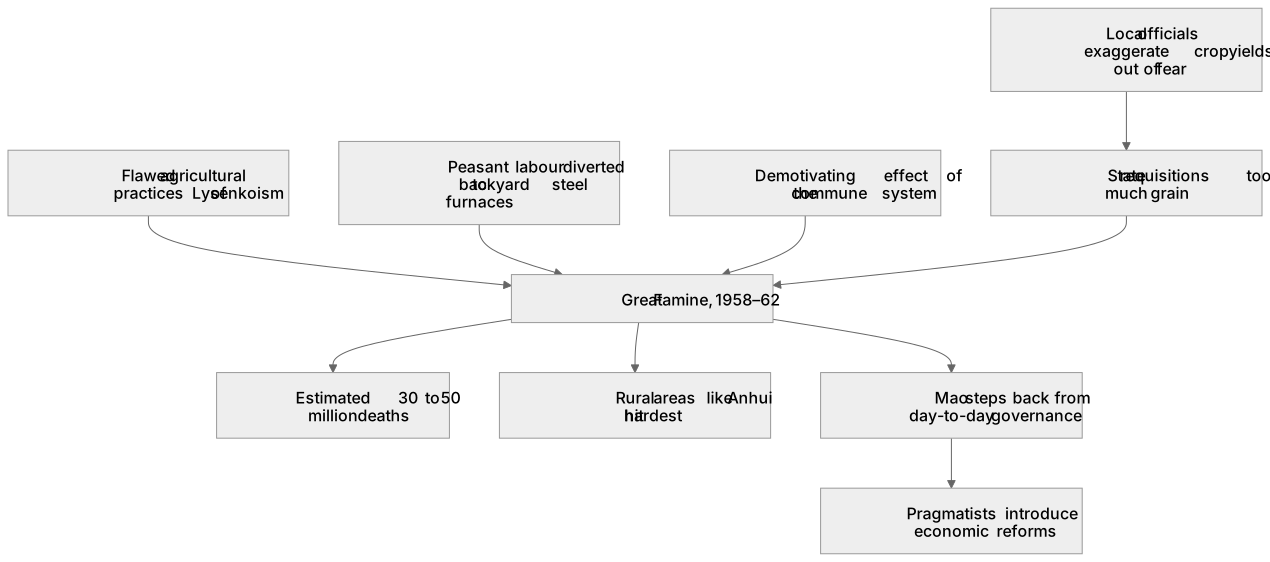
The Great Famine (1958–62) was a catastrophic event caused by disastrous government policies and extreme weather. The primary causes were the flawed agricultural practices of Lysenkoism, the diversion of peasant labour to backyard steel furnaces, and the demotivating effect of the commune system. Local officials, terrified of failing to meet Mao's unrealistic quotas, vastly exaggerated crop yields. Consequently, the state requisitioned too much grain, leaving peasants to starve. The impact was devastating, resulting in an estimated 30 to 50 million deaths. Rural areas like Anhui were hit hardest, experiencing severe starvation and disease. The famine severely damaged Mao's reputation, forcing him to step back from day-to-day governance and allowing pragmatists to introduce economic reforms.
What earns the marks
- Identify the political causes of the famine, including exaggerated production figures by fearful local cadres.
- Explain how the diversion of labour to backyard furnaces left crops rotting in the fields.
- Describe the demographic impact, noting the estimated 30 to 50 million deaths, predominantly in rural provinces.
- Analyse the political impact, specifically Mao's temporary withdrawal from frontline politics and the rise of Liu Shaoqi.
Common mistakes and how to put them right
Attributing the famine solely to natural disasters.
Put it right: While bad weather played a role, government policies were the primary cause.
Stating that the government provided adequate relief.
Put it right: The state continued to export grain and requisition food despite the starvation.
Confusing the timeline of the famine with the Cultural Revolution.
Put it right: The famine occurred during the Great Leap Forward.
Exam tips
- Use the phrase 'wind of exaggeration' to describe how local officials inflated grain production figures out of fear.
- Link the causes of the famine directly to the policies of the Great Leap Forward, such as communes and Lysenkoism.
- When discussing the impact, mention both the human cost and the political consequences for Mao's leadership.
Try the lesson
The start of the Option 32: Key topic 2: Economic policy, 1949–65 - 3 The Great Leap Forward: The causes and impact of the Great Famine, 1958–62. lesson, made from checked teaching notes for this specification point.
Have a go first
Which combination of factors was a primary cause of the Great Famine in China between 1958 and 1962?
Listen
The Great Famine (1958–62) was a catastrophic event caused by disastrous government policies and extreme weather. The primary causes were the flawed agricultural practices of Lysenkoism, the diversion of peasant labour to backyard steel furnaces, and the demotivating effect of the commune system. Local officials, terrified of failing to meet Mao's unrealistic quotas, vastly exaggerated crop yields. Consequently, the state requisitioned too much grain, leaving peasants to starve. The impact was devastating, resulting in an estimated 30 to 50 million deaths. Rural areas like Anhui were hit hardest, experiencing severe starvation and disease. The famine severely damaged Mao's reputation, forcing him to step back from day-to-day governance and allowing pragmatists to introduce economic reforms. A strong answer earns marks for these points. Identify the political causes of the famine, including exaggerated production figures by fearful local cadres. Explain how the diversion of labour to backyard furnaces left crops rotting in the fields. Describe the demographic impact, noting the estimated 30 to 50 million deaths, predominantly in rural provinces. Analyse the political impact, specifically Mao's temporary withdrawal from frontline politics and the rise of Liu Shaoqi. Exam tip: Use the phrase 'wind of exaggeration' to describe how local officials inflated grain production figures out of fear.
See it
Label the diagram
Some boxes have lost their names. Pick the right name for each number.
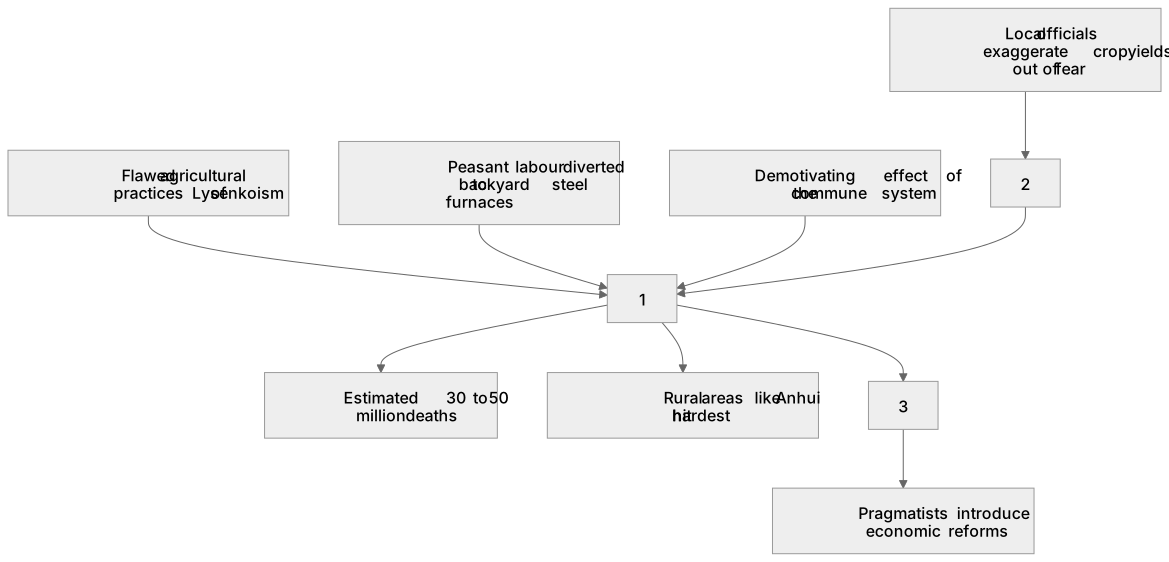
1Box 1
2Box 2
3Box 3
There is more to this lesson
The full lesson goes on to check your understanding and help you earn the marks. Create a free account to carry on, with your progress saved.
A week of Premium from your first lesson · Then the free plan continues · No card, no charge
Test your understanding of Option 32: Key topic 2: Economic policy, 1949–65 - 3 The Great Leap Forward: The causes and impact of the Great Famine, 1958–62.
Active recall beats re-reading. Take an instant quiz now to test what you’ve learned and lock it into long-term memory.
A week of Premium from your first lesson · Then the free plan continues · No card, no charge