Pearson Edexcel · GCSE · History
Course version: 1HI0 · Version from Sept 2016
Key topic 2: Economic policy, 1949–65 - 3 The Great Leap Forward: The…
Full specification wording
Option 32: Key topic 2: Economic policy, 1949–65 - 3 The Great Leap Forward: The organisation of the commune: communal living and the abolition of private farming. The significance of Lysenkoism.
During the Great Leap Forward, Mao reorganised agriculture into massive communes of around 5,000 households.
Checked against the Pearson Edexcel 1HI0 specification (opens in a new tab) on .
- Point 3 of 4
- 3 key terms
Study notes
From the checked teaching notes for this specification point.
The idea
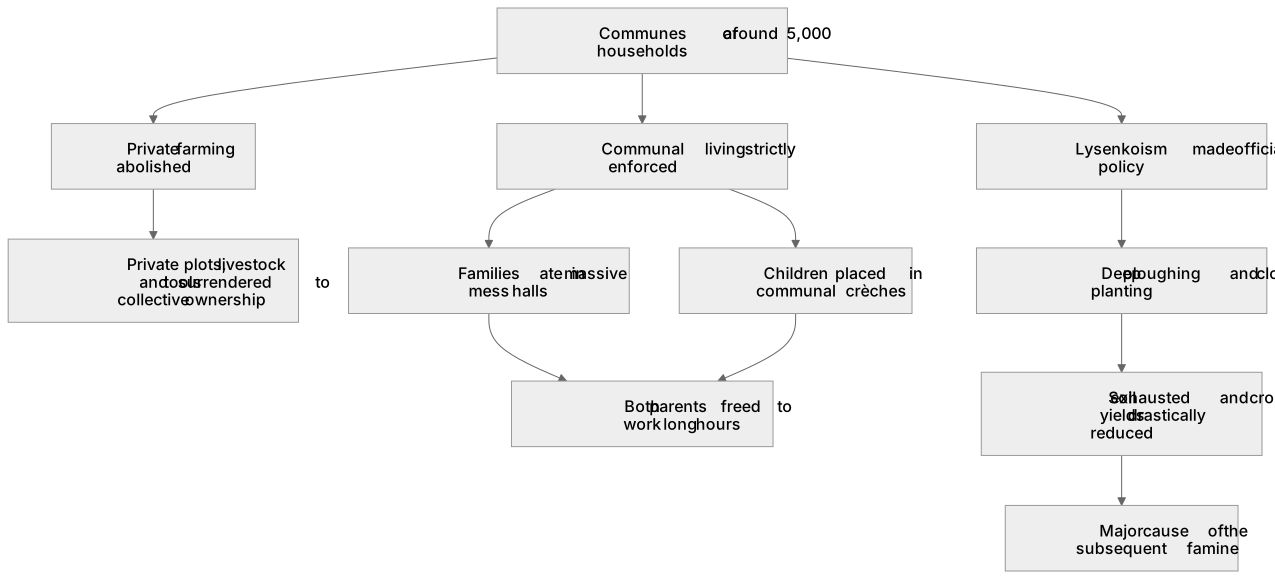
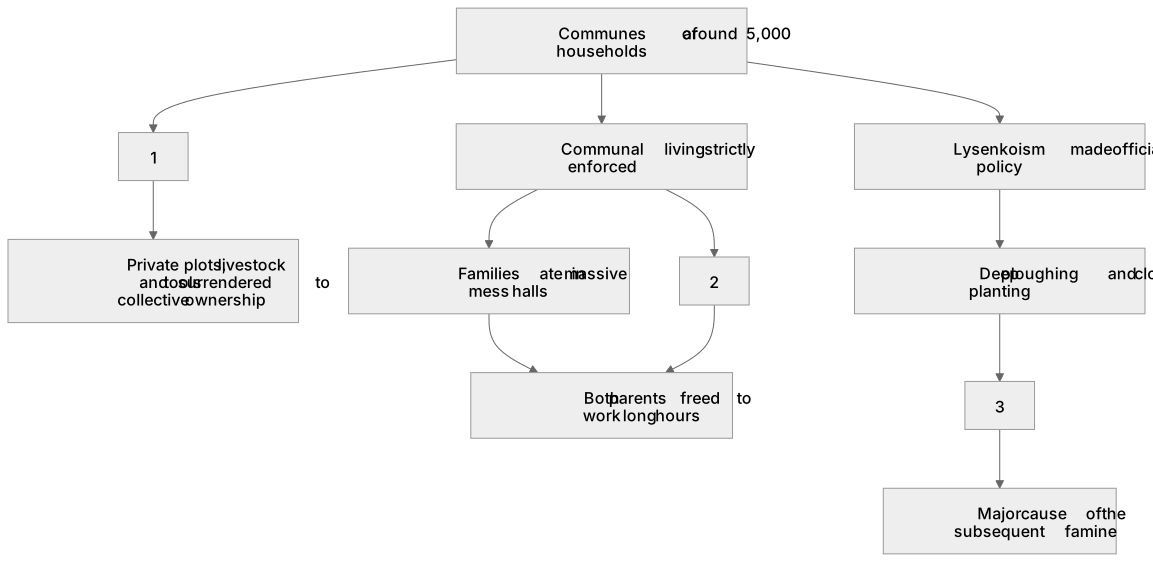
During the Great Leap Forward, Mao reorganised agriculture into massive communes of around 5,000 households. This system abolished private farming entirely; peasants surrendered their private plots, livestock, and tools to collective ownership. Communal living was strictly enforced to maximise labour efficiency. Families ate in massive mess halls and children were placed in communal crèches, freeing both parents to work long hours. The adoption of Lysenkoism—a pseudoscientific agricultural theory promoted by Soviet agronomist Trofim Lysenko—was highly significant. Lysenko's methods, such as deep ploughing and close planting, were made official policy. Because these ideas were scientifically flawed, they exhausted the soil and drastically reduced crop yields, becoming a major cause of the subsequent famine.
What earns the marks
- Explain how communes merged collectives into larger units to control all aspects of peasant life.
- Describe the features of communal living, such as mess halls, crèches, and the militarisation of daily routines.
- Detail the abolition of private farming, noting the confiscation of private plots, tools, and animals.
- Analyse the significance of Lysenkoism, explaining how flawed techniques like close planting led to crop failures.
Common mistakes and how to put them right
Confusing communes with earlier cooperatives.
Put it right: Communes were much larger and involved total communal living, not just shared labour.
Assuming Lysenkoism was a successful scientific advancement.
Put it right: It was actually pseudoscientific and caused massive agricultural damage.
Believing peasants willingly gave up private farming.
Put it right: Many resisted or slaughtered their animals rather than hand them over.
Exam tips
- When discussing the communes, link the abolition of private farming to the loss of peasant motivation and falling production.
- Use specific examples of Lysenko's methods, such as deep ploughing, to explain why crop yields collapsed.
- Connect communal living to the broader goals of the Great Leap Forward, such as freeing up female labour for industrial work.
Try the lesson
The start of the Option 32: Key topic 2: Economic policy, 1949–65 - 3 The Great Leap Forward: The organisation of the commune: communal living and the abolition of private farming. The significance of Lysenkoism. lesson, made from checked teaching notes for this specification point.
Have a go first
Which of the following was a key feature of the organisation of communes during the Great Leap Forward?
Listen
During the Great Leap Forward, Mao reorganised agriculture into massive communes of around 5,000 households. This system abolished private farming entirely; peasants surrendered their private plots, livestock, and tools to collective ownership. Communal living was strictly enforced to maximise labour efficiency. Families ate in massive mess halls and children were placed in communal crèches, freeing both parents to work long hours. The adoption of Lysenkoism—a pseudoscientific agricultural theory promoted by Soviet agronomist Trofim Lysenko—was highly significant. Lysenko's methods, such as deep ploughing and close planting, were made official policy. Because these ideas were scientifically flawed, they exhausted the soil and drastically reduced crop yields, becoming a major cause of the subsequent famine. A strong answer earns marks for these points. Explain how communes merged collectives into larger units to control all aspects of peasant life. Describe the features of communal living, such as mess halls, crèches, and the militarisation of daily routines. Detail the abolition of private farming, noting the confiscation of private plots, tools, and animals. Analyse the significance of Lysenkoism, explaining how flawed techniques like close planting led to crop failures. Exam tip: When discussing the communes, link the abolition of private farming to the loss of peasant motivation and falling production.
See it
Key words
Say what each word means before you turn the card.
Communal living
Try answering aloud or in your head before turning the card.
Lysenkoism
Try answering aloud or in your head before turning the card.
Abolition of private farming
Try answering aloud or in your head before turning the card.
See every definition
- Communal living
- A system strictly enforced to maximise labour efficiency, in which families ate in massive mess halls and children were placed in communal crèches.
- Lysenkoism
- A pseudoscientific agricultural theory promoted by Soviet agronomist Trofim Lysenko, whose methods such as deep ploughing and close planting were made official policy.
- Abolition of private farming
- The ending of private farming entirely, as peasants surrendered their private plots, livestock and tools to collective ownership.
Label the diagram
Some boxes have lost their names. Pick the right name for each number.
1Box 1
2Box 2
3Box 3
There is more to this lesson
The full lesson goes on to check your understanding and help you earn the marks. Create a free account to carry on, with your progress saved.
A week of Premium from your first lesson · Then the free plan continues · No card, no charge
Test your understanding of Option 32: Key topic 2: Economic policy, 1949–65 - 3 The Great Leap Forward: The organisation of the commune: communal living and the abolition of private farming. The significance of Lysenkoism.
Active recall beats re-reading. Take an instant quiz now to test what you’ve learned and lock it into long-term memory.
A week of Premium from your first lesson · Then the free plan continues · No card, no charge