Pearson Edexcel · GCSE · History
Course version: 1HI0 · Version from Sept 2016
Key topic 2: Economic policy, 1949–65 - 4 Economic reform: Reasons for,…
Full specification wording
Option 32: Key topic 2: Economic policy, 1949–65 - 4 Economic reform: Reasons for, and features of, economic reform (1962–65) under Liu and Deng.
Between 1962 and 1965, Liu Shaoqi and Deng Xiaoping implemented sweeping economic reforms to rescue China from the devastation of the Great Leap Forward.
Checked against the Pearson Edexcel 1HI0 specification (opens in a new tab) on .
- Point 2 of 2
- 4 key terms
Study notes
From the checked teaching notes for this specification point.
The idea
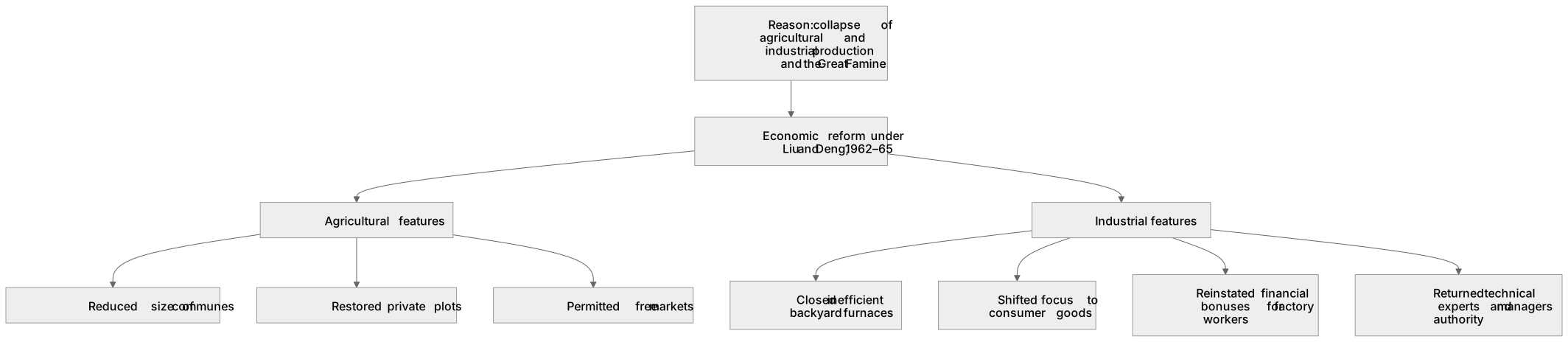
Between 1962 and 1965, Liu Shaoqi and Deng Xiaoping implemented sweeping economic reforms to rescue China from the devastation of the Great Leap Forward. The primary reason for these reforms was the collapse of agricultural and industrial production, which had caused the Great Famine. The features of their reforms were highly pragmatic. In agriculture, they reduced the size of communes, restored private plots, and permitted free markets to incentivise peasants. In industry, they closed down inefficient backyard furnaces, shifted focus to producing consumer goods, and reinstated financial bonuses for factory workers. Furthermore, technical experts and managers, who had been sidelined during Mao's campaigns, were returned to authority to ensure factories were run efficiently rather than ideologically.
What earns the marks
- Identify the need to recover from the Great Famine and industrial collapse as the main reason for the reforms.
- Describe agricultural features, such as the downsizing of communes and the reintroduction of private plots and markets.
- Detail industrial features, including the closure of backyard furnaces and the restoration of piece-rates and bonuses.
- Explain the reinstatement of technical experts and managers to replace politically appointed cadres in running industries.
Common mistakes and how to put them right
Stating that the reforms abandoned communism.
Put it right: The state still controlled heavy industry and the overall economy, but introduced pragmatic incentives.
Confusing the timeline and attributing these specific reforms to the period after Mao's death in 1976.
Exam tips
- Clearly separate your answer into 'reasons for' and 'features of' the reforms to ensure you address both parts of the specification.
- Use the contrast between Mao's reliance on mass mobilisation and Liu/Deng's reliance on technical experts to highlight the nature of the reforms.
- Provide specific examples of features, such as financial bonuses in factories, to demonstrate detailed knowledge.
Try the lesson
The start of the Option 32: Key topic 2: Economic policy, 1949–65 - 4 Economic reform: Reasons for, and features of, economic reform (1962–65) under Liu and Deng. lesson, made from checked teaching notes for this specification point.
Have a go first
Which of the following was a key feature of the economic reforms introduced by Liu Shaoqi and Deng Xiaoping between 1962 and 1965?
Listen
Between 1962 and 1965, Liu Shaoqi and Deng Xiaoping implemented sweeping economic reforms to rescue China from the devastation of the Great Leap Forward. The primary reason for these reforms was the collapse of agricultural and industrial production, which had caused the Great Famine. The features of their reforms were highly pragmatic. In agriculture, they reduced the size of communes, restored private plots, and permitted free markets to incentivise peasants. In industry, they closed down inefficient backyard furnaces, shifted focus to producing consumer goods, and reinstated financial bonuses for factory workers. Furthermore, technical experts and managers, who had been sidelined during Mao's campaigns, were returned to authority to ensure factories were run efficiently rather than ideologically. A strong answer earns marks for these points. Identify the need to recover from the Great Famine and industrial collapse as the main reason for the reforms. Describe agricultural features, such as the downsizing of communes and the reintroduction of private plots and markets. Detail industrial features, including the closure of backyard furnaces and the restoration of piece-rates and bonuses. Explain the reinstatement of technical experts and managers to replace politically appointed cadres in running industries. Exam tip: Clearly separate your answer into 'reasons for' and 'features of' the reforms to ensure you address both parts of the specification.
See it
Key words
Say what each word means before you turn the card.
Economic recovery
Try answering aloud or in your head before turning the card.
Pragmatism vs Ideology
Try answering aloud or in your head before turning the card.
Industrial management
Try answering aloud or in your head before turning the card.
Policy reversal
Try answering aloud or in your head before turning the card.
See every definition
- Economic recovery
- The rescue of China from the devastation of the Great Leap Forward, as the collapse of agricultural and industrial production was the primary reason for the reforms.
- Pragmatism vs Ideology
- The contrast between Mao's reliance on mass mobilisation and Liu and Deng's reliance on technical experts, showing the nature of the reforms.
- Industrial management
- The reinstatement of technical experts and managers, who had been sidelined during Mao's campaigns, to authority so that factories were run efficiently rather than ideologically.
- Policy reversal
- The introduction of pragmatic incentives, such as private plots and free markets in agriculture and financial bonuses in industry, while the state still controlled heavy industry and the overall economy.
Label the diagram
Some boxes have lost their names. Pick the right name for each number.
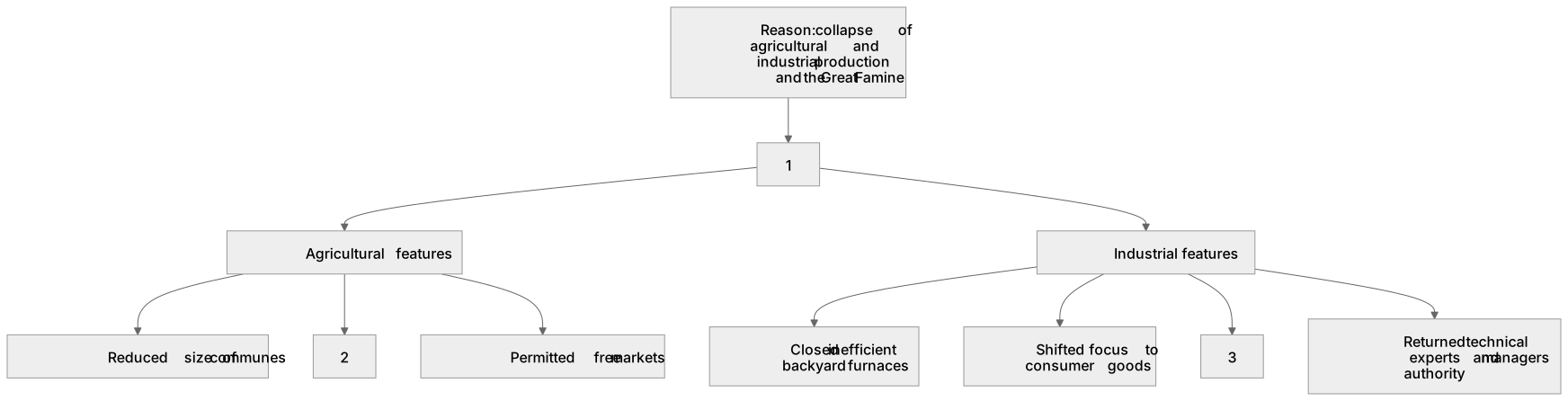
1Box 1
2Box 2
3Box 3
There is more to this lesson
The full lesson goes on to check your understanding and help you earn the marks. Create a free account to carry on, with your progress saved.
A week of Premium from your first lesson · Then the free plan continues · No card, no charge
Test your understanding of Option 32: Key topic 2: Economic policy, 1949–65 - 4 Economic reform: Reasons for, and features of, economic reform (1962–65) under Liu and Deng.
Active recall beats re-reading. Take an instant quiz now to test what you’ve learned and lock it into long-term memory.
A week of Premium from your first lesson · Then the free plan continues · No card, no charge