Pearson Edexcel · GCSE · History
Course version: 1HI0 · Version from Sept 2016
Key topic 2: Economic policy, 1949–65 - 4 Economic reform: Reasons for the…
Full specification wording
Option 32: Key topic 2: Economic policy, 1949–65 - 4 Economic reform: Reasons for the restoration of private farming under Liu Shaoqi and Deng Xiaoping.
Following the catastrophic Great Famine, pragmatists Liu Shaoqi and Deng Xiaoping took charge of the economy and recognised the urgent need to restore private farming.
Checked against the Pearson Edexcel 1HI0 specification (opens in a new tab) on .
- Point 1 of 2
- 3 key terms
Study notes
From the checked teaching notes for this specification point.
The idea
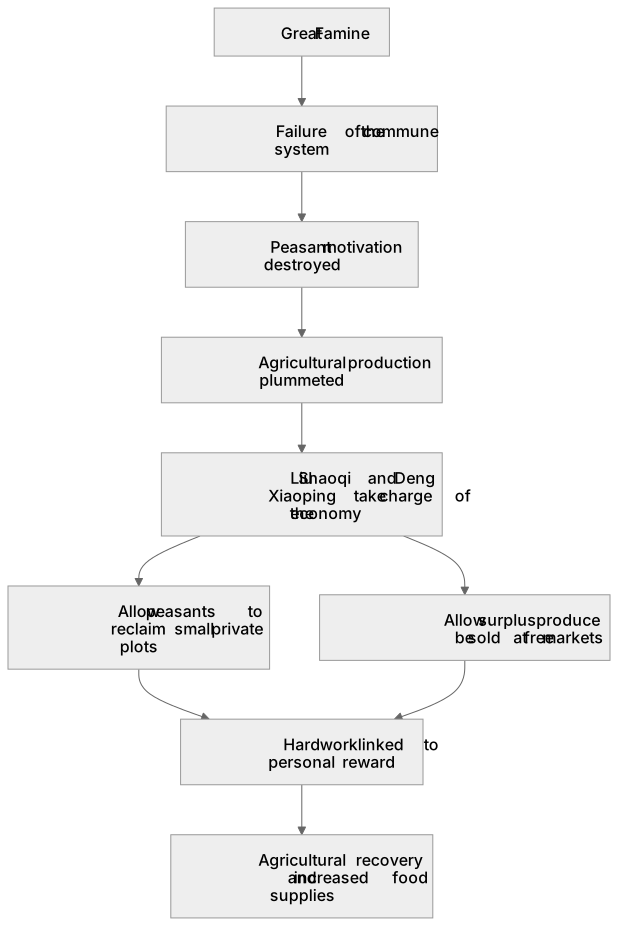
Following the catastrophic Great Famine, pragmatists Liu Shaoqi and Deng Xiaoping took charge of the economy and recognised the urgent need to restore private farming. The primary reason for this shift was the complete failure of the commune system, which had destroyed peasant motivation and led to plummeting agricultural production. To avert further starvation and stabilise the economy, Liu and Deng allowed peasants to reclaim small private plots and sell surplus produce at free markets. This pragmatic approach aimed to incentivise farmers by linking their hard work directly to personal reward. By abandoning strict ideological adherence in favour of practical solutions, they successfully stimulated agricultural recovery and increased food supplies after the disasters of the Great Leap Forward.
What earns the marks
- Explain that the devastating impact of the Great Famine necessitated immediate and pragmatic agricultural reforms.
- Identify the failure of the commune system to motivate peasants as a key reason for restoring private plots.
- Describe how allowing peasants to sell surplus goods at free markets was intended to boost food production quickly.
- Analyse the ideological shift from Mao's strict collectivism to the pragmatic economic approach of Liu and Deng.
Common mistakes and how to put them right
Believing that Liu and Deng dismantled the communes entirely.
Put it right: Communes remained, but were reduced in size and private plots were reintroduced alongside them.
Assuming Mao fully supported these reforms.
Put it right: Mao viewed the restoration of private farming as a dangerous slide towards capitalism.
Confusing these 1960s reforms with Deng Xiaoping's later, more extensive economic reforms in the 1980s.
Exam tips
- Emphasise the concept of 'pragmatism over ideology' when explaining Liu and Deng's motivations for the reforms.
- Connect the restoration of private farming directly to the need to solve the crisis caused by the Great Famine.
- Mention the reintroduction of financial incentives as the primary mechanism used to restore peasant motivation.
Try the lesson
The start of the Option 32: Key topic 2: Economic policy, 1949–65 - 4 Economic reform: Reasons for the restoration of private farming under Liu Shaoqi and Deng Xiaoping. lesson, made from checked teaching notes for this specification point.
Have a go first
Why did Liu Shaoqi and Deng Xiaoping restore private farming plots in the early 1960s?
Listen
Following the catastrophic Great Famine, pragmatists Liu Shaoqi and Deng Xiaoping took charge of the economy and recognised the urgent need to restore private farming. The primary reason for this shift was the complete failure of the commune system, which had destroyed peasant motivation and led to plummeting agricultural production. To avert further starvation and stabilise the economy, Liu and Deng allowed peasants to reclaim small private plots and sell surplus produce at free markets. This pragmatic approach aimed to incentivise farmers by linking their hard work directly to personal reward. By abandoning strict ideological adherence in favour of practical solutions, they successfully stimulated agricultural recovery and increased food supplies after the disasters of the Great Leap Forward. A strong answer earns marks for these points. Explain that the devastating impact of the Great Famine necessitated immediate and pragmatic agricultural reforms. Identify the failure of the commune system to motivate peasants as a key reason for restoring private plots. Describe how allowing peasants to sell surplus goods at free markets was intended to boost food production quickly. Analyse the ideological shift from Mao's strict collectivism to the pragmatic economic approach of Liu and Deng. Exam tip: Emphasise the concept of 'pragmatism over ideology' when explaining Liu and Deng's motivations for the reforms.
See it
Key words
Say what each word means before you turn the card.
Pragmatism
Try answering aloud or in your head before turning the card.
Economic recovery
Try answering aloud or in your head before turning the card.
Agricultural reform
Try answering aloud or in your head before turning the card.
See every definition
- Pragmatism
- An approach that abandons strict ideological adherence in favour of practical solutions, which Liu and Deng used to stimulate agricultural recovery.
- Economic recovery
- The stabilising of the economy and the increase in food supplies that followed the disasters of the Great Leap Forward.
- Agricultural reform
- The restoration of private farming, allowing peasants to reclaim small private plots and sell surplus produce at free markets.
Label the diagram
Some boxes have lost their names. Pick the right name for each number.
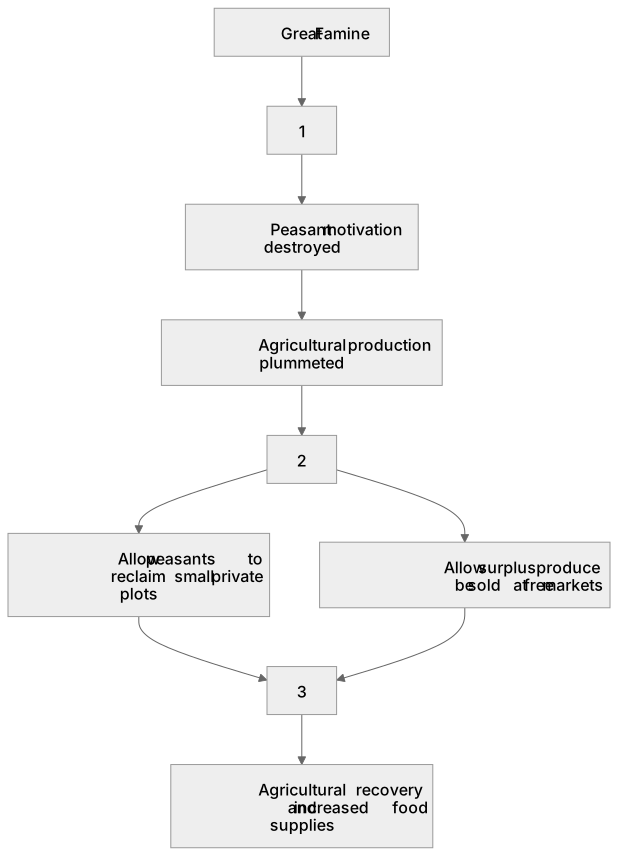
1Box 1
2Box 2
3Box 3
There is more to this lesson
The full lesson goes on to check your understanding and help you earn the marks. Create a free account to carry on, with your progress saved.
A week of Premium from your first lesson · Then the free plan continues · No card, no charge
Test your understanding of Option 32: Key topic 2: Economic policy, 1949–65 - 4 Economic reform: Reasons for the restoration of private farming under Liu Shaoqi and Deng Xiaoping.
Active recall beats re-reading. Take an instant quiz now to test what you’ve learned and lock it into long-term memory.
A week of Premium from your first lesson · Then the free plan continues · No card, no charge