Pearson Edexcel · GCSE · History
Course version: 1HI0 · Version from Sept 2016
Key topic 3: The Cultural Revolution and its aftermath, 1966–76 - 2 The…
Full specification wording
Option 32: Key topic 3: The Cultural Revolution and its aftermath, 1966–76 - 2 The Red Guards and the Red Terror: Mao’s hold on young people, including the mass rallies of 1966. Jiang Qing and the attack on the CCP.
Mao Zedong exerted a powerful hold on young people, cultivating a personality cult that portrayed him as an infallible god-like figure.
Checked against the Pearson Edexcel 1HI0 specification (opens in a new tab) on .
- Point 1 of 2
- 4 key terms
Study notes
From the checked teaching notes for this specification point.
The idea
Mao Zedong exerted a powerful hold on young people, cultivating a personality cult that portrayed him as an infallible god-like figure. This devotion was weaponised during the eight mass rallies in Tiananmen Square in 1966, where millions of ecstatic students, wearing red armbands and waving the Little Red Book, were reviewed by Mao. These rallies officially launched the Red Guards. Concurrently, Mao's wife, Jiang Qing, played a crucial role in directing this youthful fanaticism into a vicious attack on the CCP apparatus. As a key member of the Cultural Revolution Group, Jiang Qing manipulated the Red Guards to purge party officials, artists, and intellectuals who were deemed insufficiently loyal to Mao's radical ideology.
What earns the marks
- Explain how the Little Red Book and the cult of personality cemented Mao's absolute hold on Chinese youth.
- Describe the scale and emotional impact of the 1966 mass rallies in Tiananmen Square in mobilising the Red Guards.
- Detail the role of Lin Biao and the PLA in organising the logistics of the mass rallies to support Mao.
- Analyse Jiang Qing's leadership within the Cultural Revolution Group and her influence over cultural and political purges.
- Explain how Jiang Qing directed the Red Guards to attack the established CCP hierarchy to remove Mao's rivals.
Common mistakes and how to put them right
Stating that the Red Guards spontaneously organised the mass rallies.
Put it right: The rallies were meticulously orchestrated by Lin Biao and the People's Liberation Army.
Underestimating Jiang Qing's political power.
Put it right: Jiang Qing was a central political figure who actively directed the purges, not just Mao's wife.
Assuming the attack on the CCP was an accident.
Put it right: Mao and Jiang Qing deliberately targeted the party apparatus to destroy the pragmatic faction.
Exam tips
- Use the mass rallies of August 1966 as the definitive starting point of the Red Guards' active campaign.
- Highlight the Little Red Book as the primary tool of indoctrination that secured Mao's hold on young people.
- When discussing Jiang Qing, explicitly mention her role in the Cultural Revolution Group (CRG) and her control over culture.
Try the lesson
The start of the Option 32: Key topic 3: The Cultural Revolution and its aftermath, 1966–76 - 2 The Red Guards and the Red Terror: Mao’s hold on young people, including the mass rallies of 1966. Jiang Qing and the attack on the CCP. lesson, made from checked teaching notes for this specification point.
Have a go first
Which of the following was a key method used to strengthen Mao Zedong's hold on young people during the mass rallies of 1966?
Listen
Mao Zedong exerted a powerful hold on young people, cultivating a personality cult that portrayed him as an infallible god-like figure. This devotion was weaponised during the eight mass rallies in Tiananmen Square in 1966, where millions of ecstatic students, wearing red armbands and waving the Little Red Book, were reviewed by Mao. These rallies officially launched the Red Guards. Concurrently, Mao's wife, Jiang Qing, played a crucial role in directing this youthful fanaticism into a vicious attack on the CCP apparatus. As a key member of the Cultural Revolution Group, Jiang Qing manipulated the Red Guards to purge party officials, artists, and intellectuals who were deemed insufficiently loyal to Mao's radical ideology. A strong answer earns marks for these points. Explain how the Little Red Book and the cult of personality cemented Mao's absolute hold on Chinese youth. Describe the scale and emotional impact of the 1966 mass rallies in Tiananmen Square in mobilising the Red Guards. Detail the role of Lin Biao and the PLA in organising the logistics of the mass rallies to support Mao. Analyse Jiang Qing's leadership within the Cultural Revolution Group and her influence over cultural and political purges. A common slip: Stating that the Red Guards spontaneously organised the mass rallies. Instead, The rallies were meticulously orchestrated by Lin Biao and the People's Liberation Army. Exam tip: Use the mass rallies of August 1966 as the definitive starting point of the Red Guards' active campaign.
See it
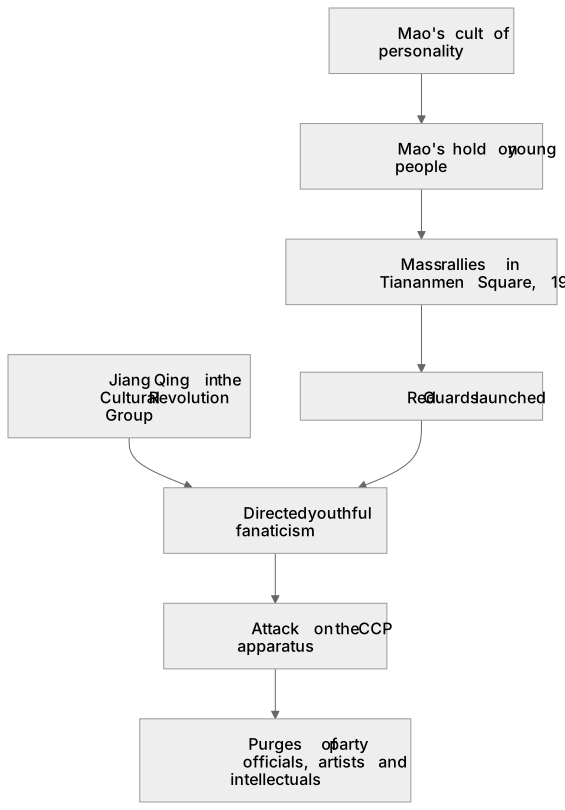
Key words
Say what each word means before you turn the card.
Cult of personality
Try answering aloud or in your head before turning the card.
Mass rallies
Try answering aloud or in your head before turning the card.
Little Red Book
Try answering aloud or in your head before turning the card.
Cultural Revolution Group
Try answering aloud or in your head before turning the card.
See every definition
- Cult of personality
- Mao cultivated a personality cult that portrayed him as an infallible, god-like figure, cementing his absolute hold on Chinese youth.
- Mass rallies
- The eight mass rallies in Tiananmen Square in 1966 saw millions of ecstatic students reviewed by Mao, officially launching the Red Guards.
- Little Red Book
- Waved by students at the rallies, it was the primary tool of indoctrination that secured Mao's hold on young people.
- Cultural Revolution Group
- Jiang Qing was a key member of this group, through which she directed the Red Guards to purge party officials, artists and intellectuals.
Label the diagram
Some boxes have lost their names. Pick the right name for each number.
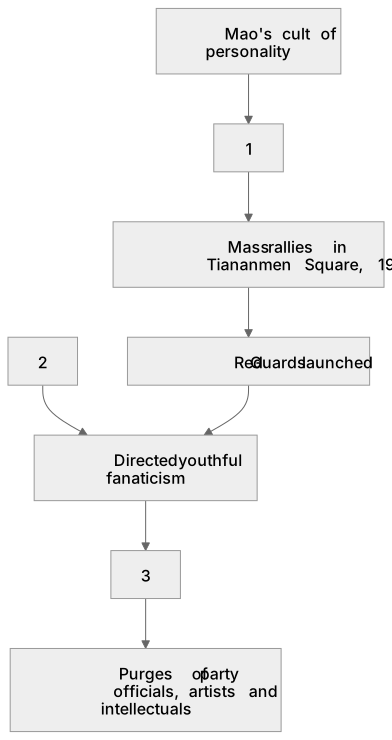
1Box 1
2Box 2
3Box 3
There is more to this lesson
The full lesson goes on to check your understanding and help you earn the marks. Create a free account to carry on, with your progress saved.
A week of Premium from your first lesson · Then the free plan continues · No card, no charge
Test your understanding of Option 32: Key topic 3: The Cultural Revolution and its aftermath, 1966–76 - 2 The Red Guards and the Red Terror: Mao’s hold on young people, including the mass rallies of 1966. Jiang Qing and the attack on the CCP.
Active recall beats re-reading. Take an instant quiz now to test what you’ve learned and lock it into long-term memory.
A week of Premium from your first lesson · Then the free plan continues · No card, no charge