Pearson Edexcel · GCSE · History
Course version: 1HI0 · Version from Sept 2016
Key topic 3: The Cultural Revolution and its aftermath, 1966–76 - 2 The…
Full specification wording
Option 32: Key topic 3: The Cultural Revolution and its aftermath, 1966–76 - 2 The Red Guards and the Red Terror: Red Guard attacks on the ‘four olds’ and the CCP. The growth of anarchy and the use of terror. Cultural destruction.
In August 1966, Mao urged the Red Guards to destroy the 'four olds': old ideas, old culture, old customs, and old habits.
Checked against the Pearson Edexcel 1HI0 specification (opens in a new tab) on .
- Point 2 of 2
- 4 key terms
Study notes
From the checked teaching notes for this specification point.
The idea
In August 1966, Mao urged the Red Guards to destroy the 'four olds': old ideas, old culture, old customs, and old habits. This sparked a wave of cultural destruction where temples, historical artefacts, and literature were obliterated. The Red Guards also launched violent attacks on the CCP, dragging officials into 'struggle sessions' where they were publicly humiliated, beaten, and often killed. As different Red Guard factions competed to prove their ideological purity, the use of terror escalated, leading to the growth of anarchy. Schools and factories closed, and local governments collapsed. The violence became so extreme and uncontrollable that Mao eventually had to deploy the People's Liberation Army to restore order.
What earns the marks
- Identify the 'four olds' (ideas, culture, customs, habits) and describe the resulting cultural destruction, such as the ransacking of museums.
- Explain the methods of terror used by the Red Guards, including violent 'struggle sessions' against teachers, intellectuals, and CCP officials.
- Detail how the attacks on the CCP led to the collapse of local party structures and the purging of veteran cadres.
- Analyse the growth of anarchy as rival Red Guard factions engaged in armed battles with each other in major cities.
- Describe the eventual intervention of the PLA to suppress the Red Guards and end the period of extreme anarchy.
Common mistakes and how to put them right
Listing incorrect elements for the 'four olds'.
Put it right: Ensure you specifically name old ideas, old culture, old customs, and old habits.
Believing the Red Guards only attacked ordinary citizens.
Put it right: A primary target of the Red Guards was the CCP leadership and local party officials.
Assuming the Red Guards were a single, united group.
Put it right: The growth of anarchy was largely driven by violent clashes between rival Red Guard factions.
Exam tips
- Provide specific examples of cultural destruction, such as the renaming of streets or the destruction of religious sites in Tibet.
- Use the term 'struggle sessions' to accurately describe the public humiliation and torture inflicted by the Red Guards.
- Link the attacks on the 'four olds' directly to the broader growth of anarchy and the breakdown of law and order.
Try the lesson
The start of the Option 32: Key topic 3: The Cultural Revolution and its aftermath, 1966–76 - 2 The Red Guards and the Red Terror: Red Guard attacks on the ‘four olds’ and the CCP. The growth of anarchy and the use of terror. Cultural destruction. lesson, made from checked teaching notes for this specification point.
Have a go first
Which of the following were targeted by the Red Guards during their campaign against the 'four olds'?
Listen
In August 1966, Mao urged the Red Guards to destroy the 'four olds': old ideas, old culture, old customs, and old habits. This sparked a wave of cultural destruction where temples, historical artefacts, and literature were obliterated. The Red Guards also launched violent attacks on the CCP, dragging officials into 'struggle sessions' where they were publicly humiliated, beaten, and often killed. As different Red Guard factions competed to prove their ideological purity, the use of terror escalated, leading to the growth of anarchy. Schools and factories closed, and local governments collapsed. The violence became so extreme and uncontrollable that Mao eventually had to deploy the People's Liberation Army to restore order. A strong answer earns marks for these points. Identify the 'four olds' (ideas, culture, customs, habits) and describe the resulting cultural destruction, such as the ransacking of museums. Explain the methods of terror used by the Red Guards, including violent 'struggle sessions' against teachers, intellectuals, and CCP officials. Detail how the attacks on the CCP led to the collapse of local party structures and the purging of veteran cadres. Analyse the growth of anarchy as rival Red Guard factions engaged in armed battles with each other in major cities. A common slip: Listing incorrect elements for the 'four olds'. Instead, Ensure you specifically name old ideas, old culture, old customs, and old habits. Exam tip: Provide specific examples of cultural destruction, such as the renaming of streets or the destruction of religious sites in Tibet.
See it
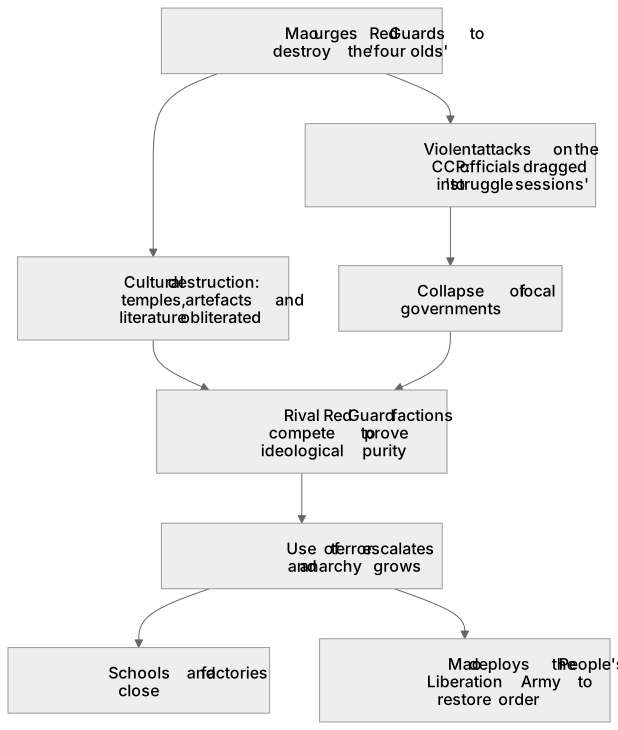
Key words
Say what each word means before you turn the card.
Terror and violence
Try answering aloud or in your head before turning the card.
Cultural destruction
Try answering aloud or in your head before turning the card.
Anarchy and disorder
Try answering aloud or in your head before turning the card.
Social upheaval
Try answering aloud or in your head before turning the card.
See every definition
- Terror and violence
- The use of terror by the Red Guards escalated as different factions competed to prove their ideological purity.
- Cultural destruction
- A wave of destruction in which temples, historical artefacts and literature were obliterated after Mao urged the Red Guards to destroy the 'four olds'.
- Anarchy and disorder
- The growth of anarchy followed the escalating use of terror, with schools and factories closing and local governments collapsing.
- Social upheaval
- Officials were dragged into 'struggle sessions' where they were publicly humiliated, beaten and often killed, while rival factions engaged in armed battles.
Label the diagram
Some boxes have lost their names. Pick the right name for each number.
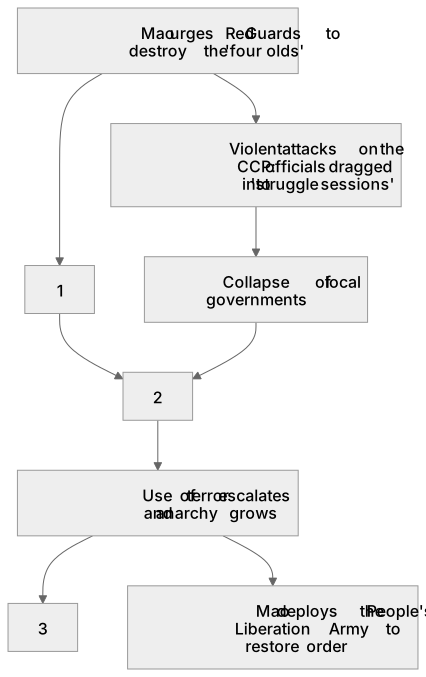
1Box 1
2Box 2
3Box 3
There is more to this lesson
The full lesson goes on to check your understanding and help you earn the marks. Create a free account to carry on, with your progress saved.
A week of Premium from your first lesson · Then the free plan continues · No card, no charge
Test your understanding of Option 32: Key topic 3: The Cultural Revolution and its aftermath, 1966–76 - 2 The Red Guards and the Red Terror: Red Guard attacks on the ‘four olds’ and the CCP. The growth of anarchy and the use of terror. Cultural destruction.
Active recall beats re-reading. Take an instant quiz now to test what you’ve learned and lock it into long-term memory.
A week of Premium from your first lesson · Then the free plan continues · No card, no charge