Pearson Edexcel · GCSE · History
Course version: 1HI0 · Version from Sept 2016
Key topic 3: The Cultural Revolution and its aftermath, 1966–76 - 3 The…
Full specification wording
Option 32: Key topic 3: The Cultural Revolution and its aftermath, 1966–76 - 3 The effects of the Cultural Revolution: Economic effects: changes in industry, the removal of technicians, the move to the countryside and the impact on farming.
The Cultural Revolution caused severe economic disruption across China.
Checked against the Pearson Edexcel 1HI0 specification (opens in a new tab) on .
- Point 3 of 3
- 2 key terms
Study notes
From the checked teaching notes for this specification point.
The idea
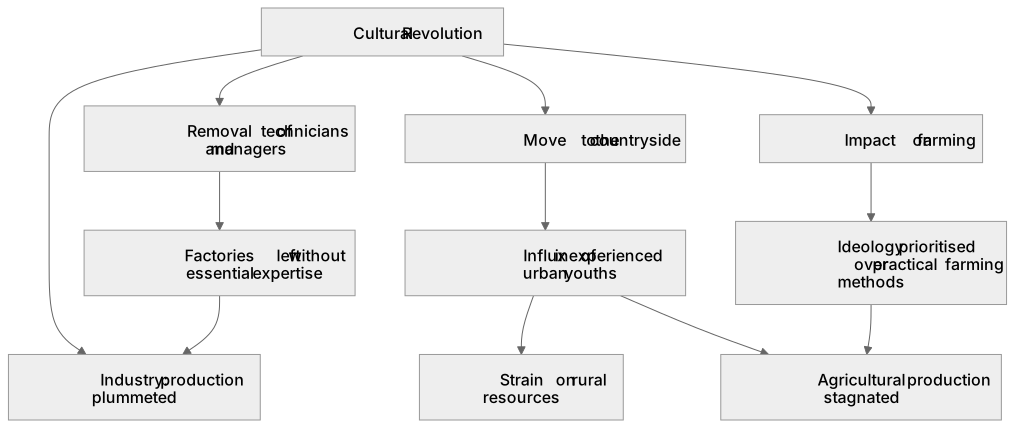
The Cultural Revolution caused severe economic disruption across China. In industry, production plummeted as workers abandoned factories to engage in political struggle. The removal of skilled technicians and managers, who were purged as 'capitalist roaders' or bourgeois experts, left factories without essential expertise, crippling industrial output. To restore order and disperse radicalised youth, millions were sent in the move to the countryside. This influx placed immense strain on rural resources. The impact on farming was detrimental; agricultural production stagnated because political ideology was prioritised over practical farming methods, and the sudden addition of inexperienced urban youths disrupted established agricultural communes.
What earns the marks
- Explain how political struggles and factional fighting led to a sharp decline in industrial production.
- Detail the removal of technicians and managers and its crippling effect on factory efficiency and output.
- Describe the 'move to the countryside' campaign and its economic rationale.
- Analyse the negative impact on farming caused by prioritising ideology over agricultural expertise.
- Evaluate the economic strain placed on rural communes by the influx of inexperienced urban youths.
Common mistakes and how to put them right
Confusing the economic effects of the Cultural Revolution with the Great Leap Forward.
Put it right by focusing on the removal of technicians and the rustication campaign rather than backyard furnaces.
Assuming the move to the countryside boosted agricultural production.
Put it right by explaining that the urban youths lacked farming skills and strained rural food supplies.
Believing industry stopped entirely.
Put it right by noting that while severely disrupted by the removal of experts, some production continued inefficiently.
Exam tips
- Clearly distinguish between the impacts on industry (loss of technicians) and farming (strain of urban youths).
- Use the concept of 'red versus expert' to explain why skilled technicians were removed in favour of politically loyal but unskilled workers.
- Link the move to the countryside to both economic strain in rural areas and the political need to dismantle the Red Guards.
Try the lesson
The start of the Option 32: Key topic 3: The Cultural Revolution and its aftermath, 1966–76 - 3 The effects of the Cultural Revolution: Economic effects: changes in industry, the removal of technicians, the move to the countryside and the impact on farming. lesson, made from checked teaching notes for this specification point.
Have a go first
What action was taken against technical experts and managers in factories during the Cultural Revolution?
Listen
The Cultural Revolution caused severe economic disruption across China. In industry, production plummeted as workers abandoned factories to engage in political struggle. The removal of skilled technicians and managers, who were purged as 'capitalist roaders' or bourgeois experts, left factories without essential expertise, crippling industrial output. To restore order and disperse radicalised youth, millions were sent in the move to the countryside. This influx placed immense strain on rural resources. The impact on farming was detrimental; agricultural production stagnated because political ideology was prioritised over practical farming methods, and the sudden addition of inexperienced urban youths disrupted established agricultural communes. A strong answer earns marks for these points. Explain how political struggles and factional fighting led to a sharp decline in industrial production. Detail the removal of technicians and managers and its crippling effect on factory efficiency and output. Describe the 'move to the countryside' campaign and its economic rationale. Analyse the negative impact on farming caused by prioritising ideology over agricultural expertise. A common slip: Confusing the economic effects of the Cultural Revolution with the Great Leap Forward. Instead, focusing on the removal of technicians and the rustication campaign rather than backyard furnaces. Exam tip: Clearly distinguish between the impacts on industry (loss of technicians) and farming (strain of urban youths).
See it
Key words
Say what each word means before you turn the card.
Economic disruption and stagnation
Try answering aloud or in your head before turning the card.
Ideology versus expertise
Try answering aloud or in your head before turning the card.
See every definition
- Economic disruption and stagnation
- Severe disruption across China, with industrial output crippled and agricultural production stagnating because political ideology was prioritised over practical methods.
- Ideology versus expertise
- Political ideology was prioritised over practical farming methods, and skilled technicians and managers were purged as bourgeois experts, leaving factories without essential expertise.
Label the diagram
Some boxes have lost their names. Pick the right name for each number.
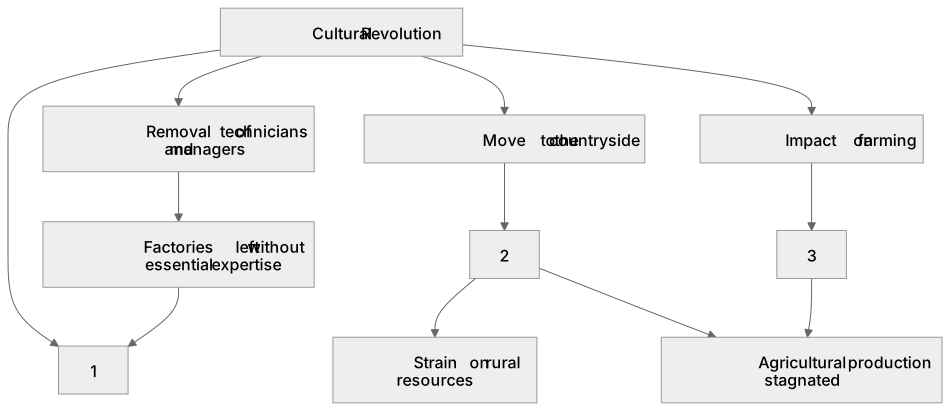
1Box 1
2Box 2
3Box 3
There is more to this lesson
The full lesson goes on to check your understanding and help you earn the marks. Create a free account to carry on, with your progress saved.
A week of Premium from your first lesson · Then the free plan continues · No card, no charge
Test your understanding of Option 32: Key topic 3: The Cultural Revolution and its aftermath, 1966–76 - 3 The effects of the Cultural Revolution: Economic effects: changes in industry, the removal of technicians, the move to the countryside and the impact on farming.
Active recall beats re-reading. Take an instant quiz now to test what you’ve learned and lock it into long-term memory.
A week of Premium from your first lesson · Then the free plan continues · No card, no charge