Pearson Edexcel · GCSE · History
Course version: 1HI0 · Version from Sept 2016
Key topic 3: The Cultural Revolution and its aftermath, 1966–76 - 3 The…
Full specification wording
Option 32: Key topic 3: The Cultural Revolution and its aftermath, 1966–76 - 3 The effects of the Cultural Revolution: Social effects, including the impact on education.
The Cultural Revolution devastated Chinese society, fundamentally disrupting traditional structures.
Checked against the Pearson Edexcel 1HI0 specification (opens in a new tab) on .
- Point 2 of 3
- 3 key terms
Study notes
From the checked teaching notes for this specification point.
The idea
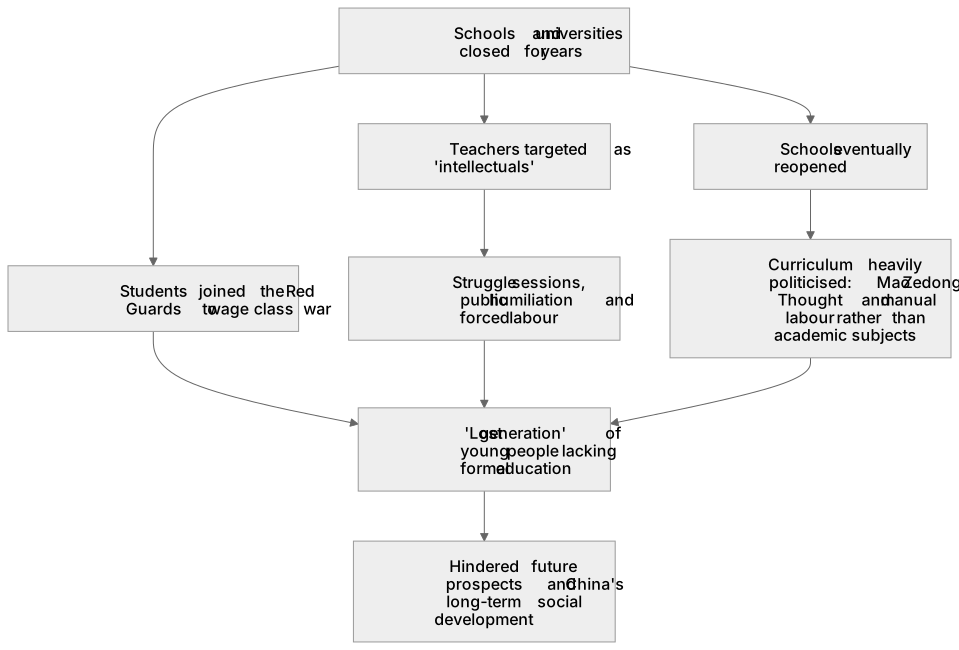
The Cultural Revolution devastated Chinese society, fundamentally disrupting traditional structures. The most profound social effect was the complete paralysis of the education system. Schools and universities were closed for years as students joined the Red Guards to wage class war. Teachers were frequently targeted as 'intellectuals' and subjected to violent struggle sessions, public humiliation, and forced labour. When schools eventually reopened, the curriculum was heavily politicised, focusing on Mao Zedong Thought and manual labour rather than academic subjects. This created a 'lost generation' of young people who lacked formal education, severely hindering their future prospects and China's long-term social development.
What earns the marks
- Identify the closure of schools and universities as a primary social effect.
- Describe the persecution of teachers and intellectuals during struggle sessions.
- Explain the shift in the curriculum towards political indoctrination and manual labour upon reopening.
- Evaluate the long-term social consequence of creating a 'lost generation' of uneducated youth.
- Discuss the breakdown of traditional family and social respect as youths rebelled against authority figures.
Common mistakes and how to put them right
Stating that education completely stopped forever.
Put it right by explaining schools eventually reopened but with a highly politicised, non-academic curriculum.
Focusing only on the Red Guards' political actions.
Put it right by ensuring the impact on the education system and teachers is explicitly detailed.
Assuming the social effects only impacted the wealthy.
Put it right by noting that teachers, intellectuals, and ordinary families were torn apart by ideological fanaticism.
Exam tips
- Use the phrase 'lost generation' to effectively summarise the long-term impact on the youth whose education was interrupted.
- Provide specific examples of how teachers were treated to illustrate the severity of the social upheaval.
- Link the attack on education to the broader campaign against the 'Four Olds' (old ideas, culture, customs, and habits).
Try the lesson
The start of the Option 32: Key topic 3: The Cultural Revolution and its aftermath, 1966–76 - 3 The effects of the Cultural Revolution: Social effects, including the impact on education. lesson, made from checked teaching notes for this specification point.
Have a go first
What was the immediate impact of the Cultural Revolution on the education system in China from 1966?
Listen
The Cultural Revolution devastated Chinese society, fundamentally disrupting traditional structures. The most profound social effect was the complete paralysis of the education system. Schools and universities were closed for years as students joined the Red Guards to wage class war. Teachers were frequently targeted as 'intellectuals' and subjected to violent struggle sessions, public humiliation, and forced labour. When schools eventually reopened, the curriculum was heavily politicised, focusing on Mao Zedong Thought and manual labour rather than academic subjects. This created a 'lost generation' of young people who lacked formal education, severely hindering their future prospects and China's long-term social development. A strong answer earns marks for these points. Identify the closure of schools and universities as a primary social effect. Describe the persecution of teachers and intellectuals during struggle sessions. Explain the shift in the curriculum towards political indoctrination and manual labour upon reopening. Evaluate the long-term social consequence of creating a 'lost generation' of uneducated youth. A common slip: Stating that education completely stopped forever. Instead, explaining schools eventually reopened but with a highly politicised, non-academic curriculum. Exam tip: Use the phrase 'lost generation' to effectively summarise the long-term impact on the youth whose education was interrupted.
See it
Key words
Say what each word means before you turn the card.
Social upheaval and generational conflict
Try answering aloud or in your head before turning the card.
The destruction of education and intellect
Try answering aloud or in your head before turning the card.
The breakdown of traditional authority
Try answering aloud or in your head before turning the card.
See every definition
- Social upheaval and generational conflict
- The disruption of Chinese society in which youths rebelled against authority figures, breaking down traditional family and social respect.
- The destruction of education and intellect
- The complete paralysis of the education system, with schools and universities closed for years and teachers targeted as 'intellectuals'.
- The breakdown of traditional authority
- The tearing apart of teachers, intellectuals and ordinary families by ideological fanaticism as youths rebelled against authority figures.
Label the diagram
Some boxes have lost their names. Pick the right name for each number.
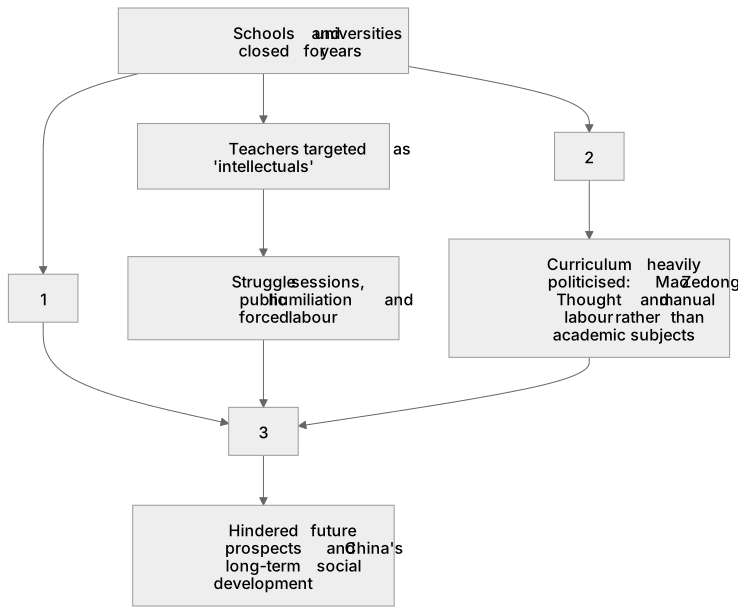
1Box 1
2Box 2
3Box 3
There is more to this lesson
The full lesson goes on to check your understanding and help you earn the marks. Create a free account to carry on, with your progress saved.
A week of Premium from your first lesson · Then the free plan continues · No card, no charge
Test your understanding of Option 32: Key topic 3: The Cultural Revolution and its aftermath, 1966–76 - 3 The effects of the Cultural Revolution: Social effects, including the impact on education.
Active recall beats re-reading. Take an instant quiz now to test what you’ve learned and lock it into long-term memory.
A week of Premium from your first lesson · Then the free plan continues · No card, no charge