Pearson Edexcel · GCSE · History
Course version: 1HI0 · Version from Sept 2016
Key topic 3: The Cultural Revolution and its aftermath, 1966–76 - 3 The…
Full specification wording
Option 32: Key topic 3: The Cultural Revolution and its aftermath, 1966–76 - 3 The effects of the Cultural Revolution: Political effects: the purging of the CCP, Liu Shaoqi and Deng Xiaoping, the rise and fall of Lin Biao.
The Cultural Revolution profoundly altered China's political landscape by purging the Chinese Communist Party (CCP) of perceived 'capitalist roaders'.
Checked against the Pearson Edexcel 1HI0 specification (opens in a new tab) on .
- Point 1 of 3
Study notes
From the checked teaching notes for this specification point.
The idea
The Cultural Revolution profoundly altered China's political landscape by purging the Chinese Communist Party (CCP) of perceived 'capitalist roaders'. Mao Zedong targeted high-ranking officials to consolidate his absolute power. Liu Shaoqi, the President, was subjected to brutal struggle sessions, expelled from the party, and died in prison in 1969. Deng Xiaoping was stripped of his posts and sent to work in a tractor factory. Meanwhile, Lin Biao, head of the PLA and Mao's designated successor, rose to immense prominence. However, his power grew too threatening; following an alleged assassination plot against Mao in 1971, Lin died in a mysterious plane crash while fleeing to the Soviet Union, severely damaging the regime's credibility.
What earns the marks
- Explain the purging of the CCP as Mao's method to remove rivals and reassert his ideology.
- Detail the fate of Liu Shaoqi, including his public humiliation, expulsion, and death.
- Describe Deng Xiaoping's demotion and exile to rural labour.
- Analyse the rise of Lin Biao as Mao's designated successor and compiler of the Little Red Book.
- Explain the circumstances and political impact of Lin Biao's fall and death in 1971.
Common mistakes and how to put them right
Confusing the fates of Liu Shaoqi and Deng Xiaoping.
Put it right by remembering Liu died in prison while Deng survived to eventually lead China.
Assuming Lin Biao was purged at the start of the Cultural Revolution.
Put it right by noting he rose to power initially and fell later in 1971.
Believing the CCP was completely destroyed.
Put it right by explaining it was purged of Mao's opponents but remained the ruling apparatus under his strict control.
Exam tips
- Use the contrast between Liu Shaoqi's death and Lin Biao's initial rise to demonstrate the volatility of Mao's favour.
- When discussing political effects, explicitly link the purges to Mao's desire to eliminate 'capitalist roaders' and secure his own authority.
- Mention the 'Project 571' plot when explaining the fall of Lin Biao to add specific historical detail.
Try the lesson
The start of the Option 32: Key topic 3: The Cultural Revolution and its aftermath, 1966–76 - 3 The effects of the Cultural Revolution: Political effects: the purging of the CCP, Liu Shaoqi and Deng Xiaoping, the rise and fall of Lin Biao. lesson, made from checked teaching notes for this specification point.
Have a go first
Which two senior Chinese Communist Party leaders were purged during the early stages of the Cultural Revolution for allegedly taking the 'capitalist road'?
Listen
The Cultural Revolution profoundly altered China's political landscape by purging the Chinese Communist Party (CCP) of perceived 'capitalist roaders'. Mao Zedong targeted high-ranking officials to consolidate his absolute power. Liu Shaoqi, the President, was subjected to brutal struggle sessions, expelled from the party, and died in prison in 1969. Deng Xiaoping was stripped of his posts and sent to work in a tractor factory. Meanwhile, Lin Biao, head of the PLA and Mao's designated successor, rose to immense prominence. However, his power grew too threatening; following an alleged assassination plot against Mao in 1971, Lin died in a mysterious plane crash while fleeing to the Soviet Union, severely damaging the regime's credibility. A strong answer earns marks for these points. Explain the purging of the CCP as Mao's method to remove rivals and reassert his ideology. Detail the fate of Liu Shaoqi, including his public humiliation, expulsion, and death. Describe Deng Xiaoping's demotion and exile to rural labour. Analyse the rise of Lin Biao as Mao's designated successor and compiler of the Little Red Book. A common slip: Confusing the fates of Liu Shaoqi and Deng Xiaoping. Instead, remembering Liu died in prison while Deng survived to eventually lead China. Exam tip: Use the contrast between Liu Shaoqi's death and Lin Biao's initial rise to demonstrate the volatility of Mao's favour.
See it
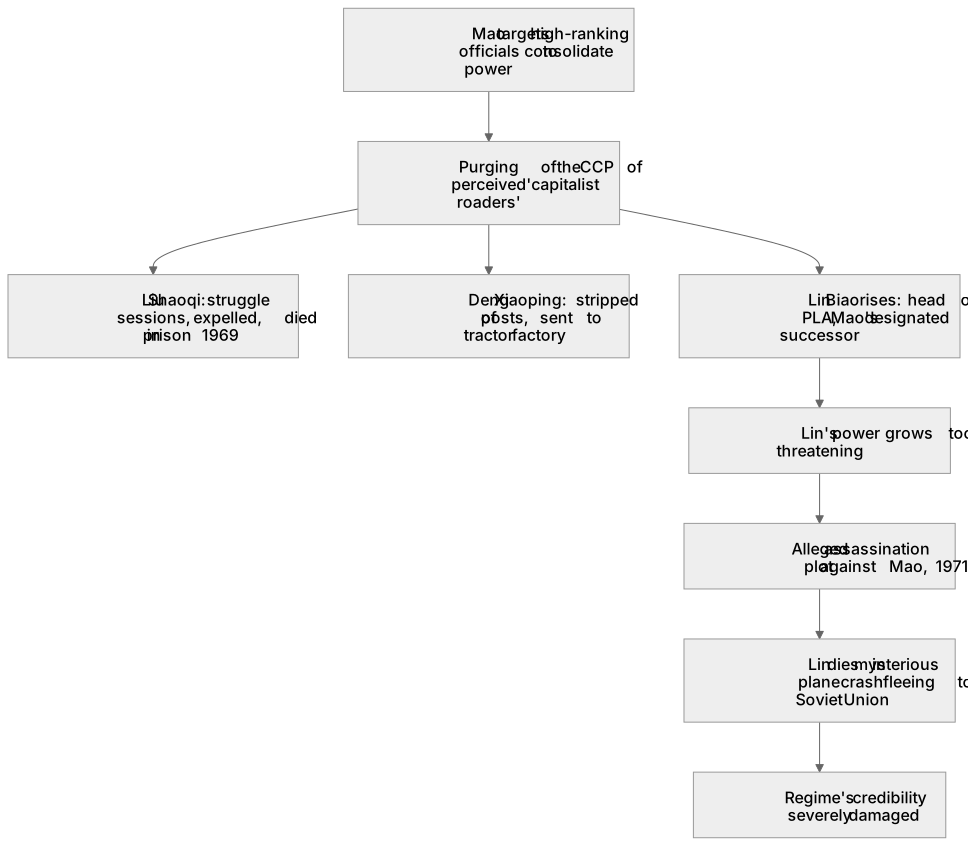
Label the diagram
Some boxes have lost their names. Pick the right name for each number.
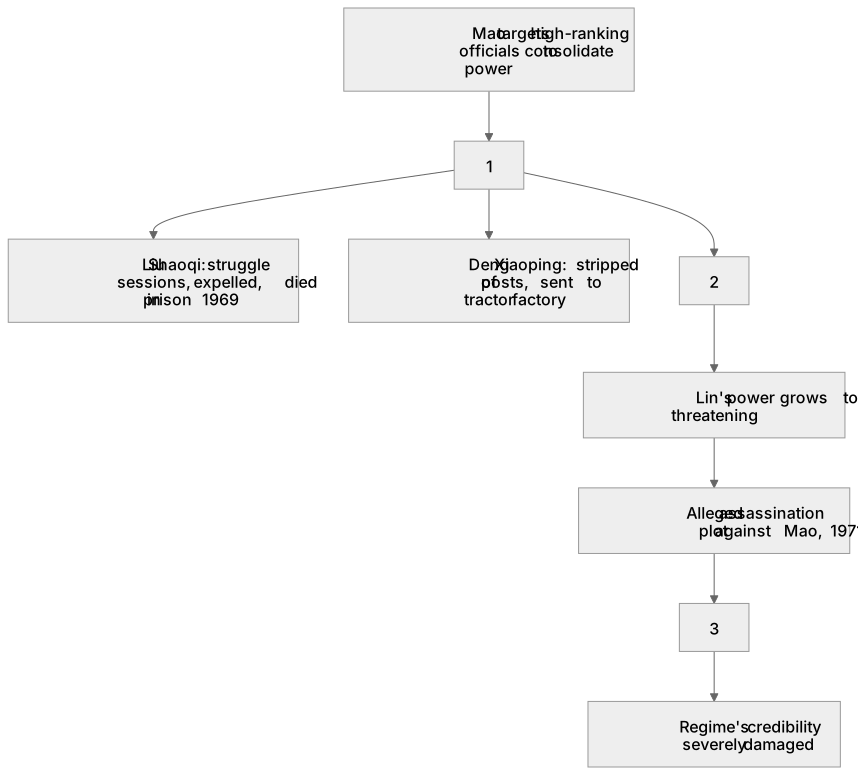
1Box 1
2Box 2
3Box 3
There is more to this lesson
The full lesson goes on to check your understanding and help you earn the marks. Create a free account to carry on, with your progress saved.
A week of Premium from your first lesson · Then the free plan continues · No card, no charge
Test your understanding of Option 32: Key topic 3: The Cultural Revolution and its aftermath, 1966–76 - 3 The effects of the Cultural Revolution: Political effects: the purging of the CCP, Liu Shaoqi and Deng Xiaoping, the rise and fall of Lin Biao.
Active recall beats re-reading. Take an instant quiz now to test what you’ve learned and lock it into long-term memory.
A week of Premium from your first lesson · Then the free plan continues · No card, no charge