Pearson Edexcel · GCSE · History
Course version: 1HI0 · Version from Sept 2016
Key topic 3: The Cultural Revolution and its aftermath, 1966–76 - 4 The…
Full specification wording
Option 32: Key topic 3: The Cultural Revolution and its aftermath, 1966–76 - 4 The end of the Cultural Revolution, 1968–76: Reasons for the end of the Red Guards and the significance of the restoration of order by the PLA, including the ‘Up to the mountains and down to the villages’ campaign.
By 1968, the Red Guards had fractured into rival factions, causing anarchy that threatened the state.
Checked against the Pearson Edexcel 1HI0 specification (opens in a new tab) on .
- Point 1 of 2
- 4 key terms
Study notes
From the checked teaching notes for this specification point.
The idea
By 1968, the Red Guards had fractured into rival factions, causing anarchy that threatened the state. The reasons for the end of the Red Guards stemmed from Mao's realisation that this violence was destroying the economy and risking civil war. Mao authorised the People's Liberation Army (PLA) to suppress them, marking the significance of the restoration of order by the PLA. The military forcefully disbanded student groups and re-established control. To permanently dismantle their power base, Mao launched the 'Up to the mountains and down to the villages' campaign, exiling millions of radicalised urban youths to remote rural areas to learn from the peasants, effectively ending their political influence and restoring central authority.
What earns the marks
- Identify the factional violence and threat of civil war as key reasons for the end of the Red Guards.
- Explain the significance of the PLA in forcefully suppressing the Red Guards and restoring state control.
- Describe the 'Up to the mountains and down to the villages' campaign (rustication campaign).
- Analyse how exiling urban youth to the countryside effectively dismantled the Red Guards' power base.
- Evaluate the shift in power from the radical youth back to the military and central party apparatus.
Common mistakes and how to put them right
Believing the Red Guards voluntarily disbanded.
Put it right by explaining they were forcefully suppressed by the PLA on Mao's orders.
Confusing the 'Up to the mountains...' campaign with earlier agricultural policies.
Put it right by identifying it specifically as a political tool to disperse radicalised youth in 1968.
Assuming the PLA supported the Red Guards until the end.
Put it right by noting the PLA was ordered to crush them when the anarchy became too severe.
Exam tips
- Emphasise Mao's pragmatic shift: he unleashed the Red Guards to gain power but used the PLA to crush them when they threatened state stability.
- Use the 'Up to the mountains and down to the villages' campaign as a specific example of how Mao solved the problem of urban youth unemployment and radicalism simultaneously.
- Discuss the significance of the PLA's intervention as the moment the military became the dominant political force in China.
Try the lesson
The start of the Option 32: Key topic 3: The Cultural Revolution and its aftermath, 1966–76 - 4 The end of the Cultural Revolution, 1968–76: Reasons for the end of the Red Guards and the significance of the restoration of order by the PLA, including the ‘Up to the mountains and down to the villages’ campaign. lesson, made from checked teaching notes for this specification point.
Have a go first
Which organisation was ordered by Mao Zedong to restore order and suppress the Red Guards in 1968?
Listen
By 1968, the Red Guards had fractured into rival factions, causing anarchy that threatened the state. The reasons for the end of the Red Guards stemmed from Mao's realisation that this violence was destroying the economy and risking civil war. Mao authorised the People's Liberation Army (PLA) to suppress them, marking the significance of the restoration of order by the PLA. The military forcefully disbanded student groups and re-established control. To permanently dismantle their power base, Mao launched the 'Up to the mountains and down to the villages' campaign, exiling millions of radicalised urban youths to remote rural areas to learn from the peasants, effectively ending their political influence and restoring central authority. A strong answer earns marks for these points. Identify the factional violence and threat of civil war as key reasons for the end of the Red Guards. Explain the significance of the PLA in forcefully suppressing the Red Guards and restoring state control. Describe the 'Up to the mountains and down to the villages' campaign (rustication campaign). Analyse how exiling urban youth to the countryside effectively dismantled the Red Guards' power base. A common slip: Believing the Red Guards voluntarily disbanded. Instead, explaining they were forcefully suppressed by the PLA on Mao's orders. Exam tip: Emphasise Mao's pragmatic shift: he unleashed the Red Guards to gain power but used the PLA to crush them when they threatened state stability.
See it
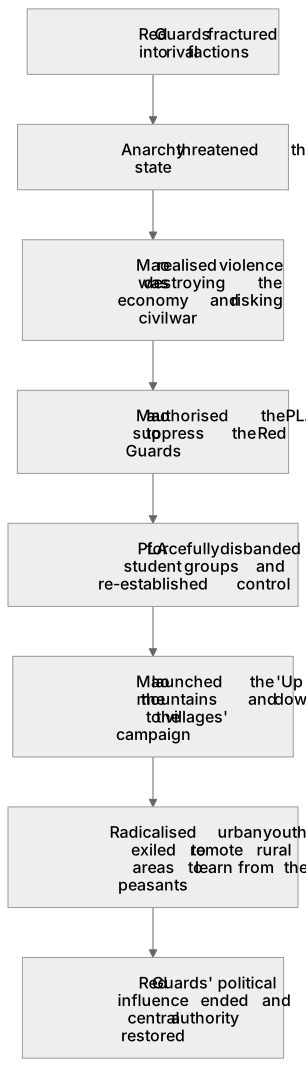
Put it in order
Put these steps in the order they happen.
- 1. PLA forcefully disbanded student groups and re-established control
- 2. Red Guards' political influence ended and central authority restored
- 3. Mao launched the 'Up to the mountains and down to the villages' campaign
- 4. Red Guards fractured into rival factions
- 5. Anarchy threatened the state
- 6. Radicalised urban youths exiled to remote rural areas to learn from the peasants
- 7. Mao realised violence was destroying the economy and risking civil war
- 8. Mao authorised the PLA to suppress the Red Guards
Key words
Say what each word means before you turn the card.
Restoration of state order
Try answering aloud or in your head before turning the card.
The power of the military (PLA)
Try answering aloud or in your head before turning the card.
Social control and forced migration
Try answering aloud or in your head before turning the card.
The shifting strategies of Mao Zedong
Try answering aloud or in your head before turning the card.
See every definition
- Restoration of state order
- The re-establishment of control by the People's Liberation Army, which forcefully disbanded student groups after the Red Guards had fractured into rival factions causing anarchy that threatened the state.
- The power of the military (PLA)
- The People's Liberation Army was authorised by Mao to suppress the Red Guards, marking the moment the military became the dominant political force in China.
- Social control and forced migration
- The 'Up to the mountains and down to the villages' campaign exiled millions of radicalised urban youths to remote rural areas to learn from the peasants, effectively ending their political influence.
- The shifting strategies of Mao Zedong
- Mao unleashed the Red Guards to gain power but used the PLA to crush them when they threatened state stability, then launched the rustication campaign to dismantle their power base.
Label the diagram
Some boxes have lost their names. Pick the right name for each number.
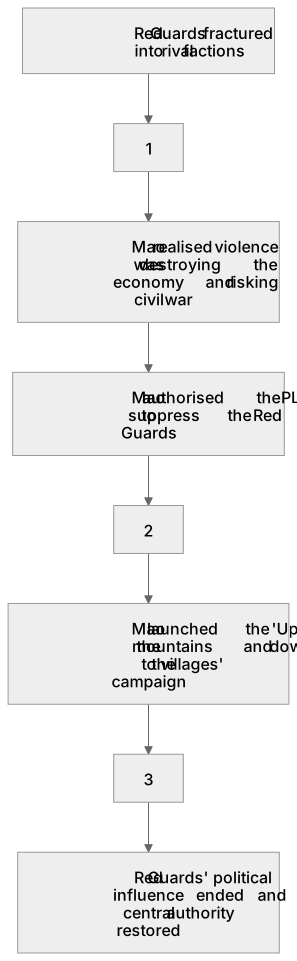
1Box 1
2Box 2
3Box 3
There is more to this lesson
The full lesson goes on to check your understanding and help you earn the marks. Create a free account to carry on, with your progress saved.
A week of Premium from your first lesson · Then the free plan continues · No card, no charge
Test your understanding of Option 32: Key topic 3: The Cultural Revolution and its aftermath, 1966–76 - 4 The end of the Cultural Revolution, 1968–76: Reasons for the end of the Red Guards and the significance of the restoration of order by the PLA, including the ‘Up to the mountains and down to the villages’ campaign.
Active recall beats re-reading. Take an instant quiz now to test what you’ve learned and lock it into long-term memory.
A week of Premium from your first lesson · Then the free plan continues · No card, no charge