Pearson Edexcel · GCSE · History
Course version: 1HI0 · Version from Sept 2016
Key topic 3: The Cultural Revolution and its aftermath, 1966–76 - 4 The…
Full specification wording
Option 32: Key topic 3: The Cultural Revolution and its aftermath, 1966–76 - 4 The end of the Cultural Revolution, 1968–76: The return to power of Deng Xiaoping and the increased influence of Zhou Enlai. The rise and fall of the ‘Gang of Four’ and the death of Mao.
The period 1968–76 saw significant power struggles as the Cultural Revolution waned.
Checked against the Pearson Edexcel 1HI0 specification (opens in a new tab) on .
- Point 2 of 2
- 4 key terms
Study notes
From the checked teaching notes for this specification point.
The idea
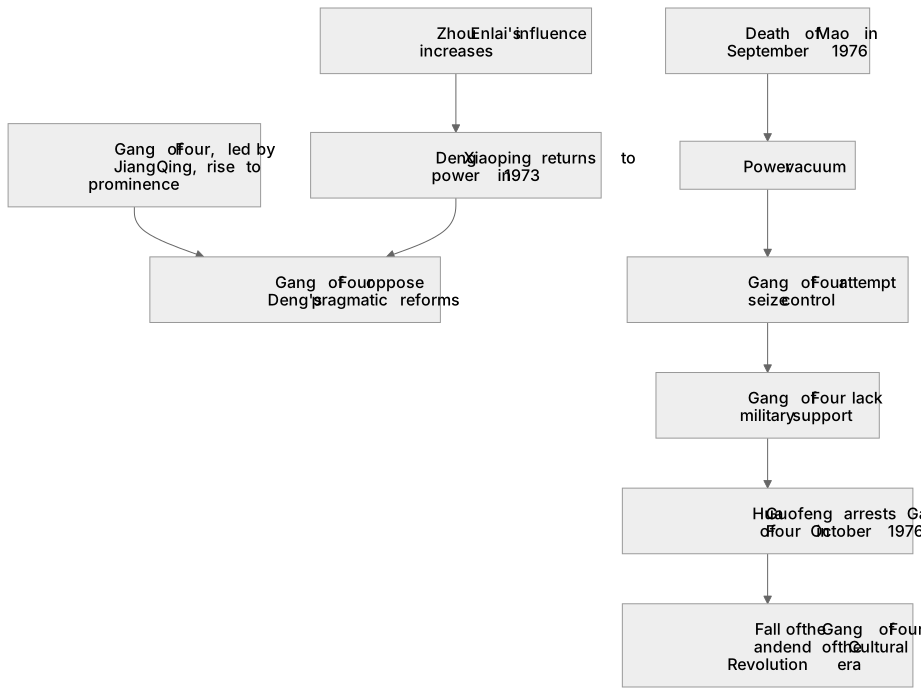
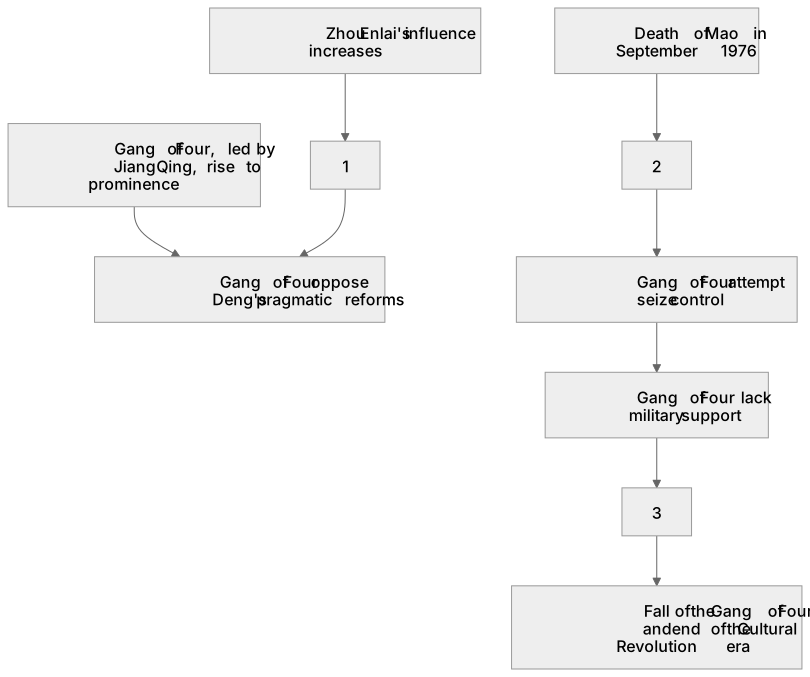
The period 1968–76 saw significant power struggles as the Cultural Revolution waned. Zhou Enlai's influence increased as he sought to restore stability and economic growth, leading to the rehabilitation and return to power of Deng Xiaoping in 1973 to help manage the government. Conversely, the radical 'Gang of Four', led by Jiang Qing, rose to prominence, championing continuous revolution and opposing Deng's pragmatic reforms. The death of Mao Zedong in September 1976 created a power vacuum. The Gang of Four attempted to seize control but lacked military support. They were swiftly arrested in October 1976 by Hua Guofeng, marking their fall and the definitive end of the Cultural Revolution era.
What earns the marks
- Explain Zhou Enlai's role in restoring order and his 'Four Modernisations' policy.
- Describe Deng Xiaoping's return to power in 1973 and his focus on economic pragmatism over ideological purity.
- Detail the rise of the Gang of Four, their control over culture and media, and their radical ideological stance.
- Analyse the impact of Mao's death in 1976 on the power struggle between pragmatists and radicals.
- Explain the events leading to the arrest and fall of the Gang of Four in October 1976.
Common mistakes and how to put them right
Confusing the roles of Zhou Enlai and Deng Xiaoping.
Put it right: Zhou was the established Premier who facilitated Deng's return, not the other way around.
Assuming the Gang of Four took power after Mao's death.
Put it right: They attempted to seize control but were outmanoeuvred and arrested by Hua Guofeng.
Believing Deng Xiaoping immediately became paramount leader upon Mao's death.
Put it right: Hua Guofeng initially succeeded Mao before Deng consolidated power later.
Exam tips
- When discussing the Gang of Four, always mention Jiang Qing's connection to Mao to explain their initial influence.
- Contrast the pragmatic policies of Zhou and Deng with the radical, ideologically driven aims of the Gang of Four.
- Use the Tiananmen Incident of April 1976 as a key example of public support for Zhou and Deng and opposition to the Gang of Four.
Try the lesson
The start of the Option 32: Key topic 3: The Cultural Revolution and its aftermath, 1966–76 - 4 The end of the Cultural Revolution, 1968–76: The return to power of Deng Xiaoping and the increased influence of Zhou Enlai. The rise and fall of the ‘Gang of Four’ and the death of Mao. lesson, made from checked teaching notes for this specification point.
Have a go first
Which political faction, led by Jiang Qing, rose to prominence during the Cultural Revolution and attempted to seize power after Mao's death?
Listen
The period 1968–76 saw significant power struggles as the Cultural Revolution waned. Zhou Enlai's influence increased as he sought to restore stability and economic growth, leading to the rehabilitation and return to power of Deng Xiaoping in 1973 to help manage the government. Conversely, the radical 'Gang of Four', led by Jiang Qing, rose to prominence, championing continuous revolution and opposing Deng's pragmatic reforms. The death of Mao Zedong in September 1976 created a power vacuum. The Gang of Four attempted to seize control but lacked military support. They were swiftly arrested in October 1976 by Hua Guofeng, marking their fall and the definitive end of the Cultural Revolution era. A strong answer earns marks for these points. Explain Zhou Enlai's role in restoring order and his 'Four Modernisations' policy. Describe Deng Xiaoping's return to power in 1973 and his focus on economic pragmatism over ideological purity. Detail the rise of the Gang of Four, their control over culture and media, and their radical ideological stance. Analyse the impact of Mao's death in 1976 on the power struggle between pragmatists and radicals. Exam tip: When discussing the Gang of Four, always mention Jiang Qing's connection to Mao to explain their initial influence.
See it
Key words
Say what each word means before you turn the card.
Power and authority
Try answering aloud or in your head before turning the card.
Ideology vs pragmatism
Try answering aloud or in your head before turning the card.
Political instability
Try answering aloud or in your head before turning the card.
Leadership succession
Try answering aloud or in your head before turning the card.
See every definition
- Power and authority
- Significant power struggles occurred as the Cultural Revolution waned, and the death of Mao Zedong created a power vacuum.
- Ideology vs pragmatism
- The Gang of Four championed continuous revolution and opposed Deng's pragmatic reforms, while Deng focused on economic pragmatism over ideological purity.
- Political instability
- The period 1968–76 saw significant power struggles, and the Gang of Four attempted to seize control but lacked military support.
- Leadership succession
- Hua Guofeng initially succeeded Mao before Deng consolidated power later, and the Gang of Four were swiftly arrested in October 1976 by Hua Guofeng.
Label the diagram
Some boxes have lost their names. Pick the right name for each number.
1Box 1
2Box 2
3Box 3
There is more to this lesson
The full lesson goes on to check your understanding and help you earn the marks. Create a free account to carry on, with your progress saved.
A week of Premium from your first lesson · Then the free plan continues · No card, no charge
Test your understanding of Option 32: Key topic 3: The Cultural Revolution and its aftermath, 1966–76 - 4 The end of the Cultural Revolution, 1968–76: The return to power of Deng Xiaoping and the increased influence of Zhou Enlai. The rise and fall of the ‘Gang of Four’ and the death of Mao.
Active recall beats re-reading. Take an instant quiz now to test what you’ve learned and lock it into long-term memory.
A week of Premium from your first lesson · Then the free plan continues · No card, no charge