Pearson Edexcel · GCSE · History
Course version: 1HI0 · Version from Sept 2016
Key topic 4: Life in Mao’s China, 1949–76 - 3 Education and health:…
Full specification wording
Option 32: Key topic 4: Life in Mao’s China, 1949–76 - 3 Education and health: Reasons for changes in education. Growth in literacy and the significance of Pinyin. The collapse of education after 1966.
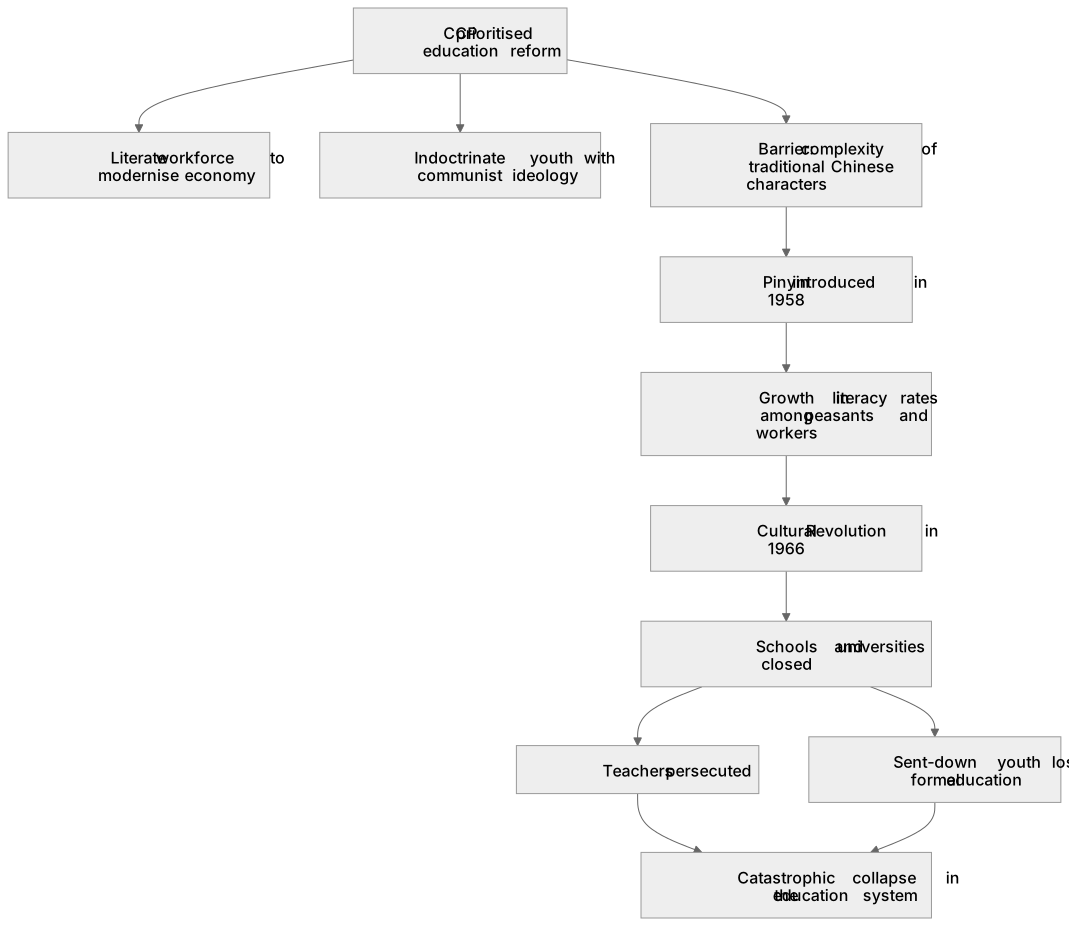
The CCP prioritised education reform to create a literate workforce capable of modernising China's economy and to indoctrinate the youth with communist ideology.
Checked against the Pearson Edexcel 1HI0 specification (opens in a new tab) on .
- Point 1 of 2
Study notes
From the checked teaching notes for this specification point.
The idea
The CCP prioritised education reform to create a literate workforce capable of modernising China's economy and to indoctrinate the youth with communist ideology. A major barrier to literacy was the complexity of traditional Chinese characters. To solve this, the government introduced Pinyin in 1958, a phonetic alphabet using Latin characters, which vastly accelerated the growth in literacy rates among peasants and workers. However, this progress was violently interrupted by the Cultural Revolution in 1966. Schools and universities were closed as students joined the Red Guards to attack the 'Four Olds'. Teachers were persecuted, and a generation of 'sent-down youth' lost their formal education, causing a catastrophic collapse in the education system.
What earns the marks
- Identify the economic and ideological motives behind Mao's educational reforms, such as producing skilled workers and loyal communists.
- Explain how the introduction of Pinyin simplified the learning of Mandarin, leading to a significant increase in national literacy rates.
- Describe the impact of the Cultural Revolution on education, including the closure of schools and universities from 1966.
- Analyse the long-term consequences of the collapse of education, such as the creation of a 'lost generation' of uneducated youth.
Common mistakes and how to put them right
Assuming Pinyin replaced Chinese characters entirely.
Put it right: Clarify that Pinyin was introduced as a phonetic aid to help people learn to pronounce and read standard Mandarin characters.
Stating that education improved continuously under Mao.
Put it right: Highlight the sharp reversal and collapse of the education system after 1966 due to the Cultural Revolution.
Believing the Red Guards were only university students.
Put it right: Note that middle and high school students also formed Red Guard units and abandoned their studies.
Exam tips
- Link the introduction of Pinyin directly to the rapid growth in literacy rates among the adult peasant population.
- Use the term 'lost generation' when evaluating the impact of the Cultural Revolution on students whose education was halted.
- Contrast the early successes in literacy with the destructive anti-intellectualism of the late 1960s.
Try the lesson
The start of the Option 32: Key topic 4: Life in Mao’s China, 1949–76 - 3 Education and health: Reasons for changes in education. Growth in literacy and the significance of Pinyin. The collapse of education after 1966. lesson, made from checked teaching notes for this specification point.
Have a go first
What was the primary purpose of introducing Pinyin in Chinese education?
Listen
The CCP prioritised education reform to create a literate workforce capable of modernising China's economy and to indoctrinate the youth with communist ideology. A major barrier to literacy was the complexity of traditional Chinese characters. To solve this, the government introduced Pinyin in 1958, a phonetic alphabet using Latin characters, which vastly accelerated the growth in literacy rates among peasants and workers. However, this progress was violently interrupted by the Cultural Revolution in 1966. Schools and universities were closed as students joined the Red Guards to attack the 'Four Olds'. Teachers were persecuted, and a generation of 'sent-down youth' lost their formal education, causing a catastrophic collapse in the education system. A strong answer earns marks for these points. Identify the economic and ideological motives behind Mao's educational reforms, such as producing skilled workers and loyal communists. Explain how the introduction of Pinyin simplified the learning of Mandarin, leading to a significant increase in national literacy rates. Describe the impact of the Cultural Revolution on education, including the closure of schools and universities from 1966. Analyse the long-term consequences of the collapse of education, such as the creation of a 'lost generation' of uneducated youth. A common slip: Assuming Pinyin replaced Chinese characters entirely. Instead, clarify that Pinyin was introduced as a phonetic aid to help people learn to pronounce and read standard Mandarin characters. Exam tip: Link the introduction of Pinyin directly to the rapid growth in literacy rates among the adult peasant population.
See it
Label the diagram
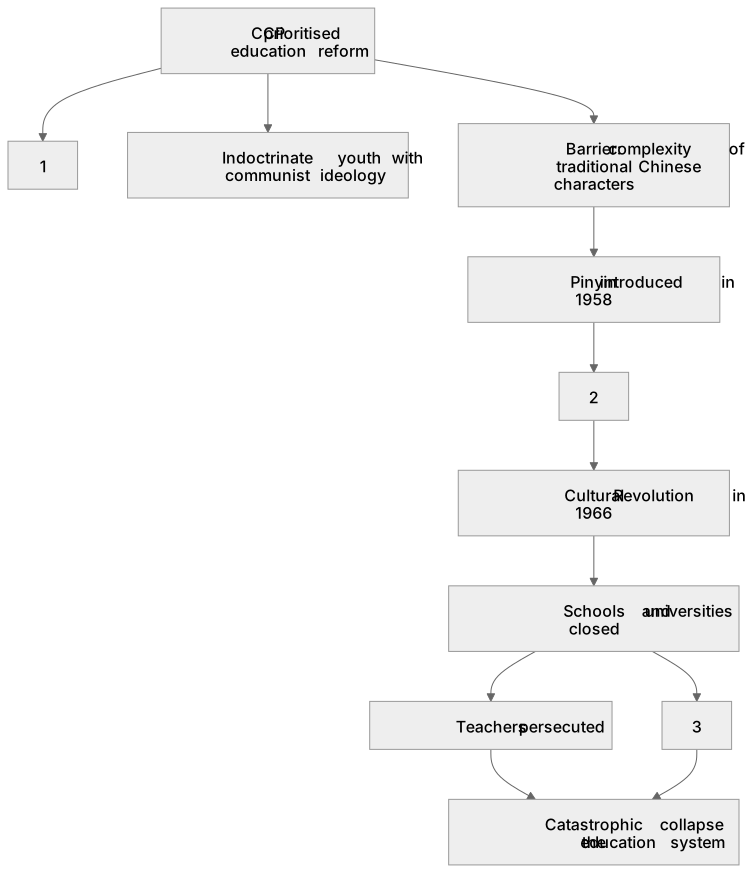
Some boxes have lost their names. Pick the right name for each number.
1Box 1
2Box 2
3Box 3
There is more to this lesson
The full lesson goes on to check your understanding and help you earn the marks. Create a free account to carry on, with your progress saved.
A week of Premium from your first lesson · Then the free plan continues · No card, no charge
Test your understanding of Option 32: Key topic 4: Life in Mao’s China, 1949–76 - 3 Education and health: Reasons for changes in education. Growth in literacy and the significance of Pinyin. The collapse of education after 1966.
Active recall beats re-reading. Take an instant quiz now to test what you’ve learned and lock it into long-term memory.
A week of Premium from your first lesson · Then the free plan continues · No card, no charge