Pearson Edexcel · GCSE · History
Course version: 1HI0 · Version from Sept 2016
Key topic 4: Life in Mao’s China, 1949–76 - 3 Education and health:…
Full specification wording
Option 32: Key topic 4: Life in Mao’s China, 1949–76 - 3 Education and health: Reasons for changes in health provision. The significance of the barefoot doctors. Successes and failures of healthcare reform.
Before 1949, China suffered from high mortality rates and endemic diseases, with healthcare concentrated in cities.
Checked against the Pearson Edexcel 1HI0 specification (opens in a new tab) on .
- Point 2 of 2
Study notes
From the checked teaching notes for this specification point.
The idea
Before 1949, China suffered from high mortality rates and endemic diseases, with healthcare concentrated in cities. The CCP changed health provision to ensure a healthy workforce and demonstrate socialist progress. A key initiative was the 'barefoot doctors' programme, launched in the 1960s. These were paramedics with basic medical training sent to rural villages to provide preventative care, hygiene education, and basic treatments. Successes included the control of epidemic diseases like cholera and a significant increase in life expectancy. However, failures persisted, such as the uneven quality of care, severe shortages of modern equipment in rural clinics, and the disruption of advanced medical training during the Cultural Revolution.
What earns the marks
- Explain the reasons for changes in health provision, focusing on the lack of rural care and the prevalence of preventable diseases before 1949.
- Describe the significance of the barefoot doctors in delivering basic healthcare and hygiene education to rural communities.
- Identify the successes of healthcare reform, such as increased life expectancy, reduced infant mortality, and the control of epidemic diseases.
- Evaluate the failures of the system, including the limited medical expertise of barefoot doctors and the lack of funding for rural hospitals.
Common mistakes and how to put them right
Confusing barefoot doctors with fully qualified physicians.
Put it right: Specify that barefoot doctors received only basic, short-term paramedical training.
Claiming healthcare became perfectly equal across China.
Put it right: Note that urban hospitals still received better funding and equipment than rural communes.
Ignoring the impact of the Cultural Revolution on health.
Put it right: Mention that the persecution of senior doctors negatively affected advanced medical care.
Exam tips
- Use the barefoot doctors as a prime example of Mao's focus on the rural peasantry over the urban elite.
- Balance your evaluation by contrasting the impressive statistical improvements in life expectancy with the rudimentary nature of rural treatments.
- Link healthcare improvements to the CCP's broader economic goals of maintaining a fit and productive workforce.
Try the lesson
The start of the Option 32: Key topic 4: Life in Mao’s China, 1949–76 - 3 Education and health: Reasons for changes in health provision. The significance of the barefoot doctors. Successes and failures of healthcare reform. lesson, made from checked teaching notes for this specification point.
Have a go first
Who were the "barefoot doctors" in Mao's China?
Listen
Before 1949, China suffered from high mortality rates and endemic diseases, with healthcare concentrated in cities. The CCP changed health provision to ensure a healthy workforce and demonstrate socialist progress. A key initiative was the 'barefoot doctors' programme, launched in the 1960s. These were paramedics with basic medical training sent to rural villages to provide preventative care, hygiene education, and basic treatments. Successes included the control of epidemic diseases like cholera and a significant increase in life expectancy. However, failures persisted, such as the uneven quality of care, severe shortages of modern equipment in rural clinics, and the disruption of advanced medical training during the Cultural Revolution. A strong answer earns marks for these points. Explain the reasons for changes in health provision, focusing on the lack of rural care and the prevalence of preventable diseases before 1949. Describe the significance of the barefoot doctors in delivering basic healthcare and hygiene education to rural communities. Identify the successes of healthcare reform, such as increased life expectancy, reduced infant mortality, and the control of epidemic diseases. Evaluate the failures of the system, including the limited medical expertise of barefoot doctors and the lack of funding for rural hospitals. A common slip: Confusing barefoot doctors with fully qualified physicians. Instead, Specify that barefoot doctors received only basic, short-term paramedical training. Exam tip: Use the barefoot doctors as a prime example of Mao's focus on the rural peasantry over the urban elite.
See it
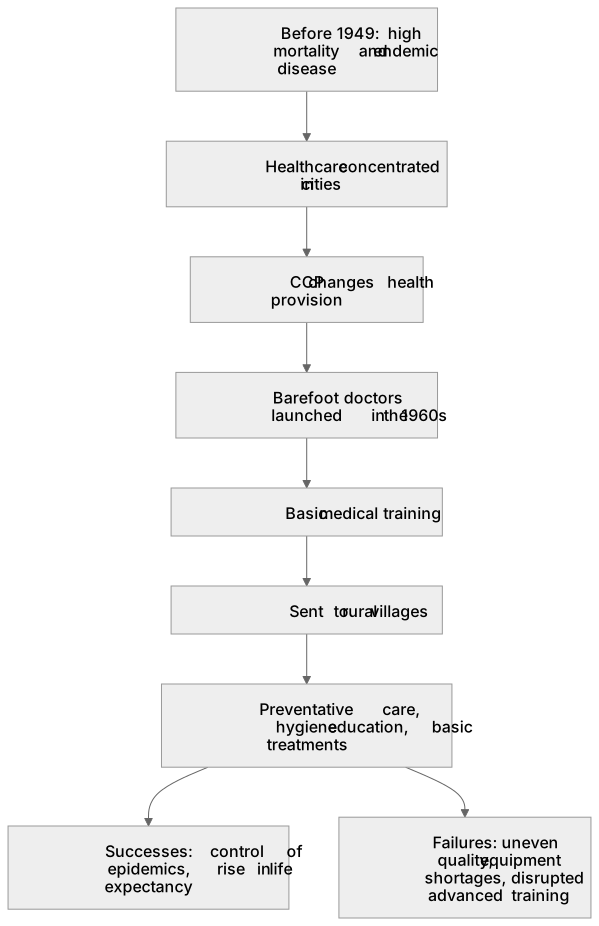
Label the diagram
Some boxes have lost their names. Pick the right name for each number.
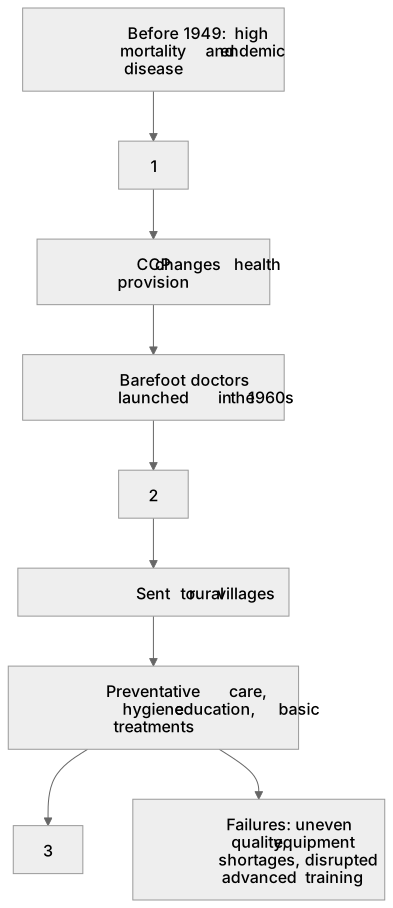
1Box 1
2Box 2
3Box 3
There is more to this lesson
The full lesson goes on to check your understanding and help you earn the marks. Create a free account to carry on, with your progress saved.
A week of Premium from your first lesson · Then the free plan continues · No card, no charge
Test your understanding of Option 32: Key topic 4: Life in Mao’s China, 1949–76 - 3 Education and health: Reasons for changes in health provision. The significance of the barefoot doctors. Successes and failures of healthcare reform.
Active recall beats re-reading. Take an instant quiz now to test what you’ve learned and lock it into long-term memory.
A week of Premium from your first lesson · Then the free plan continues · No card, no charge