Pearson Edexcel · GCSE · History
Course version: 1HI0 · Version from Sept 2016
Key topic 1: The development of the civil rights movement, 1954–60 - 1 The…
Full specification wording
Option 33: Key topic 1: The development of the civil rights movement, 1954–60 - 1 The position of Black Americans in the early 1950s: Segregation, discrimination and voting rights in the Southern states.
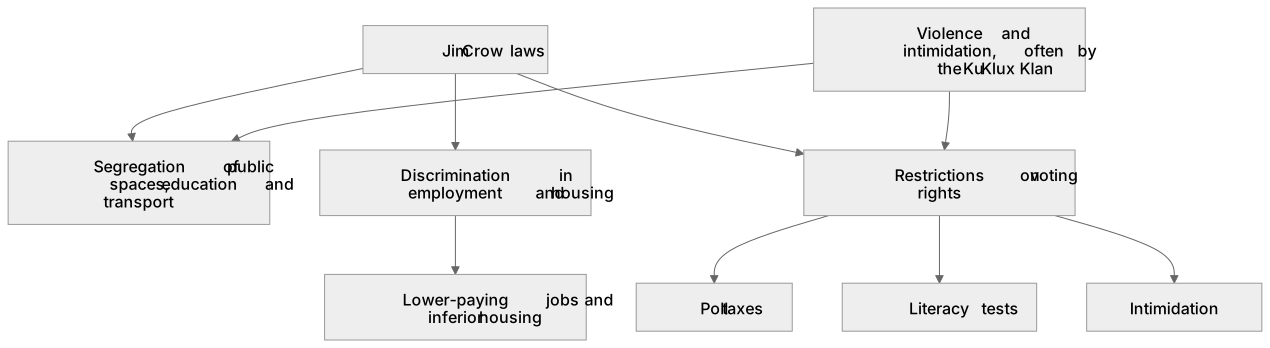
In the early 1950s, Black Americans in the Southern states faced systemic oppression enforced by Jim Crow laws.
Checked against the Pearson Edexcel 1HI0 specification (opens in a new tab) on .
- Point 1 of 2
- 4 key terms
Study notes
From the checked teaching notes for this specification point.
The idea
In the early 1950s, Black Americans in the Southern states faced systemic oppression enforced by Jim Crow laws. Segregation mandated separate and vastly inferior public facilities, including schools and transport, under the legal fiction of 'separate but equal'. Discrimination permeated employment and housing, trapping many in poverty. Furthermore, voting rights were severely restricted despite the Fifteenth Amendment. Southern states employed disenfranchisement tactics such as poll taxes, impossibly difficult literacy tests, and intimidation to prevent Black citizens from registering to vote. This legalised marginalisation was maintained through the constant threat of white supremacist violence.
What earns the marks
- The enforcement of Jim Crow laws which legally mandated the segregation of public spaces, education, and transport.
- The economic and social discrimination that resulted in Black Americans having access only to lower-paying jobs and inferior housing.
- The use of poll taxes and literacy tests specifically designed and administered to disenfranchise Black voters.
- The role of violence and intimidation, often by groups like the Ku Klux Klan, in enforcing segregation and preventing voter registration.
Common mistakes and how to put them right
Claiming Black Americans had no legal right to vote.
Put it right: Clarify that they had the constitutional right via the 15th Amendment, but state-level barriers practically prevented them from exercising it.
Confusing the situation in the North with the South.
Put it right: Specify that while the North had de facto segregation based on custom and housing, the South had de jure segregation enforced by Jim Crow laws.
Using 'segregation' and 'discrimination' interchangeably.
Put it right: Define segregation as the physical separation of races, and discrimination as the unequal treatment in areas like employment and justice.
Exam tips
- Provide specific examples of voting barriers, such as the poll tax or literacy tests, to strengthen explanations of disenfranchisement.
- Reference the 'separate but equal' doctrine from Plessy v. Ferguson to explain the legal justification used by Southern states.
- Connect the lack of voting rights to the inability of Black Americans to change discriminatory laws or sit on juries.
Try the lesson
The start of the Option 33: Key topic 1: The development of the civil rights movement, 1954–60 - 1 The position of Black Americans in the early 1950s: Segregation, discrimination and voting rights in the Southern states. lesson, made from checked teaching notes for this specification point.
Have a go first
In the early 1950s, what was the primary purpose of the Jim Crow laws in the Southern states of the USA?
Listen
In the early 1950s, Black Americans in the Southern states faced systemic oppression enforced by Jim Crow laws. Segregation mandated separate and vastly inferior public facilities, including schools and transport, under the legal fiction of 'separate but equal'. Discrimination permeated employment and housing, trapping many in poverty. Furthermore, voting rights were severely restricted despite the Fifteenth Amendment. Southern states employed disenfranchisement tactics such as poll taxes, impossibly difficult literacy tests, and intimidation to prevent Black citizens from registering to vote. This legalised marginalisation was maintained through the constant threat of white supremacist violence. A strong answer earns marks for these points. The enforcement of Jim Crow laws which legally mandated the segregation of public spaces, education, and transport. The economic and social discrimination that resulted in Black Americans having access only to lower-paying jobs and inferior housing. The use of poll taxes and literacy tests specifically designed and administered to disenfranchise Black voters. The role of violence and intimidation, often by groups like the Ku Klux Klan, in enforcing segregation and preventing voter registration. A common slip: Claiming Black Americans had no legal right to vote. Instead, Clarify that they had the constitutional right via the 15th Amendment, but state-level barriers practically prevented them from exercising it. Exam tip: Provide specific examples of voting barriers, such as the poll tax or literacy tests, to strengthen explanations of disenfranchisement.
See it
Key words
Say what each word means before you turn the card.
Segregation
Try answering aloud or in your head before turning the card.
Disenfranchisement
Try answering aloud or in your head before turning the card.
Discrimination
Try answering aloud or in your head before turning the card.
Jim Crow laws
Try answering aloud or in your head before turning the card.
See every definition
- Segregation
- The physical separation of races, legally mandated in public spaces, education and transport under Jim Crow laws.
- Disenfranchisement
- The use of tactics such as poll taxes, literacy tests and intimidation to prevent Black citizens from registering to vote.
- Discrimination
- Unequal treatment in areas such as employment and housing, which trapped many Black Americans in poverty.
- Jim Crow laws
- Laws that legally mandated the segregation of public spaces, education and transport in the Southern states.
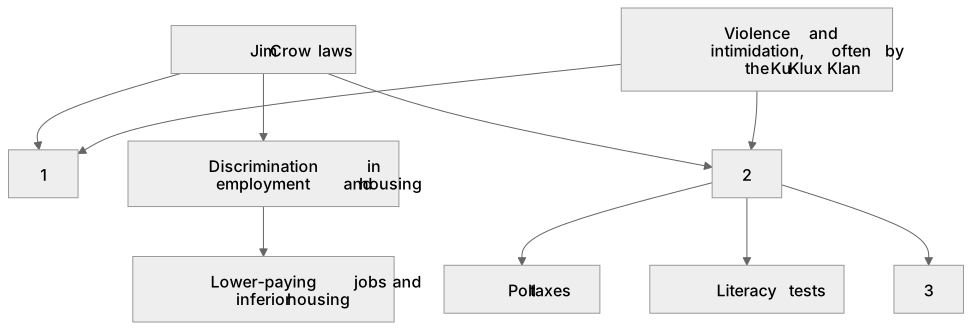
Label the diagram
Some boxes have lost their names. Pick the right name for each number.
1Box 1
2Box 2
3Box 3
There is more to this lesson
The full lesson goes on to check your understanding and help you earn the marks. Create a free account to carry on, with your progress saved.
A week of Premium from your first lesson · Then the free plan continues · No card, no charge
Test your understanding of Option 33: Key topic 1: The development of the civil rights movement, 1954–60 - 1 The position of Black Americans in the early 1950s: Segregation, discrimination and voting rights in the Southern states.
Active recall beats re-reading. Take an instant quiz now to test what you’ve learned and lock it into long-term memory.
A week of Premium from your first lesson · Then the free plan continues · No card, no charge